
How it learned · Plain gear
You will be able to: say in plain words how an AI model learned; and explain why it reflects the data it learned from, including its gaps, its unfair patterns and the date its learning stopped.
This lesson is as of November 2026.
Nobody typed in the answers
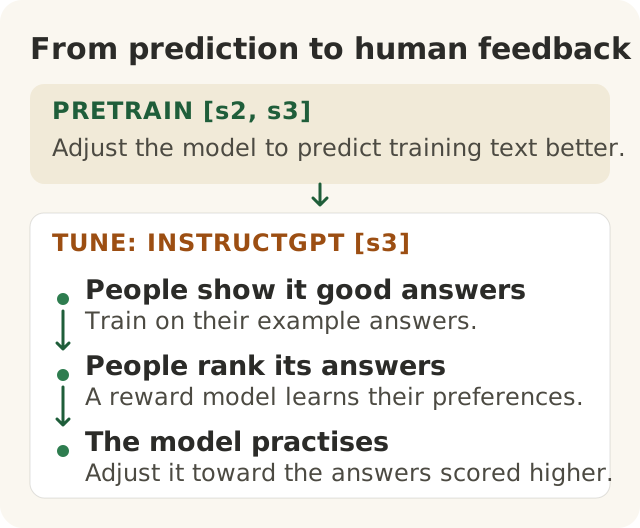
Figure data as text
From prediction to feedback
The two stages in order. Steps 2 to 4 are the tuning stage, shown as the InstructGPT example (s3).
- Pretrain — adjust the model to predict training text better. [s2, s3]
- Show — people show it good answers; train on the examples. [s3]
- Rank — people rank its answers; train a reward model on those preferences. [s3]
- Practise — the model practises; adjust it toward the answers scored higher. [s3]
Objective: 100.2-a. Text equivalent of figures/prediction-to-feedback.svg.
Many people think someone typed every answer into the AI. Nobody did. A chat model, the kind of AI you type questions to, learns in two big steps.
Step 1: Guess the next word, again and again. The model reads a huge amount of text. Its only job is to guess what comes next.1 When it guesses wrong, it is adjusted a tiny bit, so its next guesses are a little better.2 Then it guesses again. Think of a student doing fill-in-the-blank, over and over, until they get very good at it.
The amount is huge. One well-known model, GPT-3, was trained on 300 billion pieces of text, called tokens. A token is a small piece of text. Often it is a word or part of a word. So the 300 billion counts tokens, not words.3 Researchers found that these models get better at guessing in a steady, predictable way as they get bigger and read more.2
Step 2: People coach it. A model that only guesses the next word is not yet a good helper. So people coach it.1
- People write good example answers, and the model learns from them.
- People compare the model's answers and pick the better ones.
- The model is adjusted to give more answers like the ones people picked.
This is called learning from human feedback. In one study, about 40 hired people did this coaching. It worked well. People liked the coached model's answers better than those of a model 100 times bigger. But the coached model still made simple mistakes, and it still sometimes made up facts.1
Learning from examples can be powerful
Learning from examples is not only for chatbots. GraphCast is a weather model from Google DeepMind. The version in its builders' 2023 report learned from 39 years of past weather records, from 1979 to 2017. It can make a 10-day forecast for the whole world in under a minute on one computer chip. In that report's tests, it beat the main forecasting system it was compared with, called HRES, on 90% of 1,380 targets.4
GraphCast is not a chatbot. It shares only the first idea: learning from examples. It did not learn by guessing words, and people did not coach it. What it learned came from those records. To make a forecast, it is also given the latest weather to start from.4
It reflects what it learned from
A model is like a mirror of the text it read. That matters in four ways.
1. People chose the reading list. The training text is not "everything". People pick what goes in and how much each part counts.5
2. Gaps. If something was common in the reading, the model tends to do it well. If something was rare or missing, it tends to do it badly. A US government standards agency warns that AI can work worse for some groups of people or some languages when its training data does not represent them well.6
3. Unfair patterns. If the reading had unfair ideas about people, the model can repeat them. The builders of GPT-3 said it keeps the biases of its training data.3 Coaching by people did not fix that.1 And the coaching itself reflects the views of the people who did it.1
4. A cutoff date. A model only learned from text up to a certain date. One big part of GPT-3's reading was web pages from a collection called Common Crawl, gathered from 2016 to 2019.3 Anything newer was not in that part of its reading. That date is for one part only. We have not checked a date for the rest of its reading, so this lesson does not give one. The date a model's learning stopped is called its knowledge cutoff. A model can still use new facts you put in your question: GPT-3 was tested on tasks given to it only in the question, with no extra training.3 But if nobody gives it the newer facts, it can still sound sure when it is wrong.6 (Lesson 100.6 shows tools that give a model newer documents to read first.)
So a model is not neutral just because it is a machine. And it is not up to date just because it is a computer.
At Big Widget Company
Big Widget Company is made up. Its planning team uses a model that learned from ten years of widget sales.
- Good AI: they use it to forecast widgets the company has sold for years. They write down what data it learned from, and how old that data is. The planning lead checks each forecast and decides. The model suggests a number. A person owns the plan.
- Bad AI: they ask it about a brand-new widget it has never seen any data about. They treat its answer as fact. The model has nothing to go on, but it still gives a confident number.
The three yeses: the data questions. These are this lesson's questions about data. Lesson 100.9 gives the full three yeses, including who checks and owns the work. Good answers here do not, by themselves, mean "go ahead".
- Get to Yes (before you start): is this a job the model is good at? Does my task look like what it learned from? If you don't know yet, say so. Then wait for the planning lead to decide.
- Stay at Yes (while you use it): has the task moved outside what it learned from? Has the world changed since its cutoff date? Keep checking.
- Recover to Yes (when it goes wrong): stop. The planning lead owns the forecast and fixes the plan, including for anyone it hurt. The team changes the rule: new widgets wait for a person. It is only fixed once later forecasts show the new rule works.
Keep private things private. Keep notes on the data and who checked each forecast in the team's own records. Don't paste sales numbers or customer details into anything you share. Lesson 100.P shows how to keep a receipt of a decision without private details in it.
Words to know: training data, token, tuning (coaching), human feedback, bias, knowledge cutoff.