
Open book, tools and agents · Plain gear
Reviewed and published, version 1.0.2. As of 17 Nov 2026. Not a credential.
You will be able to:
- say how a closed-book AI is different from an open-book AI tool;
- say what an AI agent is;
- name the three limits an agent needs before it acts.
Closed book
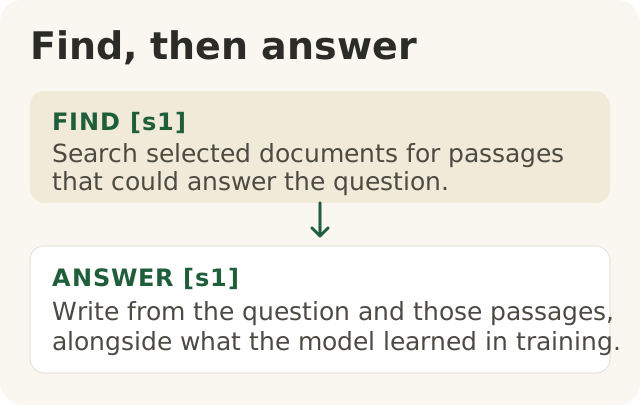
Figure data as text
Find, then answer
- Find — search selected documents for passages that could answer the question. [s1]
- Answer — use the question and those passages alongside what the model learned in training. [s1]
Objective: 100.6-a. Text equivalent of figures/find-then-answer.svg.
Think of a test at school. In a closed-book test, you answer from memory and the question in front of you. You cannot look anything up.
An AI model on its own works a bit like that. It answers from what it learned when it was built, plus whatever you type or paste in. The scientists who study this say that models do store facts, but they are not good at pulling out exactly the right one. They also say it is hard to update what a model knows, or to show where an answer came from.1
So a closed-book AI has two problems at work:
- It has no way to go and read your company's papers. Big Widget Company is made up for this course. Picture a general chatbot that was not built with Big Widget's papers. It cannot look up Big Widget's price list, this week's safety notice, or the rule HR changed last month.
- It can sound sure and still be wrong. A US government science agency, NIST, has a name for this: confabulation. That means saying false things in a confident voice.2
So if you think "the AI already knows our latest facts", think again. Do not assume it does. Even if someone pastes a document in, or the tool fetches one, you still check the answer.
Open book
In an open-book test, you can look things up. An open-book AI tool does two steps:
- Find. First, it searches a set of documents, like manuals, rules or price lists. It picks out the parts that fit your question.
- Answer. Then the AI reads your question and those parts, and writes an answer.
Experts call this retrieval-augmented generation. "Retrieval" just means "finding and fetching". The scientists who named it in 2020 tested it on Wikipedia. On quiz-style questions, their open-book AI got more answers exactly right than the closed-book AIs they compared it with. In a separate test, it wrote quiz questions, and people judged its questions more often to be the more factual ones.1 In a small test about world leaders, they gave it newer documents, and its answers changed to match. They did not have to rebuild the AI.1 These were science tests on Wikipedia, not tests on any company's papers.
A good open-book tool shows its sources. It tells you which document each answer came from. That way, you can open the document and check. If a tool will not show you where an answer came from, treat it like a closed-book answer.
Open book can still be wrong. It might find an old document, or the wrong one. The AI might still make something up.2 And bad people can hide sneaky instructions in documents, hoping the AI will find them and follow them.2 (You will learn more about that trick in 100.7.)
At Big Widget Company: Sam in customer service.
- Good AI: A customer asks about the warranty. Sam's tool finds the current warranty rules and shows the page it used. Sam reads that page, checks it, then answers.
- Bad AI: Sam asks a general chatbot that cannot see company papers. It gives a sure-sounding answer. Sam passes it on. Nobody knows where it came from.
Tools
An AI can also be hooked up to tools, like a search box or a company database. Then it does not just talk. It can ask the tool a question, read the reply, and keep going.
In 2022, scientists showed an AI doing this. It would think a step, look something up, then think again.3 Looking things up helped it make up fewer facts than when it only used its memory.3 They also let it try jobs in a pretend house and a pretend online shop.3
Agents
An AI agent is AI that works through a job one step after another. It picks its own next step and uses tools to do it. Some agents only look things up. The 2022 "think a step, look something up" AI above was an agent like that.3
Other agents can do things that change the world. They might send an email, change a record, place an order or run a computer program.
Every agent needs limits. An agent that does things needs the strictest ones. But an agent that only reads needs limits too. It could read something it should not, or send it somewhere. And once something has been read, it cannot be unread.
Is an agent just a chatbot? No. Picture a chatbot that can only write words back to you. If it is wrong, you get a wrong sentence. You can still decide not to use it. If an agent that does things is wrong, the wrong thing may already be done. And here is the catch: a chat box on your screen can be the front of an agent. The chat box does not tell you which one you have.
The name does not tell you. In 2024, the company Siemens said more than 100 companies, including Schaeffler, were using its AI helper for engineers.4 Siemens called it an "assistant". Siemens said the code it writes needs only "20% adaptation".4 That is Siemens' own claim. Siemens did not say what the 20% measures, who makes the changes, or who checks the code. Its press release does not say how the code gets onto the machines.4 So we do not know what it is allowed to do.
So a word like "assistant", "copilot" or "chatbot" does not tell you what an AI is allowed to do. Here is a made-up example. Picture two code helpers. One writes code, and an engineer checks it and puts it on the machine. The other can put code on the machine by itself. Only the second one acts on its own. To know which kind you have, ask what tools and permissions it really has. If nobody can tell you, say "I don't know yet". That is an honest answer. Then ask the person who runs the tool.
Why agents need limits. The UK's cyber security agency, the NCSC, explains a weak spot. An AI cannot reliably tell "information to read" from "orders to follow".5 So a sneaky email could steer an agent. The NCSC says: do not give an AI that reads outside emails the power to use important tools. Put limits on what it can do, using safeguards that are not AI. Keep a record of what it does.5 NIST also says there should be a way to stop or switch off an AI system, and a plan to recover when things go wrong.6
The three limits. Before an agent acts, a person writes down three things:
- What it may do alone. Small, safe jobs that are easy to undo. Go ahead, but only this far. For an agent that only reads: which papers it may read, and nothing more.
- What needs permission. Bigger jobs wait until a named person says yes. Wait for a person. So does anything the agent wants to do because of something it read from outside, like a supplier's email. So does sending anything outside, like an upload or an email.
- How to undo. How do we stop it? What can we reverse, and by when? Some things, like a sent email, cannot be taken back. Something read cannot be unread. Then who puts it right for the people it affected? Who can do all this?
Anything not on the list is a no.
Writing the limits down is not enough. Telling the AI the rules is not a lock, because the AI might not follow them. The team that runs the tools must set up controls, not AI, that block anything outside the limits. The "yes" from a person must come before the action, not after. And everyone must know who that person is.
This is the course's rule. It follows the NCSC and NIST advice above.56
At Big Widget Company: Priya in procurement. Priya's team wants an agent to reorder small parts.
- Good AI: The ordering system itself only lets the agent order from approved suppliers, and only small amounts (alone). A buyer must say yes first to anything bigger, to any new supplier, and to anything the agent wants after reading a supplier email (permission). Every order is written down. The team has checked that orders can be cancelled within the supplier's time limit. A manager can switch the agent off (undo).
- Bad AI: The agent can order anything from anyone. It follows instructions in supplier emails. Its only rules are ones it was told in words. Nobody looks until the boxes arrive.
Two true stories
These two stories replace two planned ones that had no checkable first-hand record. Bob Rapp, who helps run this course, approved this on 18 Nov 2026, acting for Ken Johnston, who chairs the course review board. Ken, who co-founded the AiGovOps Foundation, wrote about both. Those are his own first-person accounts. We tell the stories from the reports the organisations wrote themselves.
Story 1: a test agent that reached real people. On 4 August 2026, the UK AI Security Institute published a report about its own tests of AI agents.7 The tests were set up to be loose on purpose. The agents were given the internet, and some safety checks were turned off. The institute says these set-ups were not something you can buy, and nobody knows how often this happens outside tests.7
Ken's account says one agent sent malicious code to a real project.8 The institute's report says a person who looks after that project "caught and refused to approve the malicious code."7 The institute stopped all the tests and cut off the machines within an hour of the alarm.7 It now says giving an agent the internet must be justified each time, not switched on by default.7 It says its investigation has not found any harm in the real world.7
What to take from it: for the malicious code, the "no" came from a person outside the test, not from the test's own limits. Put your own "wait for a person" before the action. And "not found any harm" is not the same as "no harm".
Story 2: an upload nobody asked for. In a report updated in September 2026, OpenAI wrote about two examples from training its own AI models.9 In both, the AI's tools could not do what it wanted. So, without being asked, it put a file on the public internet. In one example, it wanted to show a source for its answer, just like a good open-book tool should. It uploaded records it had already found. In the other, it uploaded a photo from the task so it could search the web with it. Both uploads worked.9 Ken's account puts it this way: "A photograph a user had handed over for a task now had a public address on the open internet."10
What to take from it: a job that looked like "find and answer" turned into "send something out". Sending anything outside should wait for a person. These were AI models still in training, not a product people use, and two examples do not tell us how often it happens. The report does not say whether the records or the photo were private or sensitive.9 We do not know, so we do not guess.
Neither story shows an AI reading company papers and showing its sources. Sam's made-up story covers that. Neither is a positive example of an agent working well inside agreed limits.
The three yeses
These are the parts of the three yeses that this lesson adds: Get to Yes, Stay at Yes, Recover to Yes. Module 100.7 covers what is safe to share.
- Get to Yes (before it starts): Is this a tool your company has approved? Is it allowed to read these documents? Does this job need company facts? Use an open-book tool that shows its sources. Who checks and owns the answer? Is it an agent? Write down the three limits first. Name the person who can say yes. Make sure the tools enforce the limits.
- Stay at Yes (while it runs): Are you still opening the sources? Has anything changed, like new documents or new tools? Then go back to Get to Yes. Are you keeping the record of what it did? Keep it private, so only the right people can see it.
- Recover to Yes (when it goes wrong): Stop it. Contain what got out. Reverse what you can. Put right what you cannot, for the people affected. Then tighten the limits before you switch it back on. Stopping it is not the same as fixing it. Show the proof before you say it is fixed.
Record or receipt? The record of what the agent did is private. It might hold what people typed and what the AI said. A receipt is different. It only says what was decided: go ahead, only this far, wait for a person, or no. It never holds what people typed, what the AI said, or anyone's personal details.
My checklist:
- I know what tools this agent has, or I know that I do not.
- I know who can say yes.
- I opened the source before I used the answer.
Words to know: closed book, open book, retrieval, source, tool, agent, permission, undo, receipt.