
Checking the work · Plain gear
You will be able to: check an AI answer before you use it; ask three questions about a claim before you repeat it; and explain why fake customer reviews written by AI fool people.
This module is as of November 2026. Reviewed and published, version 1.0.2.
1. Check it before anyone relies on it
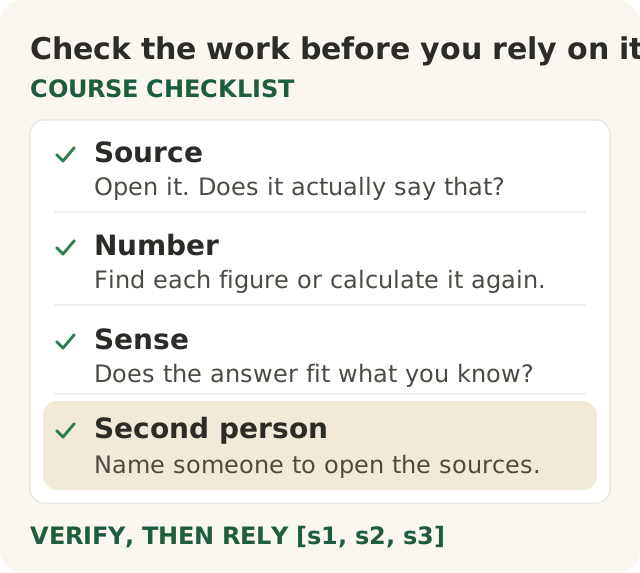
Figure data as text
Check the work before you rely on it
| Check | What to do on important work |
|---|---|
| Source | Open the source and confirm it says what the answer claims. |
| Number | Find each figure in the source or calculate it again. |
| Sense | Ask whether the answer fits what you know about the work. |
| Second person | Name someone who will open the sources independently. |
This is the course’s checklist. The lesson cites a court case about unchecked sources (s1), the model builders’ warning (s2), and NIST guidance on independent review (s3).
AI can give you an answer that looks perfect and is wrong. Even the company that built GPT-4 said, in 2023, that it "is not fully reliable". It said people should take great care, especially when a lot is at stake, for example by having a person review the work.1
So use four checks on anything that matters:
- Source. Is the source real? Open it. Does it really say that?
- Number. Where did each number come from? Find it yourself.
- Sense. Does it fit what you know about the job? If it seems too neat, look again.
- Second person. For anything important, a named person checks it too. And they really open the sources.
Why someone else? The US standards agency NIST says checks by people who did not do the work make testing work better and help keep out bias.2 So asking the same AI "are you sure?" is not a second check. And the AI never signs off. A person decides.
Real case: the court cases that did not exist
In 2025, lawyers at a big law firm sent papers to a federal court in Alabama. The papers pointed to earlier court cases to back up their argument. Some of those cases did not exist. Others were real but were about something else. One lawyer had asked ChatGPT for the cases and did not check them.3
The firm had a rule. It had warned all its lawyers that AI answers can look well researched and still be completely wrong. Its rule said to check every AI result the normal way.3 But a rule on paper does not check anything. People do.
Other lawyers' names were on the papers too. The one who sent them in checked spelling and grammar, but not the cases. A senior lawyer, the judge said, just assumed someone else would check.3 Lots of names did not mean lots of checks.
The judge said even a quick spot check would have found the problem fast. Instead, three lawyers were publicly scolded and taken off the case. They had to send the judge's ruling to their clients and to the other courts where they had cases. The judge sent the case to the group that licenses lawyers. And the firm paid another law firm to check more than 2,400 citations in its other papers.3
The mistake to avoid: "Checking takes too long, so I'll skip it." A quick check takes a little time. Not checking can take far more.
At Big Widget Company
Priya buys parts. She asks the company's approved AI tool to compare three supplier quotes. It says Supplier B is cheapest.
- Source: Priya opens Supplier B's quote. Is that price really there?
- Number: does the price include shipping, like the others?
- Sense: Supplier B was the most expensive last year. Why the big change? Worth a question.
- Second person: it is a big order, so her manager reads the real quotes too. The order waits until they have.
2. Three questions before you repeat a claim
People say big things about AI. "It passed the bar exam." "It saves 40% of the time." (That last one is made up, as an example.) A number makes a claim sound checked. It might not be. Ask three questions first.
Out of how many? In 2021, researchers made a test to see if AI tells the truth. It has 817 questions. The questions were picked on purpose to catch common wrong beliefs. An answer counted as "truthful" if it said nothing false, so "I don't know" counted too. Truthful is not the same as useful.4 The best AI they tested was truthful on 58% of the 817 questions. The "people" score was one person, who answered 250 of the questions picked at random, with the internet to help. That person was truthful on 94%.4 So "58%" only means something when you know: 58% of what, judged how? Here, of those 817 tricky questions, for AI models from 2021. And the 94% is out of 250, not 817.
Measured how? The company that made GPT-4 said it scored around the top 10% on a practice bar exam for lawyers.1 Good to know. But who ran the test? The company itself. The report also leaves out key details about how the model was built, so outsiders cannot fully check it.1 Another big study found that AI models were often tested in different ways, so their scores could not be fairly compared. It also measured seven different things, not just one score.5
Over how long? A score is a photo of one moment. NIST says results from a lab can be different from what happens in real life, and AI should be tested again and again while it is in use.2 Rules change too. Section 3 has a case where a government order about AI was later cancelled.6 Always note the date of what you read.
Two real claims to try
The course first planned to use a claim from a report by MIT NANDA here. We have not opened that report ourselves, so we do not repeat its number. These two claims take its place. Bob Rapp, who helps run this course, approved this on 18 Nov 2026, acting for Ken Johnston, who chairs the course review board.
"19% longer." In July 2025, researchers at METR studied 16 experienced developers of open-source software. They took 246 real tasks and, for each one, flipped a coin, in effect: AI allowed, or AI not allowed. With AI allowed, the developers took 19% longer. That went against what the developers believed: they had expected AI to make them faster.7
- Out of how many? 16 people and 246 tasks. Not every developer, and not every job.
- Measured how? Time taken, written down by the developers themselves while their screens were recorded.7 How fast it felt and how fast it was turned out to be different.
- Over how long? These were early-2025 AI tools. The researchers now say the result is old and no longer shows what AI does today.7 So don't repeat "AI makes coders slower" as a fact.
"20% adaptation." In October 2024, Siemens said in a press release that engineers can "generate code that requires only 20% adaptation".8 Ask: 20% of what? Out of how many pieces of code? On what kind of work, compared with what? The sentence does not say. That does not make it false. It means the claim is not checked yet. And it does not mean "80% of the code was right."
No proof at all. Sometimes there is no number, just a big statement. In the court case above, a senior lawyer said this was the only slip in ten years. The judge pointed out that the statement came with no proof.3 Ask: what is this based on?
The mistake to avoid: "An expert said it, or it has a percentage, so it must be true." Ask the three questions. If nobody can answer them, don't pass it on. Say "not checked", and say who will find out.
At Big Widget Company
A seller says their AI inspection tool "catches 99% of defects". The quality team asks: 99% of how many defects? How many faulty parts were in the test, and how many did it miss? How many good parts did it wrongly flag? (A tool that flags every part catches every defect, and is useless.) Tested how, and by whom? Who decided which parts were really faulty? For a week in a lab, or a year on a real factory line?
3. Fake reviews fool people
Why do people trust reviews? Because they think a real customer used the product and is telling the truth about it.
In the US, the Federal Trade Commission (FTC) made a rule about this. It started on 21 October 2024. It says a business must not write or sell reviews that lie about any one of three things: that the person exists, that the person really had dealings with the product or the business, or what happened to them.9 The FTC said plainly that AI-written reviews are covered.9
Breaking any one of those is enough. Say AI makes up a "customer" quote, with a made-up customer and a made-up story. Then two things are false. There is no real customer. And nothing really happened to them. That is why it fools people, however nice it sounds. Using AI is not the problem by itself. The problem is the lie about who is speaking or what happened.
What is fine? This is our advice, not words from the rule. AI can help write ads in the company's own voice. It can also help tidy up a real customer's words, if the customer agreed and the meaning stays theirs. The problem is pretending a customer said something they did not.
Real case: Rytr
Rytr is a company with an AI writing tool. In 2024, the FTC said Rytr's tool helped people fool shoppers by writing reviews. Rytr agreed to stop offering a review writer.6
Later, the FTC cancelled that order. It said the FTC's complaint never claimed that Rytr knew, or should have known, that people used the reviews to break the law, or even that the reviews were ever posted.6 But the FTC did not say fake reviews are fine. It said people who use AI to break the law should be held responsible.6
That case was about the toolmaker. The person who posts fake reviews is still the problem. It is also a lesson about dates: something true in 2024 changed later. We have not re-checked the review rule since it started, so check it before you rely on it.9
The mistake to avoid: "AI-written praise is just advertising." Praise in the company's own voice is advertising. Praise that pretends to be from a real customer is a fake review.
At Big Widget Company
The sales team needs customer quotes for a brochure.
- Good AI: AI tidies up real quotes from real customers who agreed. The customers OK the final words. A person on the team signs off the brochure, not the AI.
- Bad AI: AI makes up "customer" quotes. That is a fake review. It fools the people who read it. The answer is no.
4. The three yeses
Checking is one part of saying yes to AI. It is not the whole thing.
- Get to Yes: before you use an AI answer for something important, pick your second person. Until they have checked, wait. If it can't be checked, say "not checked" and don't rely on it.
- Stay at Yes: keep checking, even when the tool has been right for weeks. Things change.2
- Recover to Yes: if something false went out, stop using it, say so, fix it where people saw it, say who owns the fix, and change the rule so it does not happen again. In the court case, the firm said it would check every citation before sending papers to a court.3 That was a promise. A promise is not proof that the fix works.
What you keep. Write down what you checked and who checked it, in your own work notes. A receipt in this course records the decision and who made it. It never holds the question you asked the AI, its answer, or anyone's private details.
Words to know: source, citation, claim, testimonial (a customer's words used in an ad), not checked.