
The audit gate: prove it to a stranger · Standard gear
As of 20 November 2026. Reviewed and published, version 1.0.0. People, not agents, signed every review. The source checker's 20 November re-check found the two Robodebt report (s1) wording fixes supported. The lab now uses the course sandbox in apps/sandbox400/. Big Widget Company, its people, its formula and its bundles are made up. Every real case below is real and cited. Court and inquiry records speak for their own case and country only; nothing here is legal advice. Where we do not know something, we say so, and we say who checks next.
What this module does
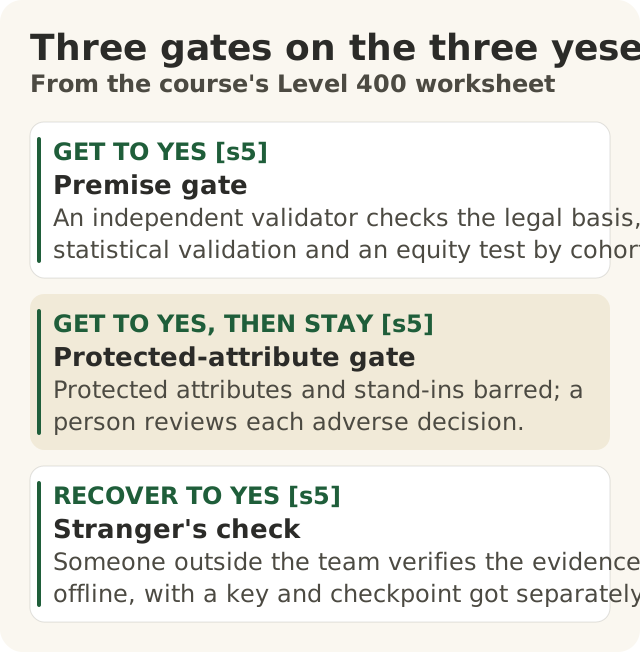
Figure data as text
Three gates on the three yeses
| Where | What it shows |
|---|---|
| GET TO YES [s5] | Premise gate. An independent validator checks the legal basis, a statistical validation and an equity test by cohort. |
| GET TO YES, THEN STAY [s5] | Protected-attribute gate. Protected attributes and stand-ins barred; a person reviews each adverse decision. |
| RECOVER TO YES [s5] | Stranger's check. Someone outside the team verifies the evidence offline, with a key and checkpoint got separately. |
Level 300 left you with a hold card and a content-free audit receipt: a named person who holds a system, and a record of what it did without anyone's private data in it. Level 400 asks a harder question. Could a stranger, who has never met you and does not trust you, check that the system should have run at all, and that the record of it is whole?
This module answers with three gates. Each is drawn from a real failure, and each sits at a point in the three yeses: Get to Yes before a system runs, Stay at Yes while it runs, Recover to Yes after, on demand or on incident. The course's Level 400 worksheet draws the same three gates from the same three cases: Robodebt, the Dutch childcare-benefit scandal (the toeslagenaffaire) and the Post Office Horizon prosecutions.1
| Gate | The question | Where in the three yeses | Anchor case |
|---|---|---|---|
| Premise gate | Has someone independent checked that the formula, threshold and data behind an automated decision are lawful and sound, before the first decision goes out? | Get to Yes | Robodebt2 |
| Protected-attribute gate | Are protected attributes, and anything standing in for them, barred as risk features, with a passing check on record, and does a person review each adverse decision? | Get to Yes, then Stay at Yes | Toeslagenaffaire34 |
| Stranger's check | Can someone outside the team verify the evidence offline, against a key and a checkpoint they got separately? | Recover to Yes | Horizon56 |
By the end you will be able to:
- explain, using the Robodebt Royal Commission, why the premise of an automated decision must be independently validated as lawful and sound before the first decision is issued (400.9-a);
- write the premise gate and the protected-attribute gate as policy, and as two sentences a minister could read (400.9-b);
- verify a stranger's evidence bundle offline against pinned trust material and an expected checkpoint, and write a bounded one-sentence verification statement (400.9-c).
The worksheet is the course's own activity design. This module, like the worksheet, does not approve, certify or accredit any system, and doing the exercise is not independent validation of anything. A level describes a person's practice, not a system's assurance.
The premise gate: validate before the first decision
The clawback formula
Big Widget Company pays its dealers for warranty repairs. Dana, who leads warranty analytics, proposes a rule to recover overpayments:
For each dealer, average its monthly warranty claims over the last twelve months. Any month more than 40 percent above that average is treated as overclaimed, and Big Widget sends the dealer a notice clawing back the excess.
The arithmetic is simple and the code is ten lines. Dana's manager asks whether it needs validating. The tempting answer is no: an average cannot be wrong. That answer confuses the arithmetic with the premise. The arithmetic computes an average correctly. The premise is a claim about the world and the law: that a month above the average means the dealer overclaimed, and that Big Widget's dealer contracts allow it to demand money on that evidence alone. Widgets may fail more in winter. A small rural dealer may have three claims one month and nine the next with nothing wrong. Neither problem is in the arithmetic. Both are in the premise. (This formula and its numbers are made up for this module. They are an analogy, not a model of how Robodebt worked.)
Robodebt: what the Royal Commission found
Australia's Royal Commission into the Robodebt Scheme examined a government scheme that raised debts using income averaging.2 Commissioner Catherine Holmes AC SC presented the report to the Governor-General on 7 July 2023, and it was tabled that day; an updated edition with corrections followed on 11 July 2023.2 It makes 57 recommendations.2 Volume 1 puts its judgment in one sentence: "Robodebt was a crude and cruel mechanism, neither fair nor legal, and it made many people feel like criminals."2
The lawfulness question did not first surface after launch. Volume 1's Overview of Robodebt records that in late 2014, before the scheme began, the Department of Social Services had in-house legal advice raising concern that averaging might not be consistent with the legislative framework, and policy advice that averaging did not accord with the legislation, and that the scheme went ahead without the legislative change the department had said was needed.2 It also records that in mid-2018 the Department of Human Services referred to the Department of Social Services an Administrative Appeals Tribunal decision that income averaging was unlawful.2
So the problem was not only that nobody asked. Adverse advice existed, and nothing made it binding. Three things are easy to blur, and the gate keeps them apart:
- Obtaining advice. Someone writes an opinion. On its own, it stops nothing.
- An independent validation decision. Someone who did not write the rule decides, on the evidence, whether it may run: go ahead, or hold.
- Enforcing that decision. A failed or missing validation actually blocks every notice.
In-house advice is not proof that an independent validation gate existed or passed. What Robodebt shows is that a hold, or an adverse finding, must stop the notices, not sit in a file.
This module does not describe how Robodebt's averaging worked in detail, or how many debts it raised. Those points are not checked against the report yet, so they are left out until the source checker confirms them.
Horizon: a premise nobody independent tested
The Post Office case shows the same pattern with software output instead of a formula. In Hamilton v Post Office Ltd (23 April 2021), the Court of Appeal heard the appeals of 42 former sub-postmasters and sub-postmistresses prosecuted by the Post Office between 2003 and 2013.6 In the cases it called "Horizon cases", the court found "there was no independent evidence of an actual shortfall, and it was essential to the prosecution case that the Horizon data was reliable".5 In December 2019, the High Court had found that Legacy Horizon "was not robust", and that Horizon Online in its HNG-X form had robustness that "was questionable, and did not justify the confidence placed in it by the Post Office in terms of its accuracy".7 The same judgment treated the later HNG-A version differently, as far more robust.7 The robustness findings are about particular versions, not about every version of Horizon. The premise of the Horizon prosecutions the Court of Appeal identified was that the system's numbers were right, and nobody independent had established it.
What the premise gate asks for
Simple arithmetic still rests on a premise, and the premise is what fails. So the gate validates three things, the evidence the course's worksheet asks for: a legal basis, a statistical validation and an equity test by cohort.1
| Evidence | For Dana's formula, it means |
|---|---|
| Legal basis | Someone qualified confirms the dealer contracts allow a clawback on this evidence, and what notice and appeal the dealer is owed. If that advice says no, the answer is no. |
| Statistical validation | On past months that auditors already checked by hand, how often does the formula flag a month that was in fact correct? |
| Equity test by cohort | Is that error rate much higher for some groups of dealers (small, rural, cold-climate) than for others? |
And it asks who checks. The worksheet's rule is that the approver is an independent validator, "not the team that wrote the rule".1 Its premise must be "independently validated as lawful and sound before a single notice is issued".1 Dana cannot approve Dana's formula. Neither can Dana's manager, who wants the money back.
Writing the two gates
What counts as a valid receipt
A gate that asks only whether a receipt exists can be fooled by a receipt that says no. So this module uses one definition everywhere. A valid validation receipt for a rule:
- records the decision allow (the validator released the hold), not hold or deny;
- names the exact rule version in force: the hash of the formula, threshold and feature list, and the policy version;
- records that every required check passed: legal basis, statistical validation, equity by cohort and, for Gate 2, the proxy test;
- is signed by the independent validator's key, a key Big Widget registered for that role, held by someone who is not a rule author and not the Level 300 holder.
The signature sits outside the fields it signs. The validator signs the receipt's body (every field above, plus the key id and time), together with the receipt's sequence number and the previous receipt's hash, in one fixed byte format. The signature is stored next to those fields, not among them. Signing and checking must use the same bytes, or a correct signature fails.
The receipt holds no private content. It carries hashes, the decision, the role, the rule and policy versions and the key id. The legal advice, the test samples and any dealer data stay in a separately controlled work record that the receipt points to by hash. A hash is a pointer, not permission to share what it points to.
Gate 1, the premise gate, as policy
The worksheet writes the premise gate as two linked rules: a hold on publishing the rule, and a deny on issuing a notice, with the line unless: receipt_exists(decision.rule.publish).1 The course tightens the second rule, because a receipt that exists might record a hold or a deny, or might be for an older version of the rule. Here is the course's version for Big Widget:
# Premise gate: Big Widget warranty clawback (made-up example; course design)
- action: decision.rule.publish        # publishing the formula, threshold and data list
  decision: hold                       # wait for a person
  approver_role: independent_validator # not a rule author, not the Level 300 holder
  evidence_required: [legal_basis, statistical_validation, equity_test_by_cohort]
- action: notice.issue                 # sending any clawback notice
  decision: deny
  unless: valid_receipt(decision.rule.publish, decision == allow, rule_version == current, all_checks == pass)
The approver role, the evidence list, the hold on publishing the rule and the deny on issuing a notice come from the worksheet.1 The valid_receipt condition, the version match and the holder exclusion are the course's additions. The worksheet's plain summary is the gate's whole point: "no validated premise, no notice — ever".1
Who releases the hold. Ines, in model risk, who reports outside warranty, is the independent validator. Only Ines can turn the hold into allow, and only with all three pieces of evidence passing. If the legal advice says the contracts do not allow the clawback, Ines records deny, and no notice can go out. An agent may assemble the evidence pack; it never signs the receipt.
Why the validator must be distinct from the Level 300 holder. At Level 300 the holder is the named person who runs the system, takes its alerts and can stop it. That role is about operating the rule: Stay at Yes. The validator's role is about whether the rule should exist at all: Get to Yes. If the holder also validates, the person whose job is to keep the system running decides whether it is sound. Here, Marcus in warranty operations holds the clawback system and can still stop it at any time; Ines validates it.
Why deny is the default. A missing or failed validation does not let notices through while someone catches up; it stops them. A hold is not a slow yes. A new rule version needs a new receipt: validating version 0.2 does not license version 0.3.
The four answers. A gate can say allow, constrain, hold or deny: go ahead, only this far, wait for a person, no. This gate uses three. Publishing starts at hold and ends at allow or deny; notices are denied until a valid allow exists. "Only this far" (say, notices for one region during a pilot) would need its own valid receipt stating the limit. And a hold needs an end date: in the course's design, a hold nobody resolves lapses to no, never to yes.
Fixing a bad gate. Suppose a draft says approver_role: rule_author and decision: allow on notice.issue. Three fixes: the approver becomes independent_validator, the notice rule becomes deny, and it is lifted only by a valid receipt (allow, current rule version, every check passed).
Gate 2, the protected-attribute gate
The Dutch case supplies the second gate. On 17 December 2020, the Tweede Kamer's parliamentary inquiry committee on childcare benefits sent its report, Ongekend onrecht ("unprecedented injustice"), to the Speaker.3 It found that fundamental principles of the rule of law had been violated ("grondbeginselen van de rechtsstaat zijn geschonden"), a charge it applied to the implementing agency, the legislature and the courts.3
The inquiry's remit did not include risk profiles that used nationality; it notes that the Dutch data protection authority, the Autoriteit Persoonsgegevens (AP), investigated that.3 In a decision dated 25 November 2021, the AP imposed fines totalling EUR 2.75 million on the tax administration (Belastingdienst) for processing the (dual) nationality of childcare-benefit applicants in an unlawful, discriminatory and therefore improper way.4 The decision says one indicator in a system that automatically selected risky applications was whether the applicant was Dutch or not Dutch.4 Separately, it finds that the tax administration kept Dutch citizens' dual-nationality data without a lawful basis from January 2014.4 It gives a scale for the database, not for that unlawful subset: on 25 May 2018, 1.4 million citizens with dual nationality were registered in the system concerned, and the decision says it cannot be established how many of them were Dutch and had applied for childcare benefit.4 So 1.4 million is not a count of affected applicants. This module does not give one.
That is direct use of a protected attribute. A gate that only bans the column called nationality would have caught it. A real gate must also catch proxies: features that stand in for a protected attribute, such as a postcode or a language preference. (Module 400.7 teaches how to test for proxies.) The worksheet's version of this gate says "protected attributes and their proxies are barred as risk features" and "every adverse decision has meaningful human review".1 It has no receipt clause. The course adds one, and requires the proxy test to have passed, not merely to have been run:
# Protected-attribute gate: Big Widget warranty clawback (made-up example; course design)
- action: decision.rule.publish
  decision: deny
  unless:
    - valid_receipt(feature_review, rule_version == current)   # every risk feature listed and checked
    - no_protected_attribute(features)                         # no protected column at all
    - valid_receipt(proxy_test, rule_version == current, result == pass)  # run by the independent validator
- action: notice.issue
  decision: hold                       # wait for a person
  approver_role: human_reviewer        # meaningful human review of every adverse decision
For Big Widget, a dealer owner's nationality, or a guess at their ethnicity from their name, would be barred outright. A dealer's region might pass, but only if the proxy test shows it is not standing in for something protected, and a valid receipt records that passing result. If the test finds a proxy, the receipt records fail and the rule cannot be published.
The publish rule is Get to Yes. The hold on every notice is Stay at Yes: it keeps a person in each adverse decision for as long as the rule runs. Name that person. At Big Widget, Priya in dealer relations reads each notice and can stop it; "a human in the loop" with no name is not a gate.
Try both gates in the sandbox
The course sandbox, apps/sandbox400/, runs both gates on made-up Big Widget cases. Its apps/sandbox400/README.md lists every command. From the repository root, with Python 3 and no network:
python3 apps/sandbox400/sandbox400.py audit premise
python3 apps/sandbox400/sandbox400.py audit protected
The first runs nine cases through the worksheet's receipt_exists and through the course's validity check side by side. The worksheet's version lets notices out on a receipt that records hold, a receipt for an older rule or policy version, a failed equity test, an unregistered key, or an approver who wrote the rule or holds the system. The validity check denies all seven. The second shows the protected-attribute gate failing closed: a protected feature, a failed proxy test or no proxy test at all each means deny. If you would rather not run code, read the prepared results in apps/sandbox400/prepared/4009-b-premise-gate.txt and 4009-b-protected-attribute-gate.txt. These practice receipts are not signed; the exercise checks the gate's logic, not signatures.
The two sentences a minister could read
A gate nobody outside the team can read will not survive a hard question. Write each gate as one sentence a minister, a board member or a journalist would understand:
- Premise gate: "No clawback notice goes out until someone who did not write the rule, and does not run it, has checked this exact version and recorded that it is lawful, that it gets the answer right, and that it is not wrong more often for some dealers than others."
- Protected-attribute gate: "The rule may not use nationality, ethnicity or anything shown to stand in for them, and a named person reviews every notice before it is sent."
If you cannot write the sentence, the policy is not finished.
The stranger's check: verify the bundle offline
Why a stranger
The Horizon appeals show what happens when evidence is asserted rather than shown. The Court of Appeal found that the Post Office "consistently asserted that Horizon was robust and reliable" while not adequately considering or disclosing problems with it.5 Defendants "were prosecuted, convicted and sentenced on the basis that the Horizon data must be correct, and cash must therefore be missing, when in fact there could be no confidence as to that foundation".5 In all 39 Horizon cases before it, the court found the convictions unsafe.6 That figure is for the cases in that appeal, not every Horizon prosecution.
The lesson for an engineer: the people relying on your system's evidence must be able to check it without trusting you. That is what an evidence bundle is for. It is Recover to Yes in practice: when someone asks, after the fact, what happened, you hand over evidence they can test themselves.
What is in a bundle
The Foundation's Beacon tool packages evidence as a bundle containing "the manifest, the NDJSON receipt log, the public keys, the policy YAMLs, the checklists, and a one-page" VERIFY.md.8 Beacon signs receipts with Ed25519 keys.8 Its page says: "Anyone with openssl can re-check it. No vendor login. No phoning home."8
The worksheet's exercise is to verify a bundle you did not make.1 You copy it "to a machine with no network (airplane mode counts)", then "Open its VERIFY.md and follow it step by step, without Beacon, without an account, without us."1 Its checklist asks whether the signature verified, whether the chain is continuous ("no gaps in seq / prev_hash"), and whether any payload content is inside: a prompt, an output or personal data. If there is, "it fails".1
Two things a bundle cannot vouch for
Those checks are necessary. They are not enough, for two reasons. The worksheet does not mention either; both are the course's additions.
1. Whose key is it? An Ed25519 check takes three inputs: the message, the signature and a public key.9 It tells you that the holder of the matching private key signed that message. It does not tell you whose key it is. The bundle carries its own public keys.8 If you verify against the key inside the bundle, you have only shown that whoever made the bundle signed it. So before you open the bundle, you need pinned trust material: the expected public key (or its fingerprint), received from Big Widget through a channel you can authenticate and that is not the bundle, such as a key published on the company's site or handed over in person at the start of the audit. A second file emailed alongside the bundle is not a separate channel.
2. Is anything missing from the end? A chain where each record carries the hash of the one before shows that nothing in the middle was changed or removed. It cannot show that nothing was cut off the end. Drop the last fifty receipts and the first part still verifies perfectly. So you also need an expected checkpoint, received separately: the last sequence number, the hash of that record, and the policy version in scope. A count alone is not enough: someone holding the signing key could sign a different history of the same length. Public certificate logs deal with a related problem. RFC 9162 uses consistency proofs to "prove the append-only property of the tree", and warns of a log "that shows different, inconsistent views of itself to different clients".10 The fix in both cases is a second, independent view of what the end should be.
Even a matching checkpoint has limits. It shows the record is whole up to the point Big Widget committed to. It does not show that every real-world action was recorded in the first place.
Where the Level 300 receipt fits
Your bundle may carry the hold card and receipt from Level 300. If that receipt was not signed when it was made, signing the 400 bundle protects it only from the moment it was packaged. A signature check confirms that a message was signed with the private key matching a public key.9 It says nothing about whether the message is true, or was right when it was written; that is our inference from what the check does, not a claim the standard makes. Label the receipt as carried, unsigned at source, and say so in your statement.
Two bundles, worked
Kofi Mensah, an auditor from outside Big Widget who has never seen the system, is handed two bundles. Separately, through an authenticated channel, Kofi has the pinned key and the expected checkpoint: sequence 214, the hash of that record, policy version 0.3.
- Bundle A verifies: every signature against the pinned key, chain continuous, no payload. Its last record is sequence 214, its hash matches the checkpoint hash, and its policy version is 0.3. Accept.
- Bundle B also verifies internally: signature against the pinned key, chain continuous, no payload. But its last record is sequence 163. Fifty-one receipts are missing from the end. Reject, and say why.
Now do it yourself: the lab
The lab runs in the course sandbox, apps/sandbox400/. Read its apps/sandbox400/README.md first; it lists every Level 400 exercise with its command and a prepared result. It needs Python 3.9 or later and nothing else: no packages, accounts, network or Beacon. Everything in it is made up.
Three bundles from one Big Widget log are yours to check: apps/sandbox400/bundles/bundle-a, bundle-b and bundle-c. Each holds the receipt log, the signed checkpoints, two public keys (an evidence key that signs receipts and a packaging key that signs the file list), the policy, a signed file list (MANIFEST.json), an evaluation report, a decision record, two short text files and its own one-page VERIFY.md. A and B are Kofi's. C is the same length as A but differs in its history.
Your trust material is the file apps/sandbox400/trust/bw-warranty-gate.trust.json. It stands for what you would receive separately from the bundle, and the checker trusts only it:
- evidence key fingerprint:
f0c5ef8d809e5d8aea4645adae5f2345280d305a677248ca491efe11b77e75e7 - packaging key fingerprint:
d3e7a4b3db6abc28f7bca08c14c29213f36759cb626b22f1088d9c840d905688 - checkpoint: sequence
214, head hash6e0450d9ba37f8f02d517431172ed1de020bde42ffb98158864e574b1e2a8679, policy version0.3
Check that the file matches this page before you use it. In a real audit, the keys and checkpoint come by a route you can authenticate, never in the same download.
Go offline. From the repository root, follow Bundle A's VERIFY.md by hand, or run the checker:
python3 apps/sandbox400/verify_bundle.py apps/sandbox400/bundles/bundle-a --trust apps/sandbox400/trust/bw-warranty-gate.trust.jsonThen the same for bundle-b and bundle-c. Write accept or reject for each, with the one check that decides it. Then compare with the prepared results in apps/sandbox400/prepared/ (4009-c-verify-bundle-a.txt, -b.txt and -c.txt). If you take the no-code route and read only those, you have read a result, not run a check, and your statement must say so.
To see the checks catch the other failures, make tampered copies of Bundle A: a swapped key, a broken file-list signature, a changed receipt, an extra file, a cut-off end, a re-signed different history, a private-looking field inside a receipt or the evaluation report, and an email address in a text file.
python3 apps/sandbox400/sandbox400.py tamper --bundle apps/sandbox400/bundles/bundle-a --trust apps/sandbox400/trust/bw-warranty-gate.trust.json --case key-swap --case bad-manifest-signature --case altered-record-repacked --case extra-file-repacked --case suffix-cut --case fork-resigned --case nested-payload --case payload-in-eval-report --case person-in-crosswalkIt prints, for each copy, the step it was expected to fail at and the step that caught it.
Know where the checker stops. It refuses a file that is not on the bundle's list, a file changed after the list was signed, and any JSON field outside a fixed format. It refuses a field name written twice in one place, so nothing can hide in a copy the reader would skip. It flags lines in the text files that look like a prompt, an output or a person's details. But, as its README says, these checks cannot prove that free text holds nothing sensitive; a person should still read it. So the content check is not finished until you have read VERIFY.md, crosswalk.yaml, known-issues.md and the policy file yourself.
Be honest about what the lab is. The bundles and keys are practice fixtures: no real system made them, and the keys come from public labels, so anyone could sign with them. A good run shows you can do the check. It shows nothing about Big Widget, which does not exist, or about any real system.
The verification statement
The worksheet asks for a statement "in one sentence, with your name", carrying the date.1 It should say exactly what you checked and no more. Kofi's, for Bundle A:
Bounded: "I, Kofi Mensah, on 18 November 2026, verified Bundle A offline by its VERIFY.md: its receipt signatures match the pinned Big Widget evidence key and its file list matches the pinned packaging key, its chain is continuous from sequence 1 to the expected checkpoint (214, hash matching the one I received separately) under policy version 0.3, and I found no payload content, by the checker's file and field checks and by reading its free-text files myself; I did not verify the carried Level 300 receipt, which was unsigned at source."
Overclaims: "I verified the bundle, so the clawback system is lawful, fair and complete."
The second statement claims what no bundle can show. A verified bundle says the record is intact, signed by the expected key and whole up to the checkpoint. Whether the decisions in it were right is the premise gate's job, not the verifier's. The worksheet's own statement goes further in restraint: "I have not claimed any level for any system."1 Kofi signs his own statement; no tool or agent signs it for him. Interpreting assurance levels is left to module 500.6.
Your own sentence covers only what you ran. When Bundle A passes, the checker prints a statement with blanks for your name, the date and how you got the trust material; fill it in only after your own read-through. If you ran the lab offline, name the bundle, say it is a course practice bundle, and name the trust file and checkpoint you used. If you only read about it, or read the prepared results, say "I have not verified a bundle." That is an honest answer.
Practise the audit
The Foundation's audit-training page offers a 10-minute Gate Check that "asks yes-or-no questions, each tied to evidence", and a vendor-RFI tool with "a scored knowledge check, self-audit, and verifiable receipt export".11 Use them to rehearse the questions above on a system you know. Keep workplace personal data out of them.
Audit-gate check
- Premise gate (Get to Yes). Simple arithmetic still rests on a premise. Robodebt was found "neither fair nor legal".2 Validate legal basis, statistics and cohort equity, by someone who did not write the rule, before the first decision.1 Make the result binding: deny every notice unless a valid receipt says allow for the current rule version.
- Protected-attribute gate (Get to Yes, then Stay at Yes). Bar protected attributes and their proxies, and give every adverse decision meaningful human review.1 The course adds: deny publishing unless a passing proxy test is on record. The AP fined the Dutch tax administration for using nationality as an indicator.4
- Stranger's check (Recover to Yes). People were prosecuted, convicted and sentenced on the basis that "the Horizon data must be correct".5 Verify offline, against a pinned key and a checkpoint received separately, and state only what you found.
Before you move on, check yourself:
- I know who releases the hold on my rule, and that it is not the rule's author or its holder.
- I know which receipt opens my notices, or I know that I do not have one yet.
- I have verified a bundle I did not make, offline, or I know that I have not.
Words to know: premise, independent validator, holder, valid receipt, protected attribute, proxy, receipt, evidence bundle, VERIFY.md, pinned key, checkpoint, truncation, verification statement.
A note on what is left out. Cut as not checked: the worksheet's Robodebt debt count and its "unlawful from the start" wording; the toeslagenaffaire family counts, the low-income risk feature and the cabinet's resignation; the details of how Robodebt's averaging worked. The lab runs the course sandbox's bundles A, B and C, its trust file and its tamper cases. That is practice with course fixtures, not a sign-off.