
One Receipt: evidence a stranger can verify · Plain gear
Reviewed and published, version 1.0.0.
Big Widget Company, its people and every card below are made up for teaching. They are not real records and not One Receipt test results. This module comes with a made-up practice bundle that a stranger can run. The results below come from the author's own run of it. You can run it yourself. It does not test any real system. The real cases are real, and each one is cited. If we do not know something, we say so.
The sealed envelope
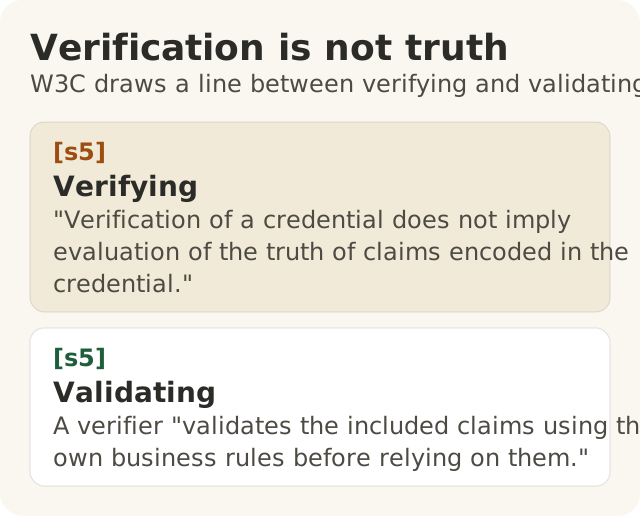
Figure data as text
Verification is not truth
W3C draws a line between verifying and validating.
| Part | Wording | Sources |
|---|---|---|
| Verifying | "Verification of a credential does not imply evaluation of the truth of claims encoded in the credential." | [s5] |
| Validating | A verifier "validates the included claims using their own business rules before relying on them." | [s5] |
This figure covers only part of this module's first objective (verifying versus validating), not the full statement-sorting exercise. The synthetic receipt is not a W3C credential (s5).
Picture a letter in a sealed envelope. The wax seal carries a stamp that only one company owns.
If the seal arrives unbroken, it suggests two things. Nobody changed the letter on the way. And it came from whoever holds that stamp.
Wax is only a picture of the idea. A digital seal, called a signature, does the same job with maths. It is only as good as the key behind it. If someone steals the key, they can make a good seal.
Either way, you do not learn that the letter inside is true.
A signed receipt for an AI action works like that seal. This lesson is about what the seal tells you, and what it never can.
The AiGovOps Foundation's own receipts work this way. Its manifesto says a gate "leaves a signed receipt that holds no private content and that a stranger can verify offline".1 Its Practice site says the receipt carries "hashes, decision, tier, policy hash, key id". It never carries "prompts, outputs, payloads, personal data".2
The Foundation's draft One Receipt rulebook is not part of this lesson. You do not need it. We use made-up cards instead.
Three questions, three different answers
Priya is a stranger to Big Widget Company. She is checking the company's AI refunds helper. The helper proposes refunds on warranty claims. It cannot pay anyone. A company rule says big refunds must wait for a named person, the warranty lead, to say yes.
Priya gets Card R1, a signed receipt. It says: "The refunds helper used rule BW-REF-3, version 4. This refund was big, so it was held for the warranty lead." It is signed with the company's key, bw-refunds-2026-11.
Priya also gets Card T, which lists what she has to trust:
- That key really belongs to Big Widget's refunds team. She found it on the company's public key list, and she writes down the date she looked.
- Nobody stole the key or misused it before the receipt was signed.
The check passes. (That is the author's run of the practice bundle.) Now she sorts what she knows into three piles.
Pile 1: the seal (integrity and origin). The record has not changed since it was signed. If both lines on Card T are right, the refunds team signed it. She knows this, as far as Card T is right.
Pile 2: the company's word (attestation). The company says it used the rule and held the refund. The seal ties the company to that claim, so it is hard for the company to deny it later. That stops being true if the key was stolen. And the seal does not prove the claim. She knows the company said it.
Pile 3: did it really work, and was it right? (effectiveness and truth). Did the warranty lead really look? Does the rule catch every big refund? Was the refund fair? The receipt cannot tell her. Someone has to go and test it.
Public standards draw the same line. One says that checking a credential "does not imply evaluation of the truth" of what it claims.3 Another says it is up to the person relying on a record "to decide which TSs and Issuers they choose to trust".4 In plain words: you choose whom to trust. This course adds one habit. Write that choice down, the way Card T does.
A real case: a record of a wrong answer
In November 2022, a passenger asked the chatbot on Air Canada's website about cheaper fares for travel after a death in the family. The chatbot said the passenger could ask for the cheaper fare after the trip. The airline's own web page, which the chatbot linked to, said the opposite.5
In February 2024 a tribunal in British Columbia decided the passenger's small claim. It said Air Canada is responsible for all the information on its website, including what its chatbot says. It ordered the airline to pay damages.5 That is one decision about one set of facts. It is not a rule for every chatbot everywhere.
Suppose the airline had kept a signed record of that chat. It would show that whoever held the airline's key signed that copy of the chat. It would not show how the words were made. And it would not make the answer right. That is Pile 1 versus Pile 3.
The level you claim is not the level you get
Some checks are stronger than others. The course uses a made-up rule card with three levels:
- C1: the seal checks out.
- C2: C1, and the rule text in the bundle matches the one the receipt names, and the records in the bundle link together with no gaps.
- C3: C2, and a separate logbook, called BW-Ledger, has a stamp showing this receipt was written into it.
These levels are a teaching card. They are not a Foundation level, a mark or a certificate.
The rule is simple. You get the highest level where every proof is there and passes. Never more than the company asked for.
- If a proof is missing, write down which one. It might exist somewhere else.
- If a proof is there but fails, write that down too. That is not the same as missing. It is a problem to report.
- If the seal itself fails, there is no level at all. Stop, and tell the person who owns the check.
Card R1 asks for C3. Priya runs the bundle's checker. In the author's run, it shows:
- Seal: good.
- Rule text matches: yes.
- Records link with no gaps: yes.
- BW-Ledger stamp: missing.
So Priya writes: C2. Missing: the BW-Ledger stamp.
Why not just give C3? Because the company's claim is the thing she is checking. A claim cannot prove itself.
What "no gaps" means. The records Priya was given link up, each to the one before. That does not show she was given every record. A refund that never made a receipt leaves no gap at all. To know the set is complete, she needs a separate list from someone else, such as the payments system's list of big refunds. Then she matches each one to its receipt. Just counting is not enough: one lost receipt and one copy would still add up. She does not have that list, so she writes "complete: not known".
Try it yourself. If you can run a short program, the bundle's VERIFY.md walks you through it. It needs no account and no internet. You will see four made-up cases. In one, the rule text has been edited, so the check fails. In another, someone changed the receipt after it was sealed, so it gets no level at all. One more thing to watch: the level can never go above what the receipt claims. So if a receipt claims no level, or a level that is not exactly C1, C2 or C3, throw it out. The practice program does this for you. It stops, prints "Rejected receipt" and gives no level, even if the seal is good. None of the four cases has a bad claim, but VERIFY.md shows you how to make one on a copy and watch it get thrown out. Also, when the program finishes without an error, that only means it ran. Read the level it prints and what it says is missing or failed.
And here is the catch. Even with the stamp, C3 would only show the receipt was written into the logbook. The standard behind such logbooks says registering a statement "only proves it was produced by" the one who made it.4 A logbook stamp is not a seal of truth. It is not a certificate either.
A rule on paper is not a rule that works
On 1 August 2012, a trading firm called Knight Capital had a software failure. In about 45 minutes its system sent millions of orders it should not have sent. The firm lost over $460 million.6
The US regulator's order lists many findings. Knight did not admit or deny them, except that it accepted the regulator had the power to bring the case.6 Some findings are about controls that existed but did not act:
- Knight had a limit on one account, but the limit was not connected to anything that would stop orders.6
- Its main risk tool depended entirely on people watching it. It sent no automatic alerts about the firm's risk.6
- Before the market opened, the system sent 97 automatic emails about the error. They were not built as alarms, and staff did not usually read them.6
The rule Knight was found to have broken asks firms to keep checking that their controls actually work.6
This was not an AI chatbot, and no receipt was involved. It is here for one lesson. A sealed record saying "we have a limit" could have been true. It would still not show that the limit stopped anything.
Design a receipt that holds no private content
Now it is your turn. Big Widget's refunds helper proposes a big refund. A proposal is not a payment. There are four steps:
- The helper proposes the refund.
- The rule holds it, because it is big.
- The warranty lead approves it or turns it down.
- Only after a yes does the payments system pay.
Your receipt records steps 1 to 3. Step 4 shows up in the payments system's own records, which the helper does not write.
Put in:
- which action (propose a refund);
- which rule and which version;
- which version of the AI helper acted;
- "above the limit" (not the exact amount);
- the decision: held, then approved or turned down;
- the approver's job title and an approval number that means nothing outside the company (not their name);
- the time, only as exact as the job needs;
- the key name and the seal.
Keep out: the customer's name, contact details, the claim, the chat, the helper's wording, the exact amount, the approver's name. Those stay in the company's private files.
Small details can still give someone away. An exact time, a size band and an approval number, put next to other records, could point to one customer. Keep each one only as exact as its job needs. Then the company's privacy owner, a named person, says yes to the list before the helper goes live.
How to link to the secrets without showing them. For the claim and the helper's answer, the receipt holds a fingerprint. It is made from the private file mixed with a long secret random number. Later, a trusted auditor with the private file and the secret number can make the fingerprint again and see that it matches.
This is the course's design, and it only works if two things stay true:
- The random number is long, new each time, and kept secret. If it leaks, someone could guess what is in the file and test the guess. Small things, like an amount, are easy to guess.
- The private files stay locked away under the company's own rules.
We state these conditions. We do not prove them here.
The computers on both sides must also write the data in exactly the same order every time. Otherwise the same record could give two different fingerprints. A published internet document, RFC 8785, sets out one fixed way to do that.7 It is an information document, not a standard. A fixed order makes fingerprints repeatable. It keeps nothing secret.
What your receipt still cannot prove. It cannot prove the warranty lead really read the claim. It cannot prove the rule catches every big refund. It says nothing about refunds that never made a receipt at all.
To know more, someone who did not build the helper must test it. This course suggests two tests, and each one looks at something different.
- Test refunds. Send in some big test refunds and see if each one waits. This covers only the test refunds tried, on the days they were tried.
- Matching the payments. Take the payments system's list of big refunds paid in one month. Match each one to its approval receipt. This covers only the real payments in that month. It cannot see a proposal that was never paid.
Neither test proves every future refund will wait. Checking that controls work is the kind of check Knight's regulator asked for.6 The test refunds are the course's example, not the regulator's.
Three yeses for this receipt
The Foundation's Practice site says: "get to yes, stay at yes, recover to yes."2 Here is what each one means for the refunds helper.
- Get to Yes, before the helper runs. Rule BW-REF-3 is written down. The limit is set. The warranty lead is named as the one person who can release a held refund. A gate has four answers: "go ahead · only this far · wait for a person · no".1 A big refund gets "wait for a person". The privacy owner says yes to the receipt's list of fields.
- Stay at Yes, while it runs. Every decision leaves a receipt. Someone who did not build the helper runs the test refunds and the payments match on a schedule. A held refund that nobody answers is not a yes. The manifesto asks how long a hold lives "before it decays to no".1
- Recover to Yes, after a problem. A seal fails. A rule text does not match. A payment has no approval receipt. Or the key may have been stolen. Then big refunds stay held, and the company's security lead stops trusting that key and tells everyone who relies on it. The warranty lead looks again at the refunds that might be affected. Turning the helper off is not the same as being back at yes. You are back only when fresh checks pass and those two people say so.
Remember
- The seal shows the record was not changed, and who made it, if you trust the key.4
- The company's word is now tied to the company. It is still just its word.3
- The level you get depends on the proofs you can see, never more than the company claims. A missing proof means a lower level. A failed seal means no level.
- Linked records show that what you were given fits together. They do not show you were given everything. For that you need someone else's list, matched one by one.
- Whether it works needs someone else to test it. Each test covers only what it tried. A receipt makes that test easier. It does not replace it.6
- The receipt holds no private content.2 In this course's design, fingerprints link to the private files without showing them.
- "I don't know yet" is an answer. The Practice site says it "always pairs you with someone".2 If you cannot tell, write "not checked" and the name of the person who can check.
Words to know: seal (signature), integrity, origin, trust, claim (attestation), level, logbook (registry), fingerprint (commitment), control.