
Talking to AI well · Plain gear
What you will learn
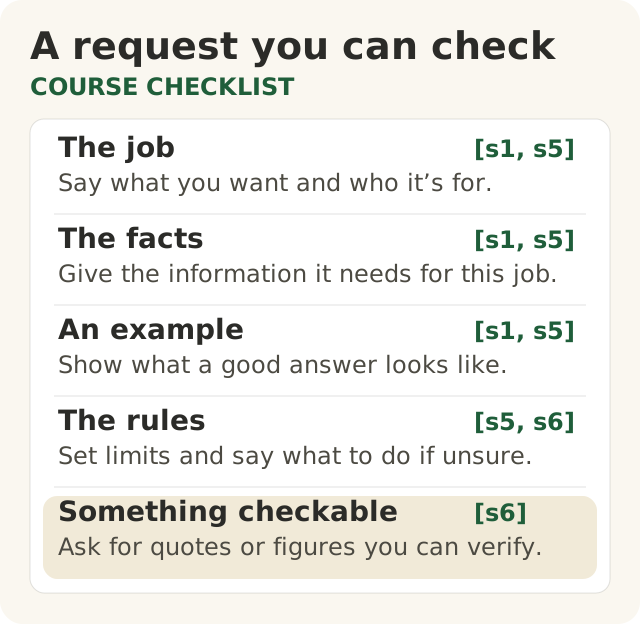
Figure data as text
A request you can check
This is the course’s checklist, not a formula tested as a whole.
| Part | What you write | Lesson sources |
|---|---|---|
| The job | Say what you want and who it’s for. | s1, s5 |
| The facts | Give the information it needs for this job. | s1, s5 |
| An example | Show what a good answer looks like. | s1, s5 |
| The rules | Set limits and say what to do if unsure. | s5, s6 |
| Something checkable | Ask for quotes or figures you can verify. | s6 |
- How to ask AI for something clearly, so you get a useful answer.
- How to make the answer better by asking again.
What you type into an AI tool is called a prompt. A prompt is like a note to a very fast new helper. The helper is smart and has learned a lot, but it has never met you. It does not know your job, your customer or your deadline unless you tell it.
One rule never changes. The AI writes a draft. You decide what happens next. It does not send, sign or agree to anything for you.
Short is not best
Lots of people type a few words, like "write an email to a supplier." Then the AI has to guess. Who is the supplier? What should the email say? How long should it be?
Researchers collected more than 10,000 prompts that people shared online.1 Almost all of them had a main part that explained the job and the background. Then the researchers ran a smaller test with one AI, GPT-4, on two kinds of jobs: writing for search engines and writing prompts for making pictures. When they took that main part out, the scores dropped more than when they took out any other part.1
A company that makes AI tools, Anthropic, says the same thing in its own guide. It says to treat the AI like a brilliant new worker who does not know how your team does things. The clearer you are, the better the result.2
The five parts of a good request
This course uses a five-part checklist. Think of it like ordering a cake from a baker.
- The job. Say what you want and who it is for. "A birthday cake for my dad's 60th."
- The facts. Give the details it needs. "Chocolate. Serves 12. Pick-up on Saturday."
- An example. Show what good looks like. "Like the one in this photo."
- The rules. Say what to avoid. "No nuts. Keep it under $40. Call me if you are not sure."
- Something you can check. Ask them to read it back. "Write down what you are making, so I can check it."
Here is why each part helps.
- The job and the facts. AI did better when a short description of the task was added to the request.3 Anthropic's guide gives a simple test. Show your prompt to a coworker who knows nothing about the task. If they would be confused, the AI will be too.2
- An example. Researchers found that showing the AI a few examples usually helped, but not always.3 In the picture-prompt test from the study of shared prompts, taking the examples out lowered the score.1 What was that score? A computer made a picture from each prompt. Then another AI scored how well the picture matched the words.1 So it measured a match, not whether anything was true. And it was one test of one kind of job, not every kind of job.
- The rules. Anthropic says to tell the AI it is allowed to say "I don't know." The company says this can cut down a lot on made-up answers.4 That is the company's own advice about its own tool. This course has not measured how much it helps. "I don't know" is a fine answer. It just means the next step is to find out, or ask someone who knows.
- A rule is a request, not a lock. "Do not promise anything" makes a promise less likely. It does not make one impossible. You still read the answer.
- Something you can check. Ask for the dates, numbers or sources it used. Then you can check them. Anthropic warns that tricks like this make mistakes rarer but do not stop them all. Always check anything important.4
- Your notes are not a receipt. Keep your prompt and the AI's answer in your own work notes, if your job allows it. In this course, a receipt shows what was decided. It never holds your prompts, the AI's answers or anyone's personal details.5 If someone needs to check your notes, your workplace decides how they get to see them. Lesson 100.P covers receipts.
One popular trick is to start with "act as an expert." In those two tests, that made only a tiny difference.1 The job and the facts did more.
A real case: a clear job, done faster
In 2022, researchers gave 95 programmers the same job: build a piece of software called a web server.6 The job was very clear. It came with twelve tests, and you were done when your work passed all twelve.6 About half of them could use an AI coding helper. Among the programmers who finished, the ones with the AI helper took less than half as long on average: 55.8% less time.6 That is time saved on one task. It does not mean they got 55.8% more work done overall.
This study did not test prompts. It shows something else: what a clear job with a built-in check looks like. Everyone knew what "done" meant. It was also only one task, and the researchers did not check how good the code was.6
The first answer is a first draft
Think about writing an important email. You write it, read it, then fix it. Researchers found that AI is the same. It does not always give its best answer on the first try.7 When they asked the AI to look at its own answer, say what was wrong and try again, the answers got better on seven different kinds of tasks.7
In that research, the AI wrote the feedback for itself. You can be the one who gives the feedback instead. The study did not test people writing feedback, so the tips below are this course's advice based on it, not proven results.
- Be exact. "Remove the promise about fast shipping" is clearer than "make it better." In the study, exact feedback from the AI worked better than vague feedback.7
- More rounds help less and less. Each new round helped a little less than the one before.7 There is no magic number of rounds. Stop when the answer does the job and you have checked it, or when it stops getting better.
- "Are you sure?" is not a check. On maths problems, the AI usually could not spot its own mistakes. One AI said "everything looks good" almost every time.7 To check a fact, look at a real source.
Good follow-ups to try:
- "The second line is wrong. Here is the right date."
- "Make it shorter and friendlier."
- "Give me two other ways to say this."
- "What could someone misread in this?"
- "For each fact, show me where it came from. Take out anything you cannot back up."4
At Big Widget Company (a made-up story)
Big Widget Company and its people are made up. The research above is real.
Priya buys parts for Big Widget Company. She needs a supplier to deliver two weeks later.
- Bad AI. Priya types "Write an email to a supplier." The AI writes a long email. It makes up a reason for the delay and offers to pay for faster shipping. Priya sends it without reading it closely. Now the company has offered money it never meant to spend.
- Good AI. Priya writes: "Write a short, polite email to a parts supplier we have used for five years. Ask to move delivery from 3 March to 17 March. Keep the price the same. Here is the email we sent them last year, which they agreed to: [she pastes it]. Copy its tone, not its dates. Under 120 words. Do not promise anything else. If you need a fact I did not give you, ask me. Then list every date you used." The draft sounds a bit stiff. She asks: "Make it warmer, and drop the second sentence." Then she reads the whole final email, not just the AI's list. She checks the dates and the price against her order, checks who it is going to, and makes sure it promises nothing new. It is her email, and she is the one who sends it.
The AI wrote the draft. Priya made the call. What if the supplier writes back asking for more money? That is not Priya's call to make. She does not ask the AI to agree. She waits, and takes it to her manager.
Three-yes check (only the parts about asking well; lesson 100.9 covers Get to Yes, Stay at Yes and Recover to Yes in full).
- Get to Yes: say what is allowed before you start. The AI may write a draft. Only Priya may send it. Only the date may change. Is anything in the prompt secret, like prices or private deals? (Lesson 100.7 covers this.) Not sure if last year's email may go in? Ask first. Who checks the email and owns it? Priya does.
- Stay at Yes: keep asking good follow-ups, and keep checking, every time. A smoother answer can still be wrong.74
- Recover to Yes: if a wrong email goes out, stop. Say it was a mistake. Tell the supplier the right facts. Then fix the prompt or the team's rule. Fixing the rule is a plan. You are back at yes when the next emails check out.
Remember
- Tell the AI the job, the facts, an example, the rules, and ask for something you can check.3124
- Let it say "I don't know."4
- The first answer is a draft. Give exact feedback and ask again.7
- The AI looking over its own work can improve a draft, but it is not proof. You check anything that matters against a real source.74
- The AI writes. A person decides and sends. Your prompt and the AI's answer are notes, not a receipt.5
Words to know: prompt, context (the facts you give it), example, follow-up, iterate (try again and improve).