
Talking to AI well · Standard gear
What you will be able to do
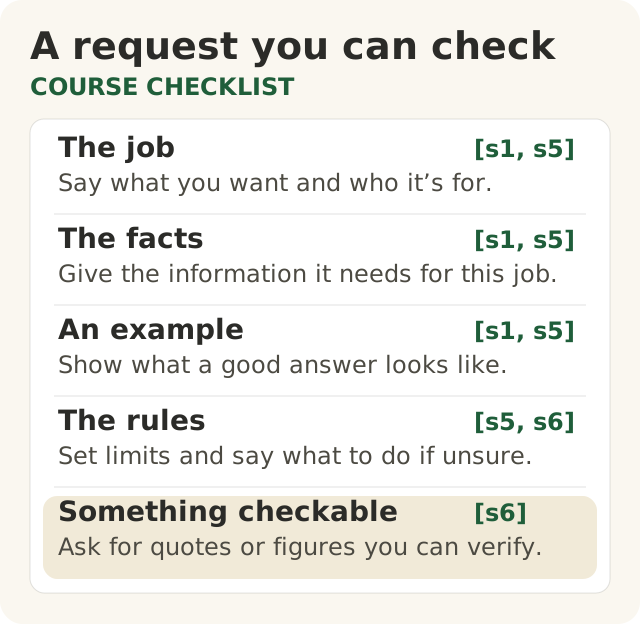
Figure data as text
A request you can check
This is the course’s checklist, not a formula tested as a whole.
| Part | What you write | Lesson sources |
|---|---|---|
| The job | Say what you want and who it’s for. | s1, s5 |
| The facts | Give the information it needs for this job. | s1, s5 |
| An example | Show what a good answer looks like. | s1, s5 |
| The rules | Set limits and say what to do if unsure. | s5, s6 |
| Something checkable | Ask for quotes or figures you can verify. | s6 |
- Write a request that states the job, gives the facts, shows an example, sets rules and asks for something you can check.
- Improve an answer by asking follow-up questions instead of accepting the first reply.
What you type into an AI tool is called a prompt. This lesson makes two points. What you put in the prompt changes what you get back. And the first answer does not have to be the last one.
The evidence comes from three research papers, one controlled experiment and one AI company's guide to its own product. They are not equally strong, so we say which is which as we go.
One thing does not change, however well you ask. The AI drafts; you decide. Nothing in this lesson lets an AI send, sign or agree to anything for you.
The wrong idea: short commands work best
Many people type a few words, such as "write an email to a supplier", and take what comes back. The tool has to guess everything else: who the email is for, what it must say, and how long it should be.
Researchers studied 10,538 prompts that people had shared on prompt-sharing websites and chat servers between December 2022 and August 2023.1 They found that these real-world prompts were built from several parts.1 The part that appeared in almost every prompt was what the researchers called the Requirement: the background, the description of the job and the instructions to follow.1 That much describes what people wrote. Separately, the researchers ran a smaller controlled test with GPT-4 on two tasks: writing for search engines, and writing prompts for an image generator. When they removed parts of those prompts one at a time, removing the Requirement had the biggest effect on the quality score.1 Two tasks and one model are a narrow test, not proof for every kind of request.
Anthropic, the company that makes the Claude models, gives similar advice in its guide for its own product (as of November 2026). It says to treat the model like "a brilliant but new employee who lacks context on your norms and workflows", and that "the more precisely you explain what you want, the better the result."2
A request in five parts
This course teaches a request in five parts. The list is the course's own checklist, not a formula from any one study. Each part is backed by the evidence below.
| Part | What you write | Example words |
|---|---|---|
| 1. The job | What you want, and who it is for | "Write a short email to a parts supplier we have used for five years." |
| 2. The facts | The information it needs, so it does not guess | "Ask to move delivery from 3 March to 17 March. The price stays the same." |
| 3. An example | What a good answer looks like | "Here is an email we sent last year that worked well: ..." |
| 4. The rules | Length, tone, what to avoid, and what to do if unsure | "Under 120 words. Do not promise anything else. If you need a fact I did not give you, ask me." |
| 5. Something checkable | An answer in a form you can check | "Then list every date and number you used, so I can check them against my notes." |
1 and 2: the job and the facts
The paper that introduced GPT-3 found that model performance improved when a plain-language description of the task was added to the input.3 Anthropic's guide says that explaining the reason behind an instruction gives the model "more information about your goals" and helps it give more targeted answers.2 It suggests a test: show your prompt to a colleague who knows little about the task. If they would be confused, the model will be too.2
The facts matter because the tool only has what you give it, plus what it learned in training. If you leave out the date, the price or the customer's name, it has to guess, or fill the gap with something that sounds right.
3: an example
The GPT-3 paper tested three ways of asking: with no examples ("zero-shot"), with one example ("one-shot") and with a few examples ("few-shot").3 Performance improved as more examples were added, but the paper also says that more examples are "usually but not always better".3
In the study of shared prompts, examples were tested in only one of the two tasks, the image-prompt task, because the search-engine prompts had none. There, removing the examples lowered GPT-4's score from 0.36 to 0.30, a drop of about 17%.1
What does that score measure? In the image-prompt task, GPT-4 wrote prompts for making pictures. The researchers turned each prompt into a picture with an image generator called Stable Diffusion. Then a second AI model, called CLIP, scored how closely the picture matched the words of the prompt, on a scale from 0 to 1.1 So the 17% is a drop in a word-and-picture match score, judged by a model. It is not a measure of truth, and no person rated whether the answers were useful at work.
Anthropic's guide calls examples "one of the most reliable ways" to steer the format, tone and structure of an answer, and says the examples should closely match your real task.2
4: the rules
Rules tell the tool the length, the tone, and what it must not do. Anthropic's guide says that "being specific about the output you want can help enhance results."2
One rule is worth adding to almost every request: tell the tool it may say it does not know. Anthropic's guide on reducing made-up answers says to give the model explicit permission to admit uncertainty, and claims this "can drastically reduce false information".4 That is the company's claim about its own product, not an independent measurement. "I don't know" is an honest answer, from the tool or from you. Treat it as a next step: find the fact, or ask the person who has it.
A rule in a prompt is a request to the tool, not a lock. "Do not promise anything else" makes a stray promise less likely. This course does not treat it as stopping one. You still read the draft, and you decide whether it goes out.
Not every popular trick earns its place. Many shared prompts begin with a role, such as "act as an expert in search engine optimisation".1 In the researchers' two tests with GPT-4, adding a role made only a marginal difference to the answer.1 The job and the facts did more.
5: something checkable
Ask for the answer in a form you can check: the dates and numbers it used, its steps, or the exact words it relied on in a document you gave it. Anthropic's guide suggests making an answer "auditable" by asking the model to cite quotes and sources for each of its claims.4 The same guide warns that its techniques reduce made-up answers but "don't eliminate them entirely", and says to always check critical information.4 A list of sources is something to check, not proof. (Lesson 100.8 covers checking.)
The checkable list is a work note, not a receipt. If your workplace allows it, keep your prompt and the AI's answer in your own work record, kept apart from any receipt. Do not put them in a receipt. In the AiGovOps Foundation's practice, a receipt carries "hashes, decision, tier, policy hash, key id"; it never carries "prompts, outputs, payloads, personal data".5
That does not mean nobody may ever see your notes. This course's rule: if a reviewer or checker needs the prompt or the answer itself, they see it only through a route your workplace has approved. Holding a receipt, or a code taken from it, does not give anyone permission to read the notes behind it. Lesson 100.P covers receipts.
Real case: a clear, checkable job, done faster
In a 2022 experiment, posted as a paper in February 2023, researchers recruited 95 professional programmers and randomly split them into two groups.6 Both groups had the same clearly defined job: build a web server (an "HTTP server") in the JavaScript language, as quickly as possible.6 The job came with twelve automatic tests, and a programmer finished when their work passed all twelve.6 Among the programmers who finished, those with access to GitHub Copilot, an AI coding assistant, took 55.8% less time on average than those without it.6 That is a cut in the time taken on one task, not a 55.8% rise in overall output. Whether a programmer finished at all was a separate result: the Copilot group's success rate was higher, but the difference was not statistically significant.6
This study did not test prompts. It is in this lesson for a different reason: it shows what a clear job with a built-in check looks like. Everyone knew exactly what "done" meant, and the tests told them whether the work was right.
Keep the result in its place. It is one task in one language. The authors say the benefits may vary across tasks and languages, and that they did not study the quality of the code.6 The paper was posted on arXiv as a preprint in February 2023, and its arXiv record, as read in November 2026, lists no journal publication.6 The authors worked at GitHub, the maker of Copilot, and at Microsoft Research and MIT.6
The second wrong idea: the first answer is the best answer
The Self-Refine paper starts from a simple observation: "Like humans, large language models (LLMs) do not always generate the best output on their first try."7 Its authors had a model write an answer, then write feedback on its own answer, then rewrite the answer using that feedback, and repeat.7 Across seven tasks, from replying in a conversation to maths reasoning, people and automatic measures preferred the refined answers. On average, task performance improved by about 20 points (an absolute gain) over the first answers.7
In that study the model gave feedback to itself. At work, you can give the feedback. The study did not test people writing feedback, so using its findings for your own follow-ups is this course's suggestion, not a measured result.
Specific feedback works better than vague feedback. The authors compared specific feedback (for example, "avoid repeated calculations in the for loop") with generic feedback ("improve the efficiency of the code"). Specific feedback gave the best results.7 On one task, called sentiment reversal, the score was 43.2 with specific feedback, 31.2 with generic feedback and 0 with none.7
A few rounds help, then the gains shrink. The improvement grew smaller with each extra round, and it did not always go up every time.7
A model is not a fact-checker for itself. On maths problems, the gains were small. The authors traced this to the model not being able to tell whether its answer had a mistake. ChatGPT's feedback on its own maths answers was "everything looks good" 94% of the time.7 So asking "are you sure?" is not a check. Checking against a real source is.
Good follow-up questions
These follow-ups are the course's suggestions, built on the findings above.
- Name what is wrong, exactly. "The second paragraph promises express shipping. Remove that." In the study, specific model-written feedback beat generic feedback.7
- Add the fact it was missing. "The supplier's contact is Dana, and the order number is on the attached sheet."
- Ask for another way. "Give me two shorter versions with a warmer tone."
- Ask what could be wrong. "What in this email could the supplier misread?"
- Ask it to back each claim. Anthropic's guide suggests asking the model to find a supporting quote for each claim after it answers, and to take back any claim it cannot support.4
- Stop when the answer does the job, not after a set number of rounds. In the study, each extra round helped less, and a round could make things worse.7 Smaller gains do not mean the answer is right. If it stops improving, change the request or do that part yourself. Either way, check the answer before you use it.
At Big Widget Company (a made-up example)
Big Widget Company and the people in it are invented for this course. The studies above are real.
Priya, a buyer in procurement, needs to ask a supplier for a later delivery date.
- Bad AI. She types "Write an email to a supplier." The reply is long, invents a reason for the delay and offers to pay for faster shipping. She sends it without reading it closely.
- Good AI. She writes: "Write a short, polite email to a parts supplier we have used for five years. Ask to move delivery from 3 March to 17 March. Keep the price the same. Here is the reschedule email we sent them last year, which they accepted: [pasted]. Match its tone and length, but use only the dates and terms in this message. Under 120 words. Do not promise anything else. If you need a fact I did not give you, ask me. Then list every date and number you used." The draft is close but stiff. She replies: "Warmer tone, and drop the second sentence." She then reads the whole final draft, not just the AI's list: the dates and price against the purchase order, the recipient, and whether it commits the company to anything new or gives a reason she did not supply. The email goes out under her name, and she sends it herself.
The AI drafted. Priya decided. She is the gate, and the "Do not promise anything else" line in her prompt is not. Suppose the supplier replies asking for a higher price. Changing the price is not Priya's call, so she does not ask the AI to agree to it. She holds the reply and takes it to her manager, who owns supplier terms.
Three-yes check (the prompting questions only; lesson 100.9 covers Get to Yes, Stay at Yes and Recover to Yes in full).
- Get to Yes: say exactly what is allowed before you start. Here, the AI may draft; only Priya may send; only the delivery date may change. Is anything in the prompt secret, such as prices or a supplier's private terms? (Lesson 100.7 covers what may go into an AI tool.) If Priya does not know yet whether last year's email may be pasted in, she asks before she pastes. Who checks and owns the result? Priya.
- Stay at Yes: keep asking follow-ups, and keep checking every draft, even after the tool has done well for weeks. A better-sounding answer still needs checking.74
- Recover to Yes: if a wrong email is sent, stop, own it, and correct it with the supplier. Then change the prompt or the team's rule. A changed rule is a repair plan. You are back at yes when the next emails check out.
Summary
- A good request has five parts: the job, the facts, an example, the rules and something checkable. In the research, the description of the job and the examples mattered; a role on its own did little.31 The five-part list is this course's checklist, not one validated recipe.
- Tell the tool it may say it does not know, and ask for an answer you can check. This is the vendor's advice, not an independent measurement.4
- The first answer is a draft. In the study, specific feedback improved answers more than vague feedback, and the gains shrank with each round.7 Stop when the answer does the job and you have checked it.
- The AI reviewing its own answer can improve a draft, but it is not a check of the facts. Check important facts against a real source.74
- The AI drafts; a named person decides and sends. A rule in a prompt is a request, not a lock. Your prompt and the AI's answer are work notes, not a receipt.5
Words to know: prompt, context, example (few-shot), follow-up, iterate.