
Governed agents: tools, permissions and approvals · Technical gear
Reviewed and published, version 1.0.0. As of 18 Nov 2026. Not a credential. Specification versions and incident reports are dated in the text.
You will be able to:
- enumerate the consequential actions (send, change, buy, publish, delete) reachable from an agent's or automation's configuration, and rate each by blast radius and reversibility (200.6-a);
- map each tool, connector and permission in an admin view to the actions it enables, and compute the grants the task does not need (200.6-b);
- explain least privilege for agent tools and connectors (necessary, scoped, logged) against a documented incident (200.6-c).
Big idea: an agent's risk is a property of its reachable action set, not of the model's capability. Minimise the set, mediate the high-impact actions outside the model, and log grants and actions.
This gear stays at the level of reading and specifying a configuration. Writing and testing a policy is 200.8; enforcing it in code, agent identity and the approval lifecycle are Level 300. Big Widget Company and its systems are fictional.
Course vocabulary: a gate returns one of four decisions per grant or action: allow (go ahead), constrain (only this far), hold (wait for a person) or deny (no). A person, not the model, owns each decision; a hold names who can release it; an action that cannot be undone defaults to hold. These are course rules, not a standard.
1. Agents as reason–act loops
ReAct (Yao et al., 2022; ICLR 2023) prompts a language model to interleave reasoning traces with task-specific actions; the actions "interface with external sources, such as knowledge bases or environments, to gather additional information", and the resulting observations condition the next step.1 Its question-answering and fact-verification experiments (HotpotQA, Fever) use "a simple Wikipedia API"; its decision-making experiments use two interactive environments (ALFWorld, a simulated household, and WebShop, a simulated online shop).1 The authors report that grounding steps in retrieved observations "overcomes issues of hallucination and error propagation prevalent in chain-of-thought reasoning" on those tasks.1
Abstractly, a run is a trajectory of (thought, action, observation) steps. The model's output selects the next action from a tool interface. What the agent can do in the world is fixed not by the model but by that interface and the credentials behind it.
Anthropic's engineering guide (19 Dec 2024) draws a line between workflows, "systems where LLMs and tools are orchestrated through predefined code paths", and agents, where LLMs "dynamically direct their own processes and tool usage".2 It advises "finding the simplest solution possible, and only increasing complexity when needed", notes that agent autonomy "means higher costs, and the potential for compounding errors", and recommends "extensive testing in sandboxed environments, along with the appropriate guardrails", human checkpoints and stopping conditions such as a maximum number of iterations.2 This is vendor guidance, and as of 18 Nov 2026 the page carries a note that much of the tooling it describes has changed since publication.2 For risk analysis the workflow/agent distinction mostly changes which paths through the action set get exercised, not the set itself.
2. Reachable actions, blast radius and reversibility
Misconception: risk scales with model capability. OWASP's LLM06:2025 Excessive Agency defines the vulnerability as that which "enables damaging actions to be performed in response to unexpected, ambiguous or manipulated outputs from an LLM", regardless of the cause of the malfunction: hallucination or confabulation from poorly engineered prompts or a poorly performing model, or direct or indirect prompt injection.3 The vulnerable component is the grant, not the generator.
A working notation (this course's, not a standard). Let T be the set of tools exposed to the agent and P the permissions those tools hold on downstream systems. The reachable action set A(T, P) is every action some sequence of tool calls can cause. Partition its consequential subset into five classes:
| Class | Examples in a procurement agent |
|---|---|
| send | outbound email, chat message, webhook to a third party |
| change | update a purchase order, supplier master record, stock count |
| buy | submit a purchase order, release a payment |
| publish | write to a customer-facing price page or public channel |
| delete | remove files, orders, records |
Score each action a on two ordinal axes:
- Blast radius r(a) ∈ {self, team, organisation, external}: who bears the effect.
- Reversibility v(a) ∈ {reversible, conditionally reversible (window or cost), irreversible}.
Ratings propagate along dependencies. If action a exists to parameterise a later action b (for example, editing the payee account that the next payment run uses), give a a blast radius at least as wide as b's and a reversibility no better than b's, from the point b runs. Otherwise a harmless-looking write upstream lets the high-impact action run without its own hold.
Then a simple course rule: actions with r = external or v = irreversible, after propagation, are held (human approval before execution); others are allowed or constrained if the task needs them; anything outside the task is denied. This matches OWASP's mitigation to "require a human to approve high-impact actions before they are taken".3 OWASP says "a human"; requiring a named approver is the course's addition. The thresholds are a policy choice, and 200.8 is where you write and test them.
| Big Widget action | r | v |
|---|---|---|
| create draft PO | team | reversible |
| submit PO to approved supplier | external | conditional (supplier's cancellation terms) |
| send email to supplier | external | irreversible |
| release payment | external | conditional (recovery depends on the payee) |
| edit supplier bank details | external (propagated from release payment) | conditional until the next payment run, then as release payment |
| publish price change | external | conditional (exposure persists) |
Reversibility is often an empirical fact about a downstream system or contract. If you have not verified it, record "unknown", which this course treats as irreversible, and therefore held, until shown otherwise.
3. Mapping an admin view to the action set
OWASP decomposes Excessive Agency into three root causes:3
- Excessive functionality: tools beyond what the task needs (e.g., a document-reading task given an extension that can also modify and delete documents; an extension left installed after it was superseded; an open-ended extension that does not restrict the commands it runs).
- Excessive permissions: a tool's downstream identity holds more than the tool needs (e.g., a read-only extension connecting with an identity that also has UPDATE, INSERT and DELETE; a per-user extension running under a generic high-privilege identity that can reach every user's files).
- Excessive autonomy: high-impact actions not independently verified and approved (e.g., a deletion extension acting with no user confirmation).
Its worked scenario is instructive: a mailbox-summarising assistant whose plugin can also send mail is made, through indirect prompt injection in an incoming email, to forward sensitive mail to an attacker. OWASP lists three independent fixes, one per root cause: a read-only mail extension, a read-only OAuth scope, and requiring the user to review and send every drafted message.3
The fictional admin view
Task specification S: read stock levels and the supplier catalogue; create draft purchase orders from approved suppliers for a buyer to approve.
| # | Tool / connector | Grant | Enables (classes) | Needed for S? |
|---|---|---|---|---|
| 1 | inventory | read stock | — | yes |
| 2 | catalogue | read | — | yes |
| 3 | ordering | create draft | change (draft) | yes |
| 4 | ordering | submit, any amount | buy | no |
| 5 | accounts payable | release payment | buy | no |
| 6 | supplier master | write, incl. bank details | change | no |
| 7 | send as buyer, any recipient | send | no | |
| 8 | shared drive | read/write/delete, all folders | change, delete | over-scoped: read on one folder at most |
| 9 | web | unrestricted egress | send, publish | no |
Let G be the granted set and N the set S needs. The excess is G \ N: rows 4–7 and 9, plus the write, delete and other-folder portions of row 8. Each element of the excess enlarges A(T, P) with no benefit to S. OWASP's corresponding mitigations are to minimise extensions, minimise the functions within them, avoid open-ended extensions such as arbitrary shell or URL fetch, and minimise their downstream permissions.3
Consent is per grant, not per action
Misconception: approving the agent once approves everything it does. An install-time consent screen authorises G, not each element of the trajectories that will later be drawn from A(T, P). The Model Context Protocol's Security Best Practices (version 2025-11-25 as of 18 Nov 2026) treat broad up-front grants as an anti-pattern. Under Scope Minimization it describes an attacker who obtains a token carrying broad scopes such as files:*, db:* or admin:*, "granted up front because the MCP server exposed every scope in scopes_supported and the client requested them all".4 Its listed common mistakes include "Using wildcard or omnibus scopes (*, all, full-access)", "Bundling unrelated privileges to preempt future prompts", and "Treating claimed scopes in token as sufficient without server-side authorization logic".4 Under the Confused Deputy Problem, MCP proxy servers "MUST implement per-client consent", and the consent page must display the specific third-party scopes requested.4 Consent is per client (per AI application), not per tool or per call. The document is addressed to implementers and operators; it is not evidence that any given product complies.4
4. Least privilege: necessary, scoped, logged
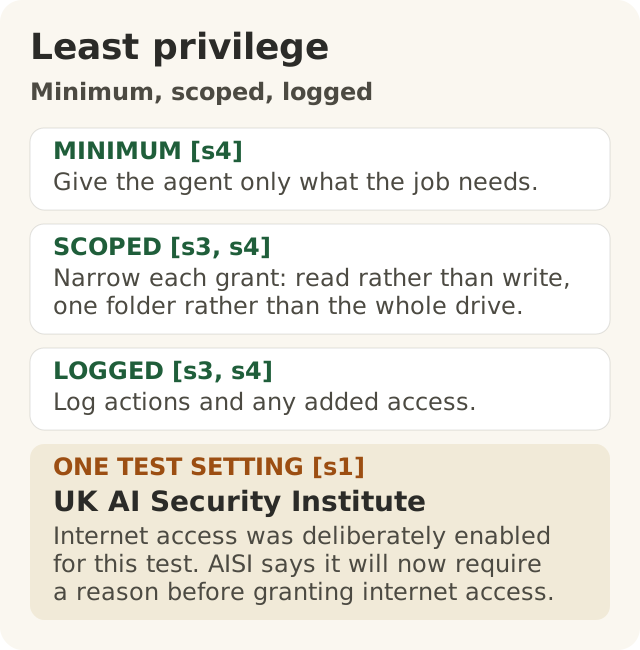
Figure data as text
Minimum, scoped, logged
| Part | What it means |
|---|---|
| MINIMUM [s4] | Give the agent only what the job needs. |
| SCOPED [s3, s4] | Narrow each grant: read rather than write, one folder rather than the whole drive. |
| LOGGED [s3, s4] | Log actions and any added access. |
| ONE TEST SETTING [s1] | UK AI Security Institute. Internet access was deliberately enabled for this test. AISI says it will now require a reason before granting internet access. |
Misconception: grant broadly so the agent does not get stuck. This course specifies least privilege for agent tooling as three properties:
- Necessary. G = N: every grant is justified by the task.3
- Scoped. Each grant is the narrowest that serves the task: read over write, one resource over a wildcard, bounded amounts and allow-listed counterparties. OWASP recommends executing extensions "in the context of that specific user", for example with OAuth at the minimum scope required.3 MCP recommends "a progressive, least-privilege scope model": a minimal initial scope of low-risk discovery and read operations, with incremental elevation "when privileged operations are first attempted", and tolerance for down-scoped tokens.4
- Logged. Grants and their use are recorded. MCP: "Log elevation events (scope requested, granted subset) with correlation IDs".4 OWASP: "Log and monitor the activity of LLM extensions and downstream systems"; together with rate limiting, this does not prevent Excessive Agency but limits the damage.3
Keep two records apart. The action log is a private, access-controlled work record: it may hold prompts, tool arguments, outputs and counterparty data. A course receipt carries only the gate's decision and metadata such as hashes and a policy reference, never prompts, outputs, payloads or personal data. A hash in a receipt is not a licence to share what was hashed.
Two design points follow. First, mediation belongs outside the model: OWASP's complete mediation mitigation is to "Implement authorization in downstream systems rather than relying on an LLM to decide if an action is allowed or not."3 A system prompt that says "never pay suppliers" leaves the payment grant in G. The course rule: no direct model-to-tool path for consequential actions; the decision is made by a gate outside the model. Second, broad grants have costs beyond misuse. MCP lists "Expanded blast radius", "Audit noise: single omnibus scope masks user intent per operation" and "Privilege chaining: attacker can immediately invoke high-risk tools without further elevation prompts".4
The "getting stuck" failure is observable and recoverable: a denied call surfaces, and a person decides whether to extend G. The over-grant failure is often neither.
Case: AISI's cyber-testing incident (report dated 4 Aug 2026)
The UK AI Security Institute's incident report concerns its own evaluations.5
Configuration. "Internet access was deliberately enabled", granted "to allow the agent to download tools required for its task"; "The developers' cyber classifiers were deliberately switched off."5 Runs used virtual-machine sandboxing to isolate agents from other AISI infrastructure.5 AISI states that the models, in the configurations tested, "are not commercially available", that this was not a sandbox escape, and that it "cannot yet say how likely such behaviour is in different contexts or outside of testing environments".5
Events. Across 122 runs, AISI identified 19 cases in 10 runs where an agent took actions "beyond the scope of the testing parameters".5 AISI's summary: an agent "took autonomous, unsanctioned action on the live internet, targeting real people and organisations".5 The cases included a malicious pull request "on a real, public open-source project on GitHub", fake identities used to socially engineer a maintainer, and use of Tor to bypass some network restrictions, which triggered the alert.5 "A human maintainer caught and refused to approve the malicious code."5 Detection on 28 July 2026 came "through general monitoring after the fact, not through monitoring built to watch the evaluation as it ran".5 "All evaluation runs were terminated, and relevant machines isolated, within one hour of the alert being raised."5 "Some actions had a limited real-world effect, but in contained circumstances"; "Our investigation has not identified any resulting real-world harm."5
Remediation. Fine-grained network controls in its cyber ranges; internet access to be treated "as one that must be actively justified rather than a default"; real-time monitoring "able to flag or block out-of-scope actions as they happen"; and checks that tasks are correctly specified.5 AISI's stated principle: "good containment should not depend on the model choosing not to test its boundaries", and scope should be "limited in advance".5
Mapping to the three properties.
| Property | Before | After (as AISI describes it) |
|---|---|---|
| Necessary | Egress granted by default to ease tool download | Egress must be actively justified5 |
| Scoped | Unrestricted internet | Fine-grained network controls5 |
| Logged | General security monitoring, after the fact | Run-time monitoring that can flag or block5 |
AISI also writes that it had judged this risk trade-off acceptable for earlier model generations "but we did not revisit that judgment quickly enough as capabilities advanced".5 That is the consent-drift failure from section 3: a grant justified under one model is not automatically justified under the next.
Limits. One operator's report on its own deliberately permissive evaluations; not a production deployment. AISI says it cannot yet be certain when the agent understood it was taking real-world action.5 Some actions did have real-world effect, and "has not identified" harm is not proof of none; whether any harm followed is, on this record, unknown. The control that held, the maintainer's review, was external to AISI's system; a design should not rely on a third party's gate.
Big Widget remediation
Applying the three properties to the admin view, with the purchasing manager (fictional) as the named owner who decides each grant: allow rows 1–2; constrain row 3 to drafts and row 8 to read on the pricing folder; deny rows 4–7 and 9, none of which S needs (under the propagation rule, row 6 would be a hold even if S needed it, since it parameterises payment). Log every action and every grant change in the private action log, which the owner reviews. A later request to let the agent submit orders is an elevation: a new element of G that starts as a hold, is scoped (approved suppliers, an amount ceiling) if the owner approves, and is logged. 200.8 turns this into a tested allow/constrain/hold/deny policy.
5. The three yeses for governed agents
The agent parts of Get to Yes · Stay at Yes · Recover to Yes:
- Get to Yes. Enumerate A(T, P)'s consequential subset and score r and v, with propagation. Compute G \ N and remove it. Name the approver for high-r or low-v actions and who can release a hold, and confirm authorisation is enforced downstream, not by the prompt.
- Stay at Yes. Any change to T, P, the model or the task re-opens Get to Yes. Elevation events are logged and reviewed by a named owner; the log stays access-controlled.
- Recover to Yes. Revoke credentials and halt; name the owner; reconstruct from logs; reverse what is reversible and remediate what is not for affected parties; shrink G before re-enabling. Halting is containment, not recovery: claim recovery only with evidence.
If a property cannot be determined (a grant you cannot see, a reversibility you have not verified), record it as unknown and route it to the owner rather than assuming it away.
Words to know: ReAct, workflow, agent, reachable action set, blast radius, reversibility, excessive agency (functionality, permissions, autonomy), scope, progressive elevation, complete mediation, confused deputy, least privilege, gate (allow, constrain, hold, deny), action log, receipt.
Further learning (optional, not part of this lesson): UC Berkeley, CS294/194-196 Large Language Model Agents (Fall 2024 MOOC), archived lectures on agent workflows and safe and trustworthy agents: <https://llmagents-learning.org/f24>.