
Designing a governance regime · Technical gear
Reviewed and published, version 1.0.0.
The law here is as it stood on 18 November 2026. Big Widget Company and its hiring assistant are fictional. Legal text is cited version by version; nothing here is legal advice or a compliance determination. "Not checked" marks every point this module did not verify against a primary text, and each one has a named owner.
Scope and notation
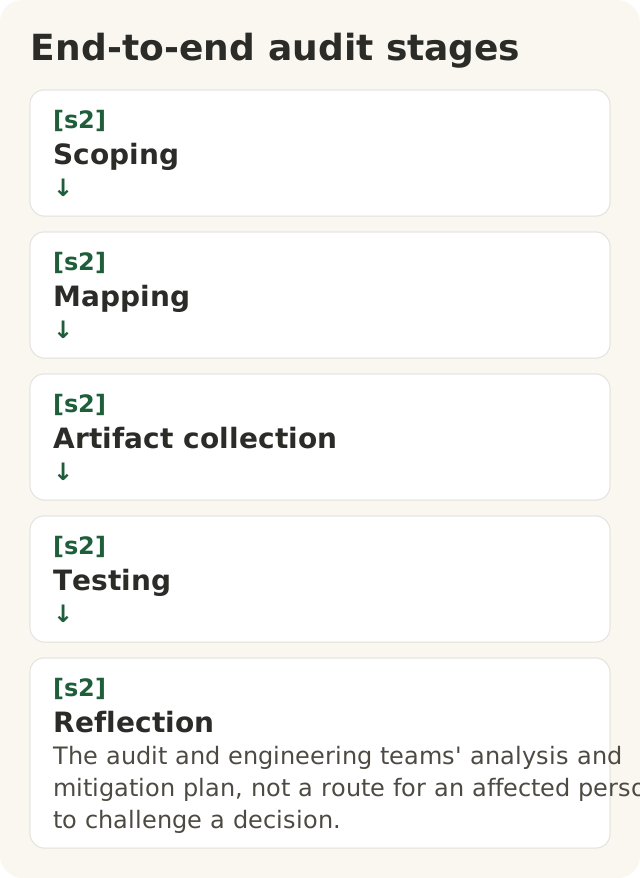
Figure data as text
End-to-end audit stages
Five stages in order. [s2]
- Scoping. [s2]
- Mapping. [s2]
- Artifact collection. [s2]
- Testing. [s2]
- Reflection: the audit and engineering teams’ analysis and mitigation plan, not a route for an affected person to challenge a decision. [s2]
Objective: 500.8-a. Text equivalent of figures/end-to-end-audit-stages.svg.
This gear treats a governance regime as a data structure with completeness and traceability properties, then instantiates it for a dated legal scenario. The structure is this course's own; the sources it draws on are cited only where they say something specific about one part of it.
Prerequisites: 300.7 (risk structure; provider and deployer capacities under Articles 3 and 25 of Regulation (EU) 2024/1689) and the Level 100–400 gate pattern.
1. A regime as a typed mapping
Let A be the set of consequential actions an AI system takes part in. A regime is a mapping
R : A → (D, G, E, C)
where, for each action a:
- D(a), the decider: a named role with authority to approve, refuse and stop a;
- G(a), the gate: a predicate over recorded state that must evaluate true, by a check independent of the system under governance, before a executes;
- E(a), the evidence schema: the fields recorded when a executes, with retention and access;
- C(a), the contest route: who may challenge, the reviewer, the reviewer's powers (at minimum reverse), and the time limit.
Completeness. R is complete iff for every a ∈ A, each of D, G, E, C is defined, and G(a) is a non-trivial predicate unless a is risk-reducing (such as stop) and R documents G(a) = ⊤ as a deliberate choice. A framework document that defines none of these for any concrete a is not a regime under this definition, however many controls it lists. That is the misconception this objective corrects.
Effective decider. Naming D(a) is not enough. For every execution x of a, the trace must show decider(x) = D(a) and t_decide(x) < t_exec(x). An automated rejection with no human decision event fails this test as well as G(a). The Foundation's manifesto states the same boundary as a rule: "No direct model-to-tool path for consequential actions."1 Its gate returns one of "go ahead · only this far · wait for a person · no";1 here, allow, constrain, hold or deny, with a named person able to release a hold.
Contestability depends on traceability. C(a) is effective only if the reviewer can reconstruct the decision. Define a minimal decision record for a as
e = (subject_ref, input_ref, input_digest, system_version, config_version, rules_version, output, decider, gate_result, reason, t)
where input_ref locates the retained input within its retention period and rules_version identifies the rules pack (section 3.3). C(a) is effective only if E(a) ⊇ {subject_ref, input_ref, system_version, config_version, rules_version, output, decider, reason, t}: without those fields the reviewer cannot tell which input, system and rule produced the outcome or who adopted it. This dependency is why the evidence schema is fixed before deployment, not after a complaint.
Record versus receipt. e holds personal data, so it is a controlled work record: access-limited, with retention set by the log rule and data-protection law. A signed gate receipt r is a different object. The Foundation's Practice site lists what a receipt carries, "hashes, decision, tier, policy hash, key id", and what it never carries, "prompts, outputs, payloads, personal data".2 So r may hold H(e) and the decision, never subject_ref in clear, the application or the rank.
Independence. Two constraints, both design choices of this course: G(a) is not evaluated by the governed system itself, and the reviewer in C(a) is not D(a) for the decision under challenge.
Where the guidance overlaps (course-authored mapping)
The four-field structure is this course's. Neither source below defines it. The table shows only where a source names something that overlaps one field.
| Element | NIST AI RMF outcome (voluntary)3 | Raji et al. (2020)4 |
|---|---|---|
| D | GOVERN 2.1: roles and responsibilities "are documented and are clear to individuals and teams throughout the organization" | Organisational accountability within the audit |
| G | GOVERN 1.4: process and outcomes "are established through transparent policies, procedures, and other controls" | Scoping and mapping before testing |
| E | MANAGE 4.1: post-deployment monitoring plans | Stage documents (scoping, mapping, artifact collection, testing, reflection) that together form the audit report |
| C | GOVERN 5.1: collecting and integrating external feedback on impacts; MANAGE 4.1: mechanisms for appeal and override | None. The reflection stage (§4.6) is the audit and engineering teams' analysis and mitigation plan, not an affected-person challenge route |
NIST states that the framework is voluntary.3 Its Playbook "includes suggested actions, references, and related guidance", is "intended for voluntary use", and invites organisations to borrow "as many – or as few – suggestions as apply".5 That using the Playbook is not, by itself, evidence of meeting a legal duty is this course's inference, not the Playbook's wording. Raji and colleagues' framework is intended to run end-to-end through internal development rather than as a single post-hoc review.4
Instantiation for Big Widget
A = {configure, start_ranking, reject, resolve_challenge, stop}. Decider assignments follow the scenario (the HR governance lead owns the gates before ranking use, rejection and challenge resolution); evidence and contest fields, and the rules pack, are this course's design.
| a | D(a) | G(a) | E(a), beyond the minimal record | C(a) |
|---|---|---|---|---|
| configure | HR governance lead + counsel | role_memo.version = current ∧ transition_memo.version = current ∧ ¬(changes_intended_purpose ∨ changes_design) without review | change diff, approver, memo versions, new rules_version | any named overseer may halt pending memo |
| start_ranking | HR governance lead | role_memo signed ∧ classification_memo signed ∧ transition_memo signed by counsel ∧ overseers named and trained ∧ applicant notice live ∧ rules pack lodged for independent review ∧ stop tested | overseer list, notice version, rules_version | notice states how to request human review and an explanation |
| reject | named HR reviewer; the assistant has no reject path | human decision event recorded ∧ human reviewed application (not rank only) ∧ reason recorded | rank shown to reviewer, reason | notice states challenge route, explanation route and deadline |
| resolve_challenge | HR governance lead + independent reviewer | record e retrieved ∧ rules pack at e.rules_version retrieved ∧ re-examined | grounds, re-examination, outcome | reversal reinstates; recurring grounds reopen G(start_ranking) |
| stop | HR governance lead; any overseer may pause | ⊤, documented: stopping is always permitted | stop reason | restart only via G(start_ranking) |
The three yeses as phases of R
The manifesto ties Get to Yes, Stay at Yes and Recover to Yes to moments in a system's life.1
- Get to Yes, "before a rule or a system ships" and "before a single action runs":1 G(start_ranking) and G(configure). The yes is scoped to one rules_version and one intended purpose. If transition_memo is unsigned, G(start_ranking) returns hold, released only by counsel.
- Stay at Yes, "while it runs, in real time":1 every reject execution emits e; overseers watch; the HR governance lead reviews challenge records monthly. Coverage = |rejections with a human decision event| / |rejections sent|. The manifesto's checklist line: "I know my system's coverage number, or I know that I do not."1
- Recover to Yes, "after — on demand, on incident":1 triggers include an upheld challenge on recurring grounds, a rejection with no e, or a configure execution without G(configure). Execute stop, inspect, repair, then pass G(start_ranking) again. A stop or an announced fix is not a return to yes; the passed gate and the named people's record of it are.
2. Role, classification, transition and dated applicability
2.1 Role determination as a partial function
Article 3(3) of the original text defines a provider as one "that develops an AI system … or that has an AI system … developed and places it on the market or puts the AI system into service under its own name or trademark, whether for payment or free of charge".6 Under Article 3(4), a deployer uses an AI system under its authority, outside personal non-professional use.6 Article 25(1) provides that a "deployer or other third-party shall be considered to be a provider of a high-risk AI system", subject to the provider's obligations under Article 16, where (a) "they put their name or trademark on a high-risk AI system already placed on the market or put into service, without prejudice to contractual arrangements stipulating that the obligations are otherwise allocated"; (b) they make a substantial modification to such a system "in such a way that it remains a high-risk AI system pursuant to Article 6"; or (c) they modify the intended purpose of a system "which has not been classified as high-risk and has already been placed on the market or put into service" so that it "becomes a high-risk AI system in accordance with Article 6".6
Write the facts as variables, with ⊥ for "unknown":
| Variable | Meaning | Scenario value |
|---|---|---|
| uses_under_authority | BW uses the system under its authority | true |
| dev_BW | BW developed it or had it developed | ⊥ |
| pm_BW | BW placed it on the market or put it into service under BW's name or trademark | ⊥ |
| prior | system already placed on the market or put into service before BW's act | ⊥ |
| mark_applied_BW | BW put its name or trademark on it (an act, not the mere presence of a logo) | ⊥ |
| contract_alloc | contract allocates the obligations otherwise (25(1)(a) proviso) | ⊥ |
| subst_mod | BW made a substantial modification | ⊥ |
| purpose_changed | BW modified the intended purpose | ⊥ |
| hr_before, hr_after | high-risk before and after BW's change (2.2) | ⊥, ⊥ |
Then
deployer(BW) = uses_under_authority = true (on stated facts)
provider(BW) = (dev_BW ∧ pm_BW) ∨ (prior ∧ hr_before ∧ mark_applied_BW, subject to contract_alloc) ∨ (prior ∧ hr_before ∧ subst_mod ∧ hr_after) ∨ (prior ∧ ¬hr_before ∧ purpose_changed ∧ hr_after) = ⊥
Every disjunct depends on a ⊥ variable, so provider(BW) is undetermined. The correct output is the list of variables to resolve, not "false". Procurement's error is to treat purchase as fixing provider(BW) = false. How contract_alloc qualifies the first 25(1) branch is a legal reading for counsel; this model only flags it. Whether Regulation (EU) 2026/1744 changed any part of Article 25 is not checked here.
2.2 Classification
Annex III point 4(a) covers AI systems "intended to be used for the recruitment or selection of natural persons, in particular to place targeted job advertisements, to analyse and filter job applications, and to evaluate candidates".6 Article 6(2) treats Annex III systems as high-risk.6 Article 6(3), first subparagraph: an Annex III system "shall not be considered to be high-risk where it does not pose a significant risk of harm to the health, safety or fundamental rights of natural persons, including by not materially influencing the outcome of decision making".6 Notwithstanding that, it "shall always be considered to be high-risk where the AI system performs profiling of natural persons".6
As a procedure:
high_risk = in_4a ∧ (profiling ∨ ¬derogation)
derogation = ¬significant_risk ∧ R6(3)
where significant_risk includes materially influencing the outcome, and R6(3) stands for the remaining conditions of Article 6(3) and the procedure in 6(4), which were not read for this module. Evaluate in order: in_4a (provider's intended purpose, actual use); profiling (if true, stop: high-risk; the Act's definition of profiling is not checked here); significant_risk (does the rank set which applications HR reads, or in what order?); then R6(3), owned by counsel. Whether 2026/1744 amended Article 6 is not checked.
2.3 Application dates as a function of text version
Let T₀ = Regulation (EU) 2024/1689 as published and T₁ = T₀ as amended by Regulation (EU) 2026/1744. For a provision p and system class k, define start(p, k, Tᵢ). Then, before transition (2.4),
applicable(p, k, d) ⇔ in_scope(p, k) ∧ d ≥ start(p, k, T₁)
for a scenario date d after T₁ entered into force. T₀'s Article 113: general application from 2 August 2026; Chapters I and II from 2 February 2025; other dates for listed parts.6 T₁ was adopted on 8 July 2026 and, by its Article 4, entered into force on the third day after Official Journal publication.7 Its Article 1(40):
- (a) sets 2 December 2026 for listed Article 5 exceptions;7
- (b) replaces Article 113(c): Chapter III Sections 1–3, except Article 6(5), apply from 2 December 2027 for Article 6(2)/Annex III systems and from 2 August 2028 for Article 6(1)/Annex I systems;7
- (c) sets 27 July 2026 for Articles 102–110.7
For d = 18 November 2026 and k = Annex III high-risk:
| Provision | Location in T₀ | start under T₁ | applicable(d)? |
|---|---|---|---|
| Art. 3 | Chapter I | 2 Feb 2025 (T₀ Art. 113(a))6; not among the Art. 1(40) changes recorded for this module7 | yes |
| Art. 6(2)–(3), Annex III | Chapter III Section 1 | 2 Dec 20277 | no |
| Arts. 12, 14 | Chapter III Section 2 | 2 Dec 20277 | no |
| Arts. 25, 26 | Chapter III Section 3 | 2 Dec 20277 | no |
| Art. 86 | Chapter IX | general date 2 Aug 2026 (T₀ Art. 113)6 | not checked: in_scope requires a decision based on output from a "high-risk AI system listed in Annex III", while the classification provisions start later; 86(2)–(3) further limit it; the interaction with Art. 111(2) and any T₁ change to Art. 86 are unresolved |
Two errors this table prevents: reading start(p, k, T₀) when T₁ governs the scenario date (the 2024 timeline), and treating start(p, k, T₁) > d as "no duty ever" rather than "not yet". The European Commission's AI Act page is an overview, not T₀ or T₁, and is never used as start().8 The table gives only the earliest date. Whether a Chapter III duty reaches this system is 2.4's question.
2.4 Transition
Article 111(2), as amended by 2026/1744, provides that the Regulation applies to operators of high-risk AI systems "that have been placed on the market or put into service before the date of application of Chapter III referred to in Article 113, only if, as from that date, those systems are subject to significant changes in their designs".7 It is "Without prejudice to the application of Article 5", and providers and deployers of high-risk systems "intended to be used by public authorities" must comply by 2 August 2030.7 Recital 39 of 2026/1744 says that for this grace period "the decisive factor is the date on which the first unit of that type and model of high-risk AI system was placed on the market or put into service on the Union market for the first time".7 Let s_CIII = start(Chapter III, k, T₁) and t_pm(s) that date for the type and model of s: the first EU unit, not this installation. Big Widget's own go-live date is not t_pm(s). If an unchanged unit goes live at Big Widget after s_CIII but the first EU unit of its type and model was placed before s_CIII, using the local date would flip the result. So the transition memo records the provider's evidence for the first EU unit's date and whether Big Widget's unit is the same type and model. The recital also conditions the grace period on a unit having "been lawfully placed on the market or put into service" before the date.7 That unit need not be the first one, so the model keeps it as a separate fact: lawful_pre(s) holds when at least one unit of the type and model of s was lawfully placed on the market or put into service before s_CIII. Chronology does not establish lawful_pre(s); the memo records the provider's evidence for it apart from t_pm(s). If either fact is unresolved or lawfulness is disputed, that fact is ⊥ and counsel rules; how much weight the recital carries against the operative text is also counsel's question. The model below is deliberately narrow. It covers only a Chapter III duty p (Sections 1–3), and only a high-risk system s that is not intended to be used by public authorities. The public-authority carve-out turns on the system's intended use, so it also binds providers that are not themselves authorities; that branch is left out here. Article 5 is outside the model, because 111(2) operates without prejudice to it. For that scope,
reaches(p, s, d) ⇔ applicable(p, k, d) ∧ t_pm(s) ≤ d ∧ (t_pm(s) ≥ s_CIII ∨ ¬lawful_pre(s) ∨ ∃ t ∈ [s_CIII, d] : significant_design_change(s, t))
where p ∈ Chapter III Sections 1–3 and intended_for_public_authorities(s) = false
The model only speaks about a system already placed on the market or put into service by d; the conjunct t_pm(s) ≤ d makes that domain explicit. A placement that is only planned, or dated after d, does not make the duty reach the system as of d, even if a later actual date is supplied. The change interval is closed at both ends. A change on s_CIII itself counts, and so does one on d. A change that is only planned, or dated after d, does not make the duty reach the system as of d either. Either event is a reason to run this check again on the day it happens. An unknown is not a no: with t_pm(s), lawful_pre(s) and significant_design_change all ⊥, the terms that use them are ⊥, so once applicable(p, k, d) holds, reaches(·) is ⊥, not false. A known early t_pm(s) with lawful_pre(s) = ⊥ leaves reaches(·) at ⊥ only when no qualifying change is known, that is, when significant_design_change is ⊥ or false for every t in [s_CIII, d]. A confirmed significant change in that interval makes the last disjunct true, so the model returns true even while lawfulness is unresolved. Neither case is ever false, and neither is a permission to deploy. For BW's assistant, t_pm, lawful_pre and significant_design_change are all ⊥. intended_for_public_authorities(s) is false on the stated facts but goes in the transition memo as a fact to confirm. So every 2 Dec 2027 entry below is a lower bound, not a guarantee. The interaction of 111(2) with the deployer duties and with Art. 86 is a legal question this module does not resolve; counsel signs the transition memo, and G(start_ranking) holds until they do.
2.5 Clause → gate → evidence → owner
| Clause (T₀ wording unless marked) | start (T₁) | Gate | Evidence | Owner | Uncertainty |
|---|---|---|---|---|---|
| Arts. 3(3), 3(4), 25(1)(a)–(c)6 | Art. 3: 2 Feb 2025;6 Art. 25: 2 Dec 20277 | configure; start_ranking | role memo with the 2.1 ⊥ variables and their evidence | HR governance lead + counsel | provider(BW) = ⊥ |
| Art. 111(2) (T₁ wording)7 | turns on s_CIII and design changes7 | start_ranking; every configure that changes design | transition memo: t_pm (first EU unit of the type and model), lawful_pre (separate fact: provider's evidence that at least one unit was lawfully placed or put into service before s_CIII), same-type-and-model evidence, design-change log | counsel + HR governance lead | reaches(·) = ⊥ |
| Art. 6(2)–(3); Annex III 4(a)6 | 2 Dec 20277 | start_ranking | classification memo: intended purpose, profiling, significant-risk analysis | HR governance lead + counsel | high_risk = ⊥; R6(3) and T₁ effect on Art. 6 not checked |
| Art. 26(2): oversight by persons with "the necessary competence, training and authority"6 | 2 Dec 20277 | start_ranking | overseer list, training records | HR governance lead | adopted as policy before applicability |
| Art. 26(6): keep logs "automatically generated by that high-risk AI system to the extent such logs are under their control", for a period appropriate to the intended purpose, "of at least six months, unless provided otherwise in applicable Union or national law, in particular in Union law on the protection of personal data"6 | 2 Dec 20277 | start_ranking | retention configuration and its privacy review | HR governance lead + IT + privacy owner | automatic logs under deployer control only; depends on provider's Art. 12 capability |
| Art. 26(7): inform workers' representatives and affected workers before workplace use6 | 2 Dec 20277 | start_ranking | notification record | HR governance lead | scope for applicants vs workers |
| Art. 26(11): inform natural persons subject to Annex III decisions6 | 2 Dec 20277 | start_ranking | notice text, version | HR governance lead | adopted as policy before applicability |
| Art. 12(1): automatic recording of events; Art. 14(1): designed for effective human oversight6 | 2 Dec 20277 | start_ranking | provider instructions for use; log and override capability confirmed | provider (BW if provider(BW)) | follows provider(BW) |
| Art. 86(1)–(3): for an affected person subject to a deployer decision based on Annex III high-risk output, with legal or similarly significant effects they consider adverse to health, safety or fundamental rights, "clear and meaningful explanations of the role of the AI system in the decision-making procedure and the main elements of the decision taken"; not where Union or national law provides exceptions or restrictions; only so far as Union law does not otherwise provide the right6 | see 2.3 | reject | decision record e sufficient to generate the explanation | HR governance lead | in_scope per decision; applicability and 111(2) interaction not checked |
| BW policy (course design): plain-words explanation of any rejection on request | now | reject | explanation and version | HR governance lead | company promise, wider than Art. 86; never labelled as the legal right |
| NIST AI RMF GOVERN 2.1, 5.1; MANAGE 4.13 | none (voluntary) | all | gate-to-outcome mapping | HR governance lead | guidance, not a legal duty |
| ISO/IEC 42001:20239 | none | none claimed | none claimed | none | catalogue only; no clause |
The rows that answer procurement are the first two: they test the deployer label under Articles 3 and 25, leave provider capacity at ⊥ pending development, placing-on-market, branding and modification facts, ask whether Chapter III reaches the system at all, and cite each date from T₀ and T₁ rather than from guidance.
2.6 ISO/IEC 42001 catalogue scope
The ISO catalogue page identifies ISO/IEC 42001:2023, edition 1, December 2023, as specifying requirements for establishing, implementing, maintaining and continually improving an AI management system.9 The standard's clauses were not read for this module. Any table row that cites a numbered 42001 clause, or treats the catalogue entry as evidence of certification or of AI Act compliance, has no support here and should be rejected.
2.7 Every ⊥ has an owner
The Practice site's line, "I don't know yet" "is always an answer, and it always pairs you with someone",2 becomes a rule on the memos: every ⊥ variable and every "not checked" carries an owner and a next check. Counsel owns 111(2), t_pm, lawful_pre, Art. 86 scope, R6(3), contract_alloc and any unopened amendment; the HR governance lead owns dev_BW, pm_BW, prior, mark_applied_BW, subst_mod and purpose_changed, and gathers the provider's rollout, type-and-model evidence for t_pm and the lawful-placement evidence for lawful_pre. A ⊥ never evaluates to allow.
3. Contestability and traceability as pre-deployment requirements
Claim. If C(a) or the required fields of E(a) are undefined at deployment, the regime cannot guarantee that decisions already made can be reconstructed or reversed. Unrecorded fields cannot be read back from the system's own records; reconstruction then depends on other records or testimony, which may or may not exist. A remedy power created later may help, but the regime cannot promise it to people decided on before it existed. The argument is logical, not empirical; the two records below show the requirements in the words of the bodies that investigated real failures. Neither involved a generative model, and neither is offered as evidence that a particular design would have changed the outcome.
3.1 Robodebt Royal Commission (2023)
Report presented and tabled 7 July 2023; updated edition published 11 July 2023 after corrections.10 Recommendation 17.1: a clear review path for people affected by automated decisions; plain-language information about automated decisions; and access to business rules and algorithms for independent expert scrutiny.10 Recommendation 17.2: the Commonwealth should consider a body to monitor and audit automated decision-making for technical aspects, fairness, bias and usability.10 Only the recommendations on the report page were read; chapters and implementation status are not checked. Recommendations are prescriptions. This gear does not read them as findings that each safeguard was absent in the scheme.
3.2 Ongekend onrecht (2020)
Final report of the Dutch parliamentary inquiry into the childcare benefit, dated 17 December 2020.11 Page 7: "De commissie constateert dat bij de uitvoering van de kinderopvangtoeslag grondbeginselen van de rechtsstaat zijn geschonden" (course translation: the committee finds that fundamental principles of the rule of law were violated in administering the childcare benefit).11 Page 8 describes repeated late, incomplete and incorrect information to Parliament and deficient information management within ministries.11 Page 11 excludes nationality-based risk profiles from the inquiry's remit and refers to the data-protection authority's separate investigation; no finding of that investigation is used here.11
3.3 From recommendation or finding to regime field
Notice and version logs are partial responses to Recommendation 17.1. A notice says that a system is used. A config diff says what changed, not necessarily the operative rules. Independent scrutiny needs a rules pack P(v): the configuration, thresholds, ranking criteria and provider documentation that determine the output under rules_version v, inspectable by a named reviewer outside the deciding team under written access terms, and linked from every e by e.rules_version and e.input_ref. Where the provider withholds part of P(v), R records the gap and its owner; it does not relabel a change log as access to the rules.
| Source item (recommended / found) | Regime field | Property |
|---|---|---|
| Recommended: clear review path (Rec. 17.1)10 | C(reject), C(resolve_challenge) | route exists before first decision; reviewer can reverse |
| Recommended: plain-language information (Rec. 17.1)10 | E(start_ranking): notice version; explanation on request | issued before first decision; partial on its own |
| Recommended: rules and algorithms open to independent scrutiny (Rec. 17.1)10 | P(v); E(configure): config_version, change diff | operative rules versioned and inspectable by a non-author; a diff alone is insufficient |
| Recommended for consideration: a body to monitor and audit automated decisions (Rec. 17.2)10 | E(·): minimal record e | auditable from the first decision |
| Found: late, incomplete, incorrect information; deficient information management (p. 8)11 | e linked end-to-end across actions | outcome traceable to input, version, decider |
This matches the placement of audit in Raji and colleagues' framework, whose stage documents are produced during development rather than reconstructed afterwards,4 and NIST's inclusion of appeal and override in post-deployment monitoring plans.3
Summary
- A regime is R : A → (D, G, E, C), complete over all consequential actions, with effective deciders and G = ⊤ only for documented risk-reducing actions. The structure is this course's; NIST supplies overlapping outcomes such as documented roles and appeal and override.3 A framework document is not a regime.
- Role is a function of facts: deployer = true, provider = ⊥ until development, placing-on-market, branding and modification facts are known.6 Application dates come from T₀ as amended by T₁, not from the 2024 timeline or the Commission overview.7 8 Whether a duty reaches a system already in service turns on Article 111(2).7
- NIST is voluntary;3 5 the ISO entry is catalogue scope only.9
- C and E must be defined before deployment; the Robodebt recommendations and the Ongekend onrecht findings name what they serve.10 11 Notice and change logs are partial; scrutiny needs P(v). Receipts carry metadata, never personal data.2
Further learning (not cited, never copied): Stanford CS 181, Harvard CS 2881R and Cambridge's Practical Research in Human-centred AI, as listed in this module's source pack.