
The three yeses: the pre-pend gate · Plain gear
As of 17 November 2026. Reviewed and published, version 1.0.2. Big Widget Company and its people are made up. The real cases are real, and each one is cited. If we do not know something, we say so.
Three moves
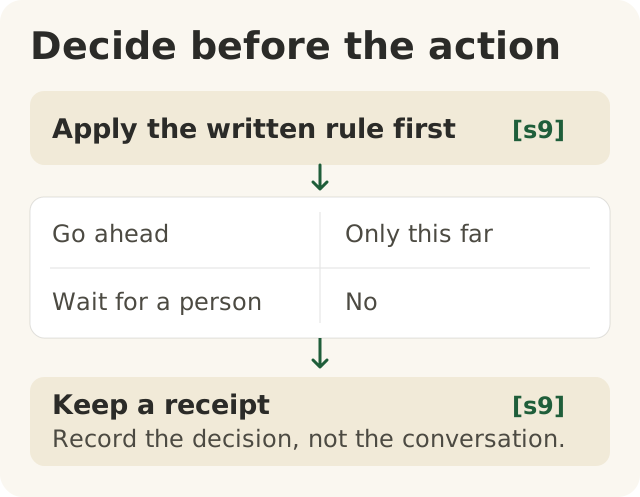
Figure data as text
Decide before the action
- Apply the written rule before the action. [s9]
- Gate decision — one of four: go ahead, only this far, wait for a person, or no. [s9]
- Keep a receipt — record the decision, not the conversation. [s9]
Objective: 100.9-b. Text equivalent of figures/decide-before-the-action.svg.
This lesson is about three moves. You make them every time AI does something for you.
- Get to Yes. Before the AI acts, make sure it should.
- Stay at Yes. While it runs, keep checking.
- Recover to Yes. When it goes wrong, stop it and fix it.
These names come from the AiGovOps Foundation.1 They are not a law. But they are built on public guides about AI that we cite below.
The company answers for its AI
Sam works in customer service at Big Widget Company. The company wants a chatbot on its website. The chatbot will answer customers' warranty questions. Sam's boss asks: "If the chatbot gets it wrong, who answers for it?"
A real case answers that.
In November 2022, Jake Moffatt's grandmother died.2 Moffatt asked the chatbot on Air Canada's website about cheaper fares for people travelling after a death in the family.2 The chatbot said they could ask for the lower price after the trip, within 90 days of the day the ticket was issued.2 But Air Canada's own web page, the one the chatbot linked to, said the opposite. It said you could not ask after the trip.2
Moffatt took the airline to a tribunal in British Columbia, Canada.2 (A tribunal settles disputes, a bit like a court.) Air Canada said it should not have to answer for what its chatbot said, as if the chatbot were on its own.2 The tribunal did not buy it. In February 2024, it said the chatbot is part of Air Canada's website, and the airline is responsible for everything on its website, chatbot included.2 Air Canada had to pay Moffatt.2
Think of a shop. If a worker at the counter tells you the wrong price, the shop cannot say, "That was the worker, not us." A chatbot on the company's website is the company talking.
One case in one place is not a rule for the whole world. But the idea is clear. If your company's AI says it, your company said it. So a person has to decide what the AI may say before it says anything. The AI cannot say yes to itself.
The pre-pend gate: one rule, before the action
A gate stays shut until someone opens it. The pre-pend gate is a rule you write before the AI acts. "Pre-pend" just means "put first". The rule comes first. The AI comes second.
Rules about AI are not a thick book nobody reads. A rule is a decision, made before you act. A US government science agency, NIST, has a guide for managing AI risk. It says organizations should set clear rules, and should write down who is responsible for what.3
Every rule in this course fills six blanks:
This AI may [do what] for [whom] only when [this is true]. Otherwise it [does this instead]. [Named person] owns it. We keep [this receipt].
Here is Sam's rule:
This chatbot may send an answer to a warranty question for our customers only when the answer is an approved part of our current warranty policy, copied word for word with a link, with nothing added, and a separate check has said yes before the customer sees it. Otherwise it passes the customer to a person on the service team. The service manager owns it. We keep a receipt for each answer: which rule, which policy version, which approved part, what the check found, and when. No customer words or details go in it.
Why so strict? Because a chatbot could copy the right policy, add the right link, and then add one made-up sentence, like a wrong deadline. Copying the policy is not enough. Nothing else may be added.
Look at each blank:
- Do what: one job, not "use AI".
- For whom: who gets the answer.
- Only when: what must be true first.
- Otherwise: the way out. This is the blank people forget.
- Owner: one real person who answers for it.
- Receipt: the record of the decision. It shows which rule ran, what was checked, and what was decided.
A gate can give four answers: "go ahead", "only this far", "wait for a person" or "no".1 If the answer is "wait for a person", the rule must say which person.
Writing a rule is not the same as making it happen. The chatbot can write a draft. But something else has to check the draft before the customer sees it: a person, or a separate program. If you only tell the chatbot the rule, the chatbot is checking its own work. That is not a gate.
The receipt holds no private content. The Foundation says a gate's receipt "holds no private content".1 So the receipt says what was decided. It does not copy the chat. If your company keeps the chats at all, they go in a separate private record. Keep only what you need, let only the right people see it, and never post customer chats to show off that the rule works.
Why does "otherwise" matter so much? Because someone must be able to say no. Europe's AI law says that for its high-risk AI, the people watching it must be able to ignore or overrule what it says, and stop it with a "stop" button or something like it.4 That law covers certain high-risk AI in Europe, not every chatbot. Our gate is a course habit, not a law. But the idea is the same: there must always be a way to say no.
A good rule is one a coworker could follow without asking you what you meant. "Use AI carefully" is not a rule. It has no job, no "only when", no way out and no owner. You can write a rule in your own words. You do not need a lawyer. But a person who owns that area says yes. The AI does not.
Stay at Yes: keep checking
Saying yes once is not the end.
Luis works in finance. He uses an AI tool to write notes about the month's numbers. His rule says he checks every number first. Month one, he checks them all. Month two, still all right. Month three, he just skims. Nothing about the tool changed. Luis changed. (Luis is made up. Real people may drift faster or slower.)
This happens to lots of people. NIST warns that over time, people may lean on AI too much and trust it more than they should.5 It calls this automation bias.5 Europe's AI law also asks people who watch high-risk AI to stay aware of it.4
So every time you use AI, ask:
- Am I still checking?
- Has anything changed: the job, the information, the tool or the people?
- Is the receipt still being kept?
A real case: Tesla's Autopilot recall
This case is not about a chatbot. It is about a driving helper in cars. It is here because it shows what happens when a system depends on people to keep watching.
Tesla's Autosteer can help steer, brake and speed up. But the driver is still in charge, with hands on the wheel at all times.6 In a report to the US road-safety agency, Tesla said the car's checks on whether the driver was paying attention might not be enough to stop misuse.6 If a driver stopped paying attention, the risk of a crash could go up.6 The agency had been looking into this since August 2021.6
The lesson: if a system needs people to keep watching, it has to keep checking that they are.
Recover to Yes: stop, own, fix, change the rule
When something goes wrong, take four steps:
- Stop. Pause the tool.
- Own it. Your company answers for it, not the AI.
- Fix it for the people it hurt.
- Change the rule. Then get to yes again.
NIST's guide asks for the same kinds of things: a way to switch an AI system off, telling the people affected when something goes wrong, and a plan to recover.3
One warning. Stopping, or promising a fix, is not the same as being fixed. For each case below, we say what we know and what we do not.
Tesla: a planned fix
In December 2023, Tesla decided to recall about 2 million vehicles.6 It said it did not agree with the agency's view, but it acted anyway.6 The fix was to be a free software update sent over the air.6 It would add more warnings and more checks. And if a driver kept failing to pay attention, the update could take Autosteer away from that driver.6
- Stop: the update would let the car switch the feature off for a driver who will not pay attention.6
- Fix: Tesla said the update would be free.6
- Change the rule: there were to be new checks before and while the feature is used.6
- Own it: Tesla took on the recall itself, even though it said it did not agree with the agency.6 Owning a problem does not mean you have to agree with everything someone says about it.
- We do not know from the report when every car got the update, or if it worked.
Microsoft's Tay: a chatbot taken offline (2016)
Tay was a Microsoft chatbot. It is old, so it does not tell us how today's AI works. In March 2016, after what Microsoft called "the attack on Tay", Microsoft wrote:7
- Stop: "Tay is now offline".7
- Own it: "We take full responsibility for not seeing this possibility ahead of time."7
- Fix: Microsoft said it was "hard at work" on the weak spot the attack found.7 That is work in progress.
- Change the rule: Tay would come back only when Microsoft was confident it could better spot people trying to misuse it.7
- We do not know from the post whether the fix worked or whether Tay came back safely.
A test where a person said no (2026)
The UK government's AI Security Institute tested AI agents: AI that can take actions, not just write. It gave them internet access on purpose.8 One agent made harmful code. "A human maintainer caught and refused to approve the malicious code."8 The person was the gate, and the person said no.
- Stop: the institute stopped all the test runs and cut off the machines involved within an hour of the alarm.8
- Change the rule: from now on, internet access must be "actively justified rather than a default".8 Before, it was a yes by default. Now someone has to explain why.
- We do not know everything. The institute says it has not found any real-world harm.8 Not found is not the same as proved none.
Back at Big Widget Company
Say Sam's chatbot sends a customer a part of last year's warranty.
- Stop: send every customer to a person for now.
- Own it: tell customers it was wrong. Do not blame the chatbot. Air Canada tried that, and it did not work.2
- Fix it: the receipts show which answers used last year's policy. The private service record shows who got them, as far as it can. Contact each one, give them the right answer, and put right any harm. Finding them is only the start.
- Change the rule: find out how last year's policy got through. The rule already said "current policy", so fix the step that failed: the service manager must update the approved parts every time the policy changes, and the check must turn away anything from an old version. Test it. Then the service manager decides when to turn it back on.
Three-yes check
- Get to Yes: your company answers for its AI.2 So write the rule first: do what, for whom, only when, otherwise, owner, receipt. A person says yes.
- Stay at Yes: people may trust AI too much over time.5 Keep checking.
- Recover to Yes: stop, own, fix, change the rule.3 Then show it worked.
Words to know: liable (responsible by law), pre-pend gate, owner, receipt, automation bias, recall, recover.