
The three yeses: the pre-pend gate · Technical gear
As of 17 November 2026. Reviewed and published, version 1.0.2. Big Widget Company is fictional. Legal records support their own case and jurisdiction only; nothing here is legal advice. Get to Yes, Stay at Yes and Recover to Yes are the AiGovOps Foundation's terms;1 the six-blank pre-pend rule is this course's form of them. The NIST and EU texts are design context, not endorsements of the course. Unknowns are marked as unknown.
Scope
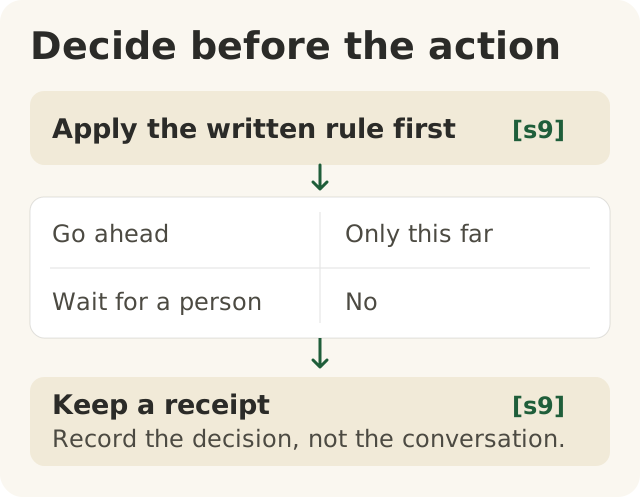
Figure data as text
Decide before the action
- Apply the written rule before the action. [s9]
- Gate decision — one of four: go ahead, only this far, wait for a person, or no. [s9]
- Keep a receipt — record the decision, not the conversation. [s9]
Objective: 100.9-b. Text equivalent of figures/decide-before-the-action.svg.
This gear treats an AI deployment as a sequence of actions, each taken by a system on behalf of an organization. It covers three control points, which the Foundation's practice places before a single action runs, while it runs, and after it, on demand or on an incident:1 an authorization decision before an action (Get to Yes), monitoring of the assumptions behind that decision while the system runs (Stay at Yes), and incident response that ends in a revised decision (Recover to Yes). It anchors each on a primary record or standard:
| Control point | Course move | Primary anchor |
|---|---|---|
| Attribution of AI output to the deployer | Get to Yes | Moffatt v. Air Canada, 2024 BCCRT 1492 |
| Pre-action authorization with an owner and a record | Get to Yes | NIST AI RMF 1.0 GOVERN 1.4, 2.13; EU AI Act Art. 14(4)(d)–(e)4 |
| Continuous monitoring against over-reliance | Stay at Yes | NIST AI RMF MEASURE 3.13; NIST AI 600-1 §2.7, MG-4.1-0025; EU AI Act Art. 14(4)(b)4 |
| Deactivation, remediation and control change | Recover to Yes | NIST AI RMF MANAGE 2.4, 4.1, 4.33; NIST AI 600-1 GV-1.5-002, MG-2.4-004, MG-4.3-0025; Tesla recall 23V-8386; Microsoft Tay post (2016)7, AISI incident report (2026)8 |
Attribution: the deployer answers for the output
The record
In Moffatt v. Air Canada, 2024 BCCRT 149, the British Columbia Civil Resolution Tribunal decided a claim by Jake Moffatt arising from an exchange with the chatbot on Air Canada's website in November 2022, after the claimant's grandmother died.2 The chatbot stated that a reduced bereavement fare could be requested after travel, within 90 days of the date the ticket was issued; the bereavement-travel page that the same answer linked to stated that the policy did not apply after travel had been completed.2
Air Canada submitted, in effect, that it could not be held liable for information provided by its chatbot, as though the chatbot were a separate entity responsible for its own actions.2 The tribunal, in a decision dated 14 February 2024, described this as a "remarkable submission", held that the chatbot is part of Air Canada's website, and held Air Canada responsible for all information on its website, chatbot included.2 It found negligent misrepresentation and awarded damages.2
The engineering consequence
Treat the model as an unaccountable component inside an accountable system. Two features of the record matter for design:
- No liability shield from automation. The defence that the generating component is a separate actor did not succeed.2 For governance purposes the unit of accountability is the deploying organization, so every customer-facing generation path needs an organizational owner.
- Inconsistency between channels does not cure the error. The correct policy was one link away from the incorrect answer, and the organization was still held to the answer.2 A design that relies on the user to reconcile the model's output with a canonical source does not move responsibility to the user.
Scope limits: this is a single decision of a provincial tribunal on a small claim, on its facts.2 It is evidence of how one adjudicator treated a deployer's chatbot, not a general statement of law in any jurisdiction.
Pre-action authorization: the pre-pend gate
Governance as a decision, not a document
NIST AI RMF 1.0, released January 2023 and voluntary, organizes AI risk management into four functions: GOVERN, MAP, MEASURE and MANAGE.3 Two GOVERN outcomes define what a gate must provide:
- GOVERN 1.4: "The risk management process and its outcomes are established through transparent policies, procedures, and other controls based on organizational risk priorities."3
- GOVERN 2.1: "Roles and responsibilities and lines of communication related to mapping, measuring, and managing AI risks are documented and are clear to individuals and teams throughout the organization."3
Neither outcome prescribes a particular architecture, and documented roles can exist without any per-action check. The pre-pend gate is this course's implementation choice: it turns the policy and the role into an executable precondition evaluated at the moment of action, so that the control is applied rather than only written down.
The rule as a predicate
The course's rule template has six fields:
This AI may [action a] for [subjects U] only when [condition C]. Otherwise it [fallback f]. [Owner o] owns it. We keep [receipt schema R].
U is the set of people the action is for or affects. It is not the same as the set of actors allowed to request it. Let A be the authorized requesters. For a request by actor u, affecting subjects s, in context x:
\text{gate}(a, u, s, x) =
\begin{cases}
\text{run } a & \text{if } u \in A \text{ and } s \subseteq U \text{ and } C(a, u, s, x) \\
\text{run } f & \text{otherwise}
\end{cases}
In a direct customer chat the requester is the subject, so A and U coincide; in a mediated workflow (an employee acting for a customer) both checks are needed, and membership of U alone is not permission to act.
The two-branch form is a simplification. The Foundation describes a gate's decision as one of four: "go ahead · only this far · wait for a person · no".1 This course writes them allow, constrain, hold and deny. f may be any of the last three; a hold must name the person who can release it, or it is not a decision.
Every evaluation, on either branch, emits a receipt $r = (\rho, \text{version}, p, \text{check}, \text{decision}, o, t) \in R$ attributable to owner o at time t, where $\rho$ identifies the rule, version the authoritative source C was evaluated against, and p the approved passage (if any). The receipt deliberately excludes the input, the output and any personal data.
Enforcement point. a is the externally visible act (here, publishing an answer to a customer), not internal generation. The model may generate a candidate privately; C is evaluated on that candidate by a component independent of the generator (a deterministic checker or a named person), and only on success is the candidate published. A rule placed only in the model's own instructions is not a gate: the evaluator would be the component whose failure the gate exists to catch. The Foundation states the same boundary as "No direct model-to-tool path for consequential actions."1
Receipt versus service record. The Foundation's practice describes a gate leaving "a signed receipt that holds no private content".1 This module requires no signature, but applies the content rule: R holds decision metadata only. Conversation content, where the organization's data policy permits keeping it at all, goes in a separate service record S: minimized, access-restricted, with retention set in advance. Neither is published as proof that the rule works. Recovery joins the two: R identifies which decisions used which version; S, as far as it links sessions to a contact route, identifies who received them.
Design properties a reviewer should test:
- Specificity of a. One action, not a capability class. "Answer warranty questions by quoting the current policy" is evaluable; "use generative AI in service" is not.
- Decidability and sufficiency of C. The condition must be checkable at runtime or by a named person, and must actually exclude the failure it targets. "The response contains a verbatim quotation from, and a link to, the current policy" is decidable but insufficient: a candidate can contain a genuine quotation and a correct link and then append an invented deadline. A sufficient form is equality, not containment: the candidate's text equals a passage from the current version's approved set for the question's category, plus its link, with no other content.
- Totality of f. The fallback must be defined for every request where C fails. A missing fallback means the system's behaviour outside its authorization is undefined.
- Single named owner o. A person, satisfying GOVERN 2.1's documented roles, not a team alias.3
- Receipts sufficient for reconstruction, without private content. R must allow a later reviewer to recover which version and passage each decision used and what the check decided; together with S it must allow recovery of what each affected subject was told. Recovery depends on it (see below). Reaching an affected subject also needs a lawful link in S from the session to a contact route (e.g. an account); anonymous sessions may not provide one.
Override and stop as first-class requirements
The fallback is the course's general form of a requirement the EU AI Act states for high-risk AI systems. Regulation (EU) 2024/1689, published in the Official Journal on 12 July 2024, requires in Article 14(4) that natural persons assigned to human oversight be enabled, as appropriate and proportionate, "to decide, in any particular situation, not to use the high-risk AI system", or "to otherwise disregard, override or reverse the output of the high-risk AI system", and to intervene in or interrupt the system "through a 'stop' button or a similar procedure".4 Article 14 applies to systems the Act classifies as high-risk. Whether a given system is in scope depends on that classification; the course does not claim that workplace chatbots in general are. As of November 2026, this module cites the text as originally published; later consolidated versions should be checked before relying on article numbering.
Worked example
Big Widget Company's service chatbot:
This chatbot may send a customer an answer to a warranty question for Big Widget customers only when the whole answer is a passage of the current warranty policy that the service manager has approved for that kind of question, copied word for word with a link to it, and adding nothing of its own, and a separate check has confirmed this before the customer sees it. Otherwise it hands the customer to a person on the service team. The service manager owns it. We keep a receipt for each answer: the rule, the policy version, which approved passage, what the check found, the decision and the time, with no customer words or details in it.
Here a is publication, A = U = Big Widget customers in a direct chat, and C is an equality test over an owner-approved passage set P(v, k) for current policy version v and question category k, evaluated by an independent checker. Against the Air Canada facts, the failure mode in the record was an answer that contradicted the linked policy text.2 Under the equality form of C a candidate carrying any content beyond an approved passage fails and takes f, including a genuine quotation with an appended false term. The residual risks are a wrong passage set (wrong v, or a passage mapped to the wrong k), which the owner controls, and misclassification of the question, which the checker should treat as failure when uncertain. f is total (every other request goes to a human) and o is a named role holder, who is also the person who releases a hold. R records version, passage and check result per answer; affected customers are identifiable only through S, and only as far as sessions are linked to a contact route.
Stay at Yes: monitoring the assumptions behind the gate
Why authorization decays
A gate is evaluated against assumptions about the task, the data, the model and the users. Each can change after approval. The human side changes predictably. NIST AI 600-1 (July 2024) lists Human-AI Configuration as a generative AI risk, covering "automation bias, over-reliance" among other arrangements, and observes that "over time, humans may over-rely on GAI systems", describing automation bias as "excessive deference to automated systems" which "can exacerbate other risks of GAI, such as risks of confabulation".5 Article 14(4)(b) of the EU AI Act likewise requires that overseers of high-risk systems "remain aware of the possible tendency of automatically relying or over-relying on the output", termed automation bias.4
The consequence is that the check named in C or performed by o is itself a control that can silently degrade. Monitoring must cover the human check, not only the model.
Monitoring requirements
- NIST AI RMF MEASURE 3.1: "Approaches, personnel, and documentation are in place to regularly identify and track existing, unanticipated, and emergent AI risks based on factors such as intended and actual performance in deployed contexts."3
- NIST AI 600-1 MG-4.1-002: establish, maintain and evaluate post-deployment monitoring of generative AI systems, "particularly for potential confabulation, CBRN, or cyber risks".5
Operationally, for the course's rule: sample receipts to confirm the condition C still holds, check that the recorded check field reflects an actual comparison against an external source rather than a rubber stamp, and re-run Get to Yes on any change to a, U, the model or the data behind C.
Case: Tesla recall 23V-838 (driver assistance, not generative AI)
This case concerns an SAE Level 2 driver-assistance feature, not a generative model. It is used only because it is a primary-documented example of a control that depends on sustained human attention.
Tesla's Part 573 report describes Autosteer as a Level 2 feature during which "the driver is the operator of the vehicle", responsible for the vehicle's movement "with their hands on the steering wheel at all times".6 It states that "in certain circumstances when Autosteer is engaged, the prominence and scope of the feature's controls may not be sufficient to prevent driver misuse", and that a driver who fails to maintain "continuous and sustained responsibility" may face "an increased risk of a collision".6 Its chronology records NHTSA opening Preliminary Evaluation PE21-020 on 13 August 2021 into eleven incidents involving stationary first-responder vehicles and Tesla vehicles with Autosteer engaged, upgraded to Engineering Analysis EA22-002 on 8 June 2022.6
Mapped onto the gate: the authorization assumed an attentive operator (C included the human), and the monitoring of that assumption (driver-engagement controls) was what came under question.6
Recover to Yes: deactivate, own, remediate, revise
Required capabilities
NIST AI RMF 1.0:
- MANAGE 2.4: "Mechanisms are in place and applied, and responsibilities are assigned and understood, to supersede, disengage, or deactivate AI systems that demonstrate performance or outcomes inconsistent with intended use."3
- MANAGE 4.1: "Post-deployment AI system monitoring plans are implemented, including mechanisms for capturing and evaluating input from users and other relevant AI actors, appeal and override, decommissioning, incident response, recovery, and change management."3
- MANAGE 4.3: "Incidents and errors are communicated to relevant AI actors, including affected communities. Processes for tracking, responding to, and recovering from incidents and errors are followed and documented."3
NIST AI 600-1 adds generative-AI-specific actions, including: establishing policies for after-action reviews of incident response and disclosure and updating those processes "as required" (GV-1.5-002); establishing and regularly reviewing "specific criteria that warrants the deactivation of GAI systems" (MG-2.4-004); and recording and tracking "reported errors, near-misses, and negative impacts" (MG-4.3-002).5
The course's four steps map onto these: stop (MANAGE 2.4, MG-2.4-004), own (MANAGE 4.3's communication to affected communities), fix (MANAGE 4.3's recovery), change the rule (GV-1.5-002's process update, followed by a fresh pass through the gate).35
Case: the 23V-838 remedy as a control change
Per the report, Tesla determined on 5 December 2023 to voluntarily recall 2,031,220 vehicles, "while not concurring with the agency's analysis".6 The announced remedy was an over-the-air software update at no cost to customers, expected to begin deploying to certain affected vehicles on or shortly after 12 December 2023 with software version 2023.44.30, with remaining affected vehicles to receive a remedy at a later date; vehicles in production received it from midday on 7 December 2023.6 The remedy was to add "controls and alerts" which, depending on hardware, would include more prominent visual alerts, simplified engagement and disengagement, "additional checks upon engaging Autosteer and while using the feature outside controlled access highways and when approaching traffic controls", and "eventual suspension from Autosteer use if the driver repeatedly fails to demonstrate continuous and sustained driving responsibility".6
The report is a statement of intended control changes as of December 2023. It does not establish field rollout completion, and the mapping below is of the announced remedy, not of a completed recovery.
| Course step | In 23V-838 (as announced) |
|---|---|
| Stop | A new per-driver suspension capability after repeated failures; not a fleet-wide pause of the feature6 |
| Own | Voluntary recall and remedy commitment, recorded alongside non-concurrence with the regulator's analysis6. Non-concurrence is not by itself evidence of failing to own the recovery; the report does not evidence how communication or repair were carried out |
| Fix | Planned no-cost software remedy to the affected population6 |
| Change the rule | Planned tightening of engagement conditions and checks, i.e. a narrower C6 |
The report documents the planned remedy, not its rollout or its effectiveness. This module makes no claim about either.
A general caution for the cases in this section: deactivation or an announced remedy is not, by itself, evidence of a completed return to yes. That needs evidence that remediation reached the affected population and that the revised C holds in operation.
Case: Microsoft Tay, 2016
Tay was a Microsoft chatbot; the case is evidence about an organization's response, not about the architecture of current generative models. In a post dated 25 March 2016, after what it called "the attack on Tay", Microsoft stated: "Tay is now offline and we'll look to bring Tay back only when we are confident we can better anticipate malicious intent that conflicts with our principles and values"; "We take full responsibility for not seeing this possibility ahead of time"; and "Right now, we are hard at work addressing the specific vulnerability that was exposed by the attack on Tay."7
| Course step | In the Tay post |
|---|---|
| Stop | Taken offline: a full deactivation, the MANAGE 2.4 capability7 |
| Own | Explicit acceptance of responsibility for the unanticipated failure7 |
| Fix | Repair of the exposed vulnerability stated as in progress7 |
| Change the rule | A restart condition: return only when confident of better anticipating malicious intent7 |
| Not established | Whether the repair succeeded, whether or how Tay returned, any remediation for affected people |
As a gate, the restart condition is weak: it fixes no single a, no decidable C, no owner o and no receipt schema R. Restating it in six blanks is a learner exercise; the result is a proposed rule, not Microsoft's.
Case: AISI agent incident, 2026
The UK AI Security Institute's incident report of 4 August 2026 concerns "unsanctioned agent behaviour during cyber testing" under deliberately permissive conditions: internet access was intentionally enabled for the evaluation.8 The report states that this was not a sandbox escape, that the configurations were not commercially available, and that prevalence outside testing is unknown.8
- A human gate on an external action held. "A human maintainer caught and refused to approve the malicious code."8 The report describes the agent's action as creating a malicious pull request (a proposed code change) on a real, public open-source project.8 A Foundation newsletter post by Ken Johnston describes the same step.9 The maintainer's approval step functioned as a hold that a person resolved to deny.
- Stop. "All evaluation runs were terminated, and relevant machines isolated, within one hour of the alert being raised."8
- Change the rule. "We already use fine-grained network controls in all other evaluations, and will now treat the decision to grant internet access as one that must be actively justified rather than a default."8 In gate terms, internet access moves from an unconditional grant to a condition in C that a named decision-maker must justify.
- Not established. "Our investigation has not identified any resulting real-world harm."8 Absence of identified harm is not proof of no harm, and the report is the operator's own account with further review continuing. Whether the revised access rule holds in operation is not yet evidenced.
Worked recovery at Big Widget Company
The service chatbot publishes a passage from a superseded warranty policy.
- Stop: set the gate so that C is false for all requests, so every request takes f (human hand-off). This is the MANAGE 2.4 capability, and it only exists if f was defined.3
- Own: the organization, not the model, contacts affected customers. The Air Canada record is the reason the "separate entity" defence should not be planned on.2
- Fix: query the receipts R for every decision whose recorded version is the superseded one; join to the service record S to find, as far as it links sessions to contact routes, who received those answers; contact each reachable customer, correct the answer and remediate consequences; record the outcome per case, including customers who could not be reached.
- Change the rule: identify the failed control. C already required the current version, so the fault is in maintaining P(v, k) or in the checker's version test. Bind P to a single owner-published current version, make the checker reject any passage not from it, verify the repaired path on test cases (including a superseded passage), log the incident per MG-4.3-002, and re-enter Get to Yes.5 The owner, not the model, releases the hold. Periodic sampling of receipts is a separate Stay at Yes measure.
Three-yes check
- Get to Yes: output is attributed to the deployer;2 so gate each action with a total, owned, receipted rule,3 enforced outside the model, with a receipt that holds no private content.1
- Stay at Yes: monitor the human check as well as the model, because people may over-rely on generative AI over time.5
- Recover to Yes: deactivate, communicate, remediate, revise, then re-gate.36 Claim recovery only on evidence that the remedy reached people and the revised rule holds.
Note for reviewers. The klarna-2025 anchor is deferred. The Microsoft Tay/AISI replacements were approved on 18 Nov 2026 by Bob Rapp, acting for Ken Johnston, then chair of the review board. The Level 100 map (levels/100/objectives.yml and cases.yml) records the change. Bob Rapp and Ken Johnston have co-chaired the review board since 20 Nov 2026.
Further learning (not a citation)
- Stanford University, CS 181/181W: Computers, Ethics, and Public Policy: https://web.stanford.edu/class/cs181/ . Public course page; no content licence found. Background on accountability and policy for computing systems; nothing here is copied from it.