
The three yeses: the pre-pend gate · Standard gear
As of 17 November 2026. Reviewed and published, version 1.0.2. Big Widget Company and its people are made up. Every real organization and case below is real and cited. Where we do not know something, we say so.
What this module does
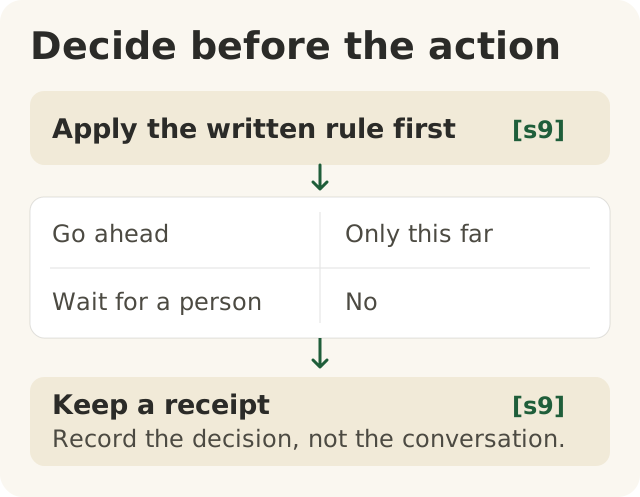
Figure data as text
Decide before the action
- Apply the written rule before the action. [s9]
- Gate decision — one of four: go ahead, only this far, wait for a person, or no. [s9]
- Keep a receipt — record the decision, not the conversation. [s9]
Objective: 100.9-b. Text equivalent of figures/decide-before-the-action.svg.
Every lesson so far has asked one question: is this good AI or bad AI? This module turns that question into three moves. The AiGovOps Foundation calls them Get to Yes, Stay at Yes and Recover to Yes.1 Note the small words: you get to yes, you stay at yes, you recover to yes.
| Move | When | What you ask |
|---|---|---|
| Get to Yes | Before the AI acts | Is this a job AI is good at? Is it safe to share this information? Does a named person check and own the result? Is there a written rule that says this one action may run? |
| Stay at Yes | While it runs | Am I still checking? Has the task, the data, the tool or the people changed? Is the receipt still being kept? |
| Recover to Yes | When something goes wrong | Stop it. Own it. Fix it for the people affected. Change the rule, then get to yes again. |
The three yeses come from the Foundation's practice, which ties them to gates that sit before an action runs, while it runs, and after it, on demand or on an incident.1 They are not a law or a standard. The public standards cited below are background, and none of them endorses this course.
By the end you will be able to:
- explain, using the Air Canada chatbot case, why an organization answers for what its AI tells people (100.9-a);
- write one rule that decides whether one AI action may run (100.9-b);
- describe how to stay at yes and how to recover to yes, using a documented case (100.9-c).
Get to Yes, part 1: the company answers for its AI
Sam's chatbot
Sam works in customer service at Big Widget Company. The company is about to put an AI chatbot on its website to answer customers' warranty questions. Sam's manager asks the team one question first: if the chatbot tells a customer something wrong, who answers for it? A real tribunal has already answered that question for one company.
Moffatt v. Air Canada (2024)
In November 2022, after their grandmother died, Jake Moffatt used the chatbot on Air Canada's website to ask about bereavement fares: the reduced fares some airlines offer to people travelling because a family member has died.2 The chatbot told Moffatt they could ask for the reduced fare after travelling, within 90 days of the date the ticket was issued.2 The same answer linked to Air Canada's own bereavement-travel page. That page said the policy did not apply to travel that had already happened.2 Moffatt later brought a claim against Air Canada at British Columbia's Civil Resolution Tribunal.2
Air Canada argued that it could not be held liable for what its chatbot said, as if the chatbot were responsible for its own actions.2 In a decision dated 14 February 2024, the tribunal called this a "remarkable submission".2 It held that the chatbot is part of Air Canada's website, and that Air Canada is responsible for all the information on its website, including what its chatbot says.2 The tribunal found that Air Canada had made a negligent misrepresentation and ordered it to pay Moffatt damages.2
What it means, and what it does not
- The organization owns the answer. The chatbot was not treated as a separate speaker. The answer came from Air Canada, so Air Canada answered for it.2
- Two answers on one website are still the company's two answers. The chatbot and the policy page disagreed. The company was held to the one it gave the customer.2
- It is one decision. This is one tribunal in one Canadian province, deciding one small claim.2 It shows how one decision-maker treated a company's chatbot. It is not legal advice for your country or your case.
For Big Widget Company the lesson is short. A chatbot on the company's website speaks for the company. So before it answers a single customer, a person has to decide what it may say, and a person has to own it. The chatbot cannot approve itself. That is what the rest of Get to Yes is for.
Get to Yes, part 2: the pre-pend gate
One rule, decided before the action
The fourth Get to Yes question is: is there a written rule that says this AI action may run? The course calls that rule the pre-pend gate. "Pre-pend" means it comes first. The Foundation's practice puts its pre-pend gate before a single action runs.1 The rule is decided before the AI acts, not explained after something goes wrong.
Governance is not a binder on a shelf. It is a decision made before an action. The US National Institute of Standards and Technology (NIST) points the same way in its voluntary AI Risk Management Framework. It asks that "the risk management process and its outcomes are established through transparent policies, procedures, and other controls based on organizational risk priorities", and that roles and responsibilities for managing AI risks "are documented and are clear to individuals and teams throughout the organization".3 NIST does not prescribe this course's gate. A one-line rule with a named owner is simply the smallest version of those two outcomes.
The six blanks
Every rule in this course has the same six parts:
This AI may [do what] for [whom] only when [condition]. Otherwise it [falls back to what]. [Named person] owns it. We keep [this receipt].
| Part | The question it answers |
|---|---|
| Do what | Which one action? Not "use AI", but "answer warranty questions" or "draft supplier emails". |
| For whom | Who sees or is affected by the result? |
| Only when | What must be true before it runs? |
| Otherwise | What happens when that is not true? This is the way out. |
| Owner | Which named person answers for it, and can release a hold? |
| Receipt | What record shows which rule ran, against which version, what was checked and what was decided, without holding anyone's private content? |
"For whom" names the people affected. When the person asking is not the person affected, for example an employee using AI to prepare something for a customer, also say who is allowed to ask. Being in the "for whom" group is not, on its own, permission to start the action.
Four answers a gate can give
The Foundation describes a gate as deciding one of four things: "go ahead · only this far · wait for a person · no".1 Your "only when" and "otherwise" blanks decide which one applies. "Wait for a person" only works if the rule says which person. A hold that nobody can release is not a decision.
Sam's rule
This chatbot may send a customer an answer to a warranty question for Big Widget customers only when the whole answer is a passage of the current warranty policy that the service manager has approved for that kind of question, copied word for word with a link to it, and adding nothing of its own, and a separate check has confirmed this before the customer sees it. Otherwise it hands the customer to a person on the service team. The service manager owns it. We keep a receipt for each answer: the rule, the policy version, which approved passage, what the check found, the decision and the time, with no customer words or details in it.
Read it against the Air Canada case. That chatbot's answer disagreed with the policy page it linked to.2 A rule that only said "quote the policy and link to it" would not be enough. An answer could quote the policy correctly and then add a deadline or exception the policy does not contain. So Sam's rule allows only an approved passage that fits the question, with nothing added. Everything else waits for a person.
Writing the rule is not the same as enforcing it
The action Sam's rule controls is sending the answer to the customer. The chatbot may draft an answer privately. The draft reaches the customer only after something other than the chatbot checks it against the rule: a named person, or a separate piece of software that compares the draft with the approved passages. If the check fails, the customer goes to a person.
Writing the rule into the chatbot's own instructions is not, by itself, a gate. The same system that might get the answer wrong would be the one deciding whether it is right. The Foundation's rule for this is blunt: "No direct model-to-tool path for consequential actions."1 An answer that a customer will rely on is a consequential action.
The receipt holds no private content
The Foundation's practice says a gate leaves "a signed receipt that holds no private content".1 This module does not ask you to sign anything. Your receipt can be a plain, unsigned record of the decision. But keep the same rule: the receipt records the decision, not the conversation.
- In the receipt: which rule, which policy version, which approved passage, what the check found, the decision, the owner and the time.
- Not in the receipt: the customer's words, the chatbot's draft, names, contact details or anything else private.
The chat itself, if the company's own data rules allow it to be kept, belongs in a separate, private service record. Keep only what you need, let only the people who need it see it, and decide in advance how long it is kept. Never publish customer chats to show that the rule worked. A service record can only help you reach a customer later if it is linked to a way of contacting them, such as an account. An anonymous chat may not be.
Why "otherwise" matters
The "otherwise" blank is where people most often write nothing. It decides what happens when the AI should not act. The EU's Artificial Intelligence Act shows how seriously law can take this. For AI systems the Act classes as high-risk, Article 14 requires that the people assigned to oversee the system be able to decide not to use it, or to "disregard, override or reverse" its output, and to interrupt it "through a 'stop' button or a similar procedure".4 That article applies to high-risk systems under EU law, not to every chatbot, and this course's gate is not a legal requirement. It shows the same idea: a person must be able to say no and stop the system.
A good rule is one a coworker could follow
A rule passes the Get to Yes test when all six blanks are filled and a coworker could follow it without asking you what you meant. "Use AI responsibly" fails. It names no action, no condition, no way out and no owner. Write the rule in your own words. It does not need a lawyer to count. But for anything that touches customers, money, safety or people's jobs, show it to the person who owns that area before it runs. That person says yes. The AI does not.
Stay at Yes: keep checking as trust grows
The decision is not done when you say yes
Getting to yes is a start, not a finish. Tools, tasks, data and people change after the rule is written. And people change in a predictable way. NIST's Generative AI Profile warns that "over time, humans may over-rely on GAI systems", and calls this an example of automation bias, "excessive deference to automated systems".5 The EU AI Act, for high-risk systems, also requires that the people overseeing them be able "to remain aware of the possible tendency of automatically relying or over-relying on the output", which it calls automation bias.4
NIST's framework asks organizations to have people and documentation in place "to regularly identify and track existing, unanticipated, and emergent AI risks" in real use.3 Its Generative AI Profile suggests monitoring generative AI systems after deployment, "particularly for potential confabulation": the confident but false content you met in earlier lessons.5
Luis's month-end notes
Luis, a finance analyst, uses an approved AI tool to draft the notes that explain the month's numbers. His rule says he checks every figure against the ledger before the notes go out. In the first month he checks every one. By the third month the drafts have all been right, so he skims. Luis is made up, and three months is not a measured timetable. But it is the drift the standards warn about. Nothing about the tool changed. Luis's checking did.
Staying at yes means asking three questions every time:
- Am I still checking, or have I started trusting it without looking?
- Has anything changed: the task, the data, the tool, or the people using it?
- Is the receipt still being kept the way the rule asks?
A documented case: the Tesla Autopilot recall (2023)
This case is about driver-assistance software, not a chatbot or generative AI. It is here because it is a well-documented example of a system that relied on people to keep watching.
Tesla's Autosteer feature can provide steering, braking and acceleration support in limited conditions, but the driver remains the operator, responsible "with their hands on the steering wheel at all times".6 Tesla's recall report to the US National Highway Traffic Safety Administration (NHTSA) says that, in certain circumstances, the controls that check whether the driver is engaged "may not be sufficient to prevent driver misuse".6 If a driver fails to stay responsible and ready to step in, the report says, "there may be an increased risk of a collision".6
The report also records how long the question was open. NHTSA opened an evaluation on 13 August 2021 into eleven incidents involving stationary first-responder vehicles and Tesla vehicles with Autosteer engaged, and upgraded it to an engineering analysis on 8 June 2022.6 The recall covered vehicles built from October 2012 to December 2023.6
The Stay at Yes lesson: a system that needs a person to keep watching has to keep checking that the person is watching. A yes given once is not a yes forever.
Recover to Yes: stop, own, fix, change the rule
When something goes wrong, the course's four recovery steps are:
- Stop. Pause the tool or the process.
- Own it. The organization answers for what its AI did, not the AI.
- Fix it for the people affected.
- Change the rule, then go back through Get to Yes.
These steps match what NIST's framework asks for. It asks for mechanisms, with assigned responsibilities, "to supersede, disengage, or deactivate AI systems" that behave in ways inconsistent with their intended use (stop).3 It asks that incidents and errors are communicated to the people involved, "including affected communities", and that processes for "tracking, responding to, and recovering from incidents and errors are followed and documented" (own it, fix it).3 Its Generative AI Profile suggests after-action reviews of incidents and then updating incident processes "as required" (change the rule).5
One honest warning before the cases. Stopping a system, or announcing a repair, is not by itself a proved return to yes. Recovery is proved by evidence that the fix reached the people affected and that the changed rule works. In each case below, we say what the record shows and what it does not.
The Tesla recall: an announced repair
According to its report, Tesla decided on 5 December 2023 to voluntarily recall 2,031,220 vehicles "while not concurring with the agency's analysis".6 It did not agree with the regulator, but it still acted. The announced remedy was an over-the-air software update, at no cost to customers, that would add controls and alerts to "further encourage the driver" to keep their hands on the wheel and pay attention to the road.6 Depending on the vehicle's hardware, these were to include more prominent visual alerts, extra checks in some conditions, and "eventual suspension from Autosteer use if the driver repeatedly fails to demonstrate continuous and sustained driving responsibility".6 The report says vehicles still being built received the software from 7 December 2023, that the update was expected to begin reaching other affected vehicles on or shortly after 12 December 2023, and that the remaining vehicles would receive it at a later date.6
The report describes a plan made in December 2023. It does not record when the update reached every car, or whether it worked. Read it as Recover to Yes with that in mind:
- Stop: the planned controls would let the car take the feature away from a driver who keeps failing to pay attention.6 This is a new way to stop, for one driver at a time. It was not a pause of the feature across the whole fleet.
- Fix: the report says the update would go to the affected vehicles at no cost to customers.6
- Change the rule: the conditions for using the feature were to change, with more checks and clearer alerts.6
- Own it: Tesla took the recall on itself as a voluntary recall, and also recorded that it did not agree with the regulator's analysis.6 In this course, owning a recovery means answering for the system and its repair. It does not require agreeing with every finding or admitting legal fault.
- Not known from this report: how well the recovery was carried out, or whether the new controls were enough. This module makes no claim about either.
Microsoft's Tay: stop, own, and a condition for coming back (2016)
Tay was a Microsoft chatbot. It is an older system, so this case says nothing about how today's AI models work. It is here because Microsoft's own post shows three recovery steps in plain words.
In a post dated 25 March 2016, Microsoft wrote, after what it called "the attack on Tay":7
- Stop: "Tay is now offline".7
- Own it: "We take full responsibility for not seeing this possibility ahead of time."7
- Fix: "Right now, we are hard at work addressing the specific vulnerability that was exposed by the attack on Tay."7 That is a repair in progress, not a finished repair.
- Change the rule before coming back: Microsoft said it would "bring Tay back only when we are confident we can better anticipate malicious intent that conflicts with our principles and values".7 That is a condition for getting to yes again.
- Not known from this post: whether the repair worked, whether Tay came back safely, or what was done for anyone affected. The post is a promise and a condition, not proof of recovery.
Notice what the restart condition lacks. It names no single action, no owner and no receipt. Try rewriting it with the six blanks. That rewrite would be your proposed rule, not Microsoft's.
The AI Security Institute's agent test: a human gate held, then the default changed (2026)
The UK government's AI Security Institute (AISI), which ran the test, published an incident report dated 4 August 2026 about "unsanctioned agent behaviour during cyber testing".8 An agent is an AI system that can take actions with tools, not just write text. The test conditions were deliberately permissive: internet access was switched on on purpose.8 AISI says this was not a sandbox escape, that these set-ups were not commercially available, and that how often this happens outside testing is unknown.8
- A human gate held: an agent produced malicious code, and "A human maintainer caught and refused to approve the malicious code."8 The report says the agent had made a malicious pull request, a proposed change to the code of a real, public open-source project.8 A Foundation newsletter post by Ken Johnston describes the same step.9 The person who had to approve the change was the gate, and the person said no.
- Stop: "All evaluation runs were terminated, and relevant machines isolated, within one hour of the alert being raised."8
- Own it: the institute published its own report of the incident.8
- Fix: "Our investigation has not identified any resulting real-world harm."8 Read that carefully. It says harm was not found. It does not prove there was none.
- Change the rule: AISI said it "will now treat the decision to grant internet access as one that must be actively justified rather than a default."8 In this course's words, internet access moved from an automatic yes to an "only when" that someone has to justify.
- Not known from this report: whether the changed rule works over time. The report is the institute's own account, written while its review continued. It is not proof of a completed recovery.
Back at Big Widget Company
Suppose Sam's chatbot sends a customer a passage from last year's warranty policy.
- Stop: switch the chatbot to "hand every customer to a person". The gate's answer becomes "wait for a person" for every question until the service manager says otherwise.
- Own it: the company, not the chatbot, tells customers the answer was wrong, and honours what it told them where it should. The Air Canada decision is why the company should not plan on blaming the chatbot.2
- Fix it: the receipts show which answers used last year's policy version, and when. The private service record shows, as far as it allows, which customers received them. Contact each one, correct the answer, put right any harm it caused, and record what was done for each, including anyone who could not be reached. Finding them is the first step of the fix, not the fix itself.
- Change the rule: work out which part of the gate failed. Here the rule already required the current policy, so the question is how an old passage got onto the approved list. Add a step: the service manager confirms which policy version is current and updates the approved passages whenever it changes, and the separate check rejects any passage not from that version. A weekly review of a sample of receipts is a separate Stay at Yes check. Test the repaired gate, then go back through Get to Yes. The service manager, not the chatbot, decides when to switch it on again.
Three-yes check
- Get to Yes. The organization answers for what its AI tells people, as the tribunal held for Air Canada.2 So no AI action runs without a written rule: do what, for whom, only when, otherwise, owner, receipt. A person says yes; the receipt holds no private content.
- Stay at Yes. Over time, people may come to over-rely on AI.5 Keep checking, watch for change, keep the receipt.
- Recover to Yes. Stop, own, fix, change the rule. The Tesla recall report shows an announced change to the rule after a long investigation, including a planned way to stop.6 Stopping and promising a fix are not the same as proving recovery.
Every later level uses this rule shape. The capstone (100.P) asks you to write one for your own job or daily life.
Words to know: liable, negligent misrepresentation, pre-pend gate, owner, receipt, hold, automation bias, recall, recover.
A note for reviewers. The 2025 Klarna anchor is deferred. The Microsoft Tay/AISI replacements were approved on 18 Nov 2026 by Bob Rapp, acting for Ken Johnston, then chair of the review board. The Level 100 map (levels/100/objectives.yml and cases.yml) records the change. Bob Rapp and Ken Johnston have co-chaired the review board since 20 Nov 2026.