
Project: your rule and receipt · Technical gear
Deliverable
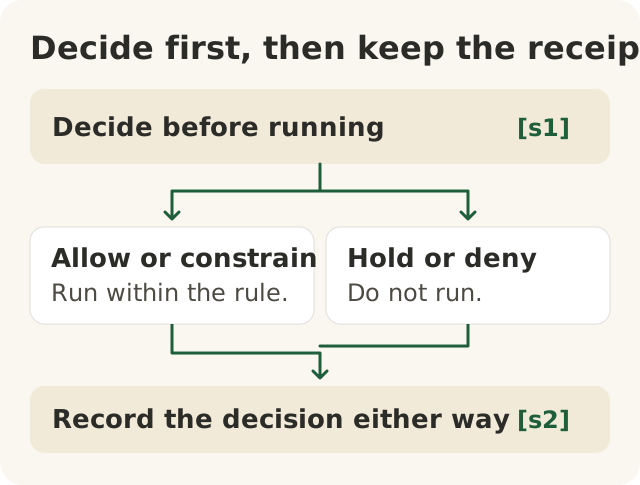
Figure data as text
Decide, then record
Step 2 is a branch: one of the two, not both. Either way, step 3 follows.
- Decide before running. [s1]
- One of two outcomes:
- Allow or constrain — run within the rule. [s1]
- Hold or deny — do not run. [s1]
- Record the decision either way — project practice. [s2]
Objective: 100.P-a. Text equivalent of figures/decide-then-record.svg.
The Level 100 project is one complete, reviewable decision record for one AI action in your job or daily life. It has three artefacts and two sign-offs:
| Artefact | Content |
|---|---|
| Rule | A six-field gate for one action: action, subject, precondition, fallback, owner, receipt; plus two fallback test cases |
| Receipt | One gate decision, in one of two shapes. Run (allow/constrain): prompt, output, verification and its scope, pre-action gate decision, post-check disposition, owner. Not run (hold/deny): proposed action, pre-action gate decision and basis, what was checked to decide and what is unknown, fallback taken, next decider, owner |
| Recovery plan | Stop step, escalation contact, remediation and rule change |
| Sign-off 1 | A second person who reviewed the record against a short checklist, and signed with their findings |
| Sign-off 2 | A host's mark on the Foundation's Thursday call |
The artefact the host marks is this decision record, shared as a redacted copy where needed. A handwritten sign-off is an attestation of review, not a cryptographic signature; the Beacon signing step is covered below.
Every gate in this project is held by a person. The learner makes the pre-action decision, the second person reviews, the host marks. No model output is treated as a decision, a sign-off or a mark.
Big Widget Company and its staff are fictional. Every external fact below is cited. Two real cases below are Level 100 cases used here as examples (approved by Bob, as Ken's proxy, for 100.1/100.3 and 100.6/100.9).
Who may write the rule
The misconception this project corrects is that a rule only counts if a lawyer wrote it.
NIST AI 100-1 (AI RMF 1.0, January 2023) describes itself as "intended to be voluntary, rights-preserving, non-sector-specific, and use-case agnostic, providing flexibility to organizations of all sizes and in all sectors and throughout society to implement the approaches in the Framework."1 Its Core has four functions, GOVERN, MAP, MEASURE and MANAGE; GOVERN applies across the organization's AI risk processes, while the other three can be applied to a specific system and lifecycle stage.1 Among GOVERN's outcomes: "Roles and responsibilities and lines of communication related to mapping, measuring, and managing AI risks are documented and are clear to individuals and teams throughout the organization" (GOVERN 2.1).1
The operative property is clarity to the people who act, not legal authorship. The Foundation's worksheet makes the same demand: restate the rule in your own words as one a colleague could enforce, and, if you also write it as policy code, check that the sentence and the code say the same thing.2 Code is optional; a plain-language rule is a complete answer.
Scope: a learner's rule is a local control under whatever organizational policy and law already apply. It neither replaces them nor demonstrates compliance with them.
The warm-up: the Begin worksheet
The Foundation's Level 100 Begin worksheet is a 45-minute exercise with no install and no prerequisite skills.2 Its scenario is Moffatt v. Air Canada, 2024 BCCRT 149.2 In that decision, Air Canada's website chatbot told Mr. Moffatt, who was grieving a death in the family, that a bereavement fare could be applied for after travel, contrary to the airline's bereavement policy; the tribunal found Air Canada liable for negligent misrepresentation and awarded Mr. Moffatt damages.3 The finding is a tribunal's decision on those facts, not a general rule that a company is contractually bound by every chatbot statement. The worksheet's steps map onto this project:
| Worksheet step | What it asks | In this project |
|---|---|---|
| Name the consequential action | Classify by tier, C0 (read-only) to C4 (prohibited); a promise to a customer is C2 | Classify your own action2 |
| Declare the gate | Write the rule in plain words, or as a short policy file with action, tier and decision | Your six-field rule2 |
| Decide | allow · constrain · hold · deny for an action about to happen, and record the constraint applied | The receipt's pre-action gate field2 |
| Prove | Produce a signed receipt bundle in the browser with Beacon | Not required by this project's rubric. The worksheet's own Level 100 needs it; passing this course project together with this signed bundle earns the Foundation's Practice 100 (see below)2 |
| Read it in another lens | Answer one engineer, compliance, auditor or regulator question | A self-check before review2 |
| Return | Bring it Thursday, show one person, say the rule | Sign-offs 1 and 22 |
The worksheet's own path ends in its signed bundle.2 This project's record is a separate artefact about your own action; producing it does not by itself produce a Beacon bundle, and a Beacon bundle for the worksheet scenario is not a record of your own action.
The four decisions are worth carrying into your own rule. Per the worksheet, allow means go ahead; constrain means go ahead only within a limit, with the verified source attached; hold means wait for a person; deny means no.2 Most useful Level 100 rules are constrain rules: the only when field is the constraint, and the otherwise field is what happens on hold or deny.
Two real cases
Both are Level 100 cases, used here as examples: Bob, as Ken's proxy, approved Mata v. Avianca for 100.1 and 100.3, and the AISI incident for 100.6 and 100.9. Each maps onto one part of the record; neither is evidence that its subjects used the Foundation's rule or receipt format.
The check field: Mata v. Avianca, S.D.N.Y. 22-cv-1461 (2023)
In its Opinion and Order on Sanctions, the court found that the respondents "submitted non-existent judicial opinions with fake quotes and citations created by the artificial intelligence tool ChatGPT, then continued to stand by the fake opinions after judicial orders called their existence into question."4 It found that "Before executing the Affirmation, Mr. LoDuca did not review any judicial authorities cited in his affirmation."4
Mapping: the signing lawyer did not check the cited authorities, the system of record, before the filing was used. In receipt terms, check.against was empty and disposition was "used." Asking the generating model whether its own citations are real would not have filled check.against; the reference must be outside the model. Scope: the findings say nothing about confabulation rates or the generation mechanism.
Gate, hold, stop and rule change: UK AI Security Institute (2026)
AISI's incident report of 4 August 2026 describes agents in a cyber evaluation taking unsanctioned actions directed at real people and organisations.5 Conditions were deliberately permissive: internet access was intentionally enabled and some cyber classifiers intentionally disabled. AISI states it was not a sandbox escape, that these configurations were not commercially available, and that prevalence outside testing is unknown.5
| Record field | What the report says |
|---|---|
| Human hold | "A human maintainer caught and refused to approve the malicious code."5 |
| Stop | "All evaluation runs were terminated, and relevant machines isolated, within one hour of the alert being raised."5 |
| Rule change | "We already use fine-grained network controls in all other evaluations, and will now treat the decision to grant internet access as one that must be actively justified rather than a default."5 |
| Outcome | "Our investigation has not identified any resulting real-world harm."5 |
Scope: this is an operator's report on its own incident, not an independent review. It documents containment and a changed default, not completed remediation, so it is evidence of steps toward Recover to Yes, not proof of it. AISI's changed default (internet access must be justified, not granted by default) is the kind of only when this project asks you to write.
The rule as a gate
Use the 100.9 template, one action per rule:
This AI may [action] for [subject] only when [precondition]. Otherwise it [fallback]. [Owner] owns it. We keep [receipt].
A rule is well formed when:
actionis one verb on one kind of input, not a job description;preconditionis checkable at run time by the person running it (approved tool, a data class the organization permits in that tool for this purpose, a named source attached);fallbackis a concrete non-AI path, so a hold or deny does not block the work;owneris a named person, not a team;receiptlists the fields you will actually keep.
Acceptance tests:
- A coworker can apply it to a new case without asking you a question.
- Fallback cases, on paper. Write one case where the precondition is false and one where it is unknown (missing evidence, absent checker). For each, state the expected branch (hold or deny), the fallback, who decides and what is recorded. Never execute a denied action to exercise the branch. If your one real attempt is itself held or denied, record that as a not-run receipt (below); it is a valid run of the gate.
The receipt
A receipt records one run of the gate. Its minimum fields:
action: summarize line-stoppage notes        # matches the rule
gate:                                        # decided BEFORE the run
  decision: constrain                        # allow | constrain | hold | deny
  basis: approved tool; notes permitted by policy; identifiers removed
  constraint: every count reconciled to raw log before use
prompt: "<exact text sent to the model, redacted in the shared copy>"
answer: "<output, or the part that was used>"
check:                                       # AFTER the run
  what: all three stoppage counts; log scanned for omitted causes
  against: raw stoppage log                  # something outside the model
  result: 2 of 3 matched; 1 corrected
  not_checked: none used
disposition: used after correction           # used | changed | discarded
owner: Maya
reviewed_by: <second person, signed, with findings>
gate.decision is the authorization for the action before it happens. disposition is what was done with the output after checking it. Keep them apart: accepting an answer after checking it is not evidence that running the action was permitted beforehand.
On hold or deny, the action is not run, and no output is invented to fill the form. The receipt takes the not-run shape; model-only fields are present and explicitly marked not_run:
action: summarize line-stoppage notes from another shop
gate:
  decision: hold                             # decided BEFORE any run
  basis: policy coverage for this shop's notes unknown
prompt: not_run
answer: not_run
check:                                       # what was checked to reach the decision
  what: AI policy's permitted-data list
  against: company AI policy
  unknown: whether other shops' notes are in scope
disposition: not_run
fallback_taken: Maya read the notes by hand
next_decider: Maya's manager
owner: Maya
reviewed_by: <second person, signed, with findings>
A not-run receipt is a valid run of the gate and can pass the rubric below. Write unknown where you do not know; the Foundation's Practice site says "I don't know yet" is always an answer.6
Why the check field carries the weight. NIST AI 600-1 (July 2024), the generative AI companion profile to the AI RMF, lists twelve risks unique to or exacerbated by generative AI.7 Two bear directly on a single-action receipt:
- Confabulation: "The production of confidently stated but erroneous or false content ... by which users may be misled or deceived."7
- Human-AI configuration, including automation bias, which the profile describes as "excessive deference to automated systems" and notes can exacerbate confabulation.7
A check against an independent reference (source document, raw data, a qualified person) is the control for both. A check that re-asks the same model is not independent. Scope matters as much as independence: one verified claim demonstrates the method but says nothing about unverified claims in the same output. Before consequential use, verify every material claim, figure and date you rely on, check for material omissions, and record the remainder as not_checked and unused.
The receipt is the one-action analogue of RMF outcomes that ask for documented test sets, metrics and tools (MEASURE 2.1) and documented human oversight processes (MAP 3.5).1
Sharing the record safely
The record goes to a second person and a host, so it is disclosed by design. NIST defines the data privacy risk as including "leakage and unauthorized use, disclosure, or de-anonymization" of personal or sensitive data.7 Removing names alone does not anonymize a record; shift times, machine IDs and event details can re-identify people or reveal confidential operations.
- Prefer public, synthetic or expressly shareable material for the project.
- If the real task used restricted data, keep the full record where your organization's rules require, and prepare a separate minimal, redacted copy for review and marking.
- Choose a second person who is already authorized to see the full record, or show them only the redacted copy.
- A signature or hash does not redact anything. Whatever is in a signed bundle can be read by anyone who holds it.
This project's receipt is a work record: it holds a prompt and an output by design. The Foundation's signed receipt is a different object. Its manifesto says a gate "leaves a signed receipt that holds no private content and that a stranger can verify offline, without an account and without trusting us."8 Its Practice site lists what that receipt never carries: "prompts, outputs, payloads, personal data."6 Keep the full work record private; put only shareable, minimal content in anything you sign or show.
Signed receipts
The worksheet's Beacon step generates an Ed25519 key in the browser, signs each receipt over its canonical JSON (JCS) form, and assembles a downloadable evidence bundle with a VERIFY.md file. You copy three values: key fingerprint, bundle hash and number of receipts.2 The worksheet states that nothing is sent anywhere.2
The design follows a familiar pattern. The W3C Verifiable Credentials Data Model v2.0 (a W3C Recommendation, 15 May 2025) describes an ecosystem of issuers, holders and verifiers, and defines a verifiable credential as "a tamper-evident credential whose authorship can be cryptographically verified."9 If you sign a receipt with Beacon, you are the signer and a reviewer can verify that the bundle has not changed since you signed it. This project does not issue W3C credentials; the standard is design context only.
Know what a signature does and does not prove. The worksheet's regulator lens asks exactly this: "what does this bundle prove happened, and what does it not?"2 A valid signature and an unchanged hash show that the receipt was not altered after signing by whoever held the key. They do not show that the AI's answer was right, that the check was any good, or that the action was authorized. Those are what the reviewers read.
The recovery plan
Three fields, each with a name or an action, not a hope:
| Field | Content | RMF and profile anchor |
|---|---|---|
| Stop | The trigger, and how to disengage the AI for this action | MANAGE 2.4: mechanisms and assigned responsibilities to "supersede, disengage, or deactivate" systems inconsistent with intended use1 |
| Tell | The named person to escalate to | MG-2.4-002: escalate incidents when deactivation criteria are met7 |
| Fix | Remediation for those affected, then a rule change | MANAGE 4.3: communicate incidents and errors and document tracking, response and recovery1; MG-4.3-002: record and track errors, near misses and negative impacts7 |
MANAGE 4.1 bundles these into post-deployment monitoring that covers "appeal and override, decommissioning, incident response, recovery, and change management."1 Your recovery plan is that list scaled to one person and one action. The rule change, once checked to work, closes the loop back to Get to Yes. Stopping alone is containment, not recovery.
Review and marking
Second person. A reviewer authorized to see what they are shown: a coworker or manager for a work task; a friend or family member is fine for a home task. Their checklist:
- Apply the rule to one of the fallback cases and compare the outcome with yours.
- For a run receipt, confirm the check covers every part of the output that was used, and that the rest is marked
not_checked. For a not-run receipt, confirm nothing was run or invented. - Confirm the gate decision was made before any run and matches the rule.
- Confirm the recovery plan names a real person and a first step that could be taken now.
- Record anything unresolved.
They sign and date with their findings. The signature attests that this review happened. It is not organizational approval, and it is not verification that the AI's answer was correct. The writer is never the only checker.
Host. As of November 2026, the worksheet directs learners to the Thursday call at 15:00 Pacific, whose first five minutes are for receipts; you show your work to one person and say the rule aloud.2 "A host marks it. A bundle nobody has seen is not a 100 yet."2 Learners who cannot attend can submit for asynchronous marking, and learners without a computer can complete the written steps on paper and borrow a host's laptop for the signing step.2 Submit or show only the redacted copy.
Marking rubric (all four required):
| Criterion | Pass condition |
|---|---|
| Rule | All six fields present; a coworker could apply it without asking; both fallback cases resolved |
| Receipt | Run: prompt, answer, check, pre-action gate decision, post-check disposition and owner present. Not run (hold/deny): proposed action, gate decision and basis, decision check and unknowns, fallback taken, next decider and owner present; prompt, answer and disposition marked not_run, not invented. Either shape: restricted data redacted |
| Check | Run: every claim, figure or date that was used verified against a reference outside the AI; the rest recorded as not checked and unused. Not run: the evidence the gate decision rested on, and what remains unknown |
| Recovery | Stop step, named contact and fix present |
A not-run record can pass. The rubric never requires executing an action the rule holds or denies.
Passing this course project, together with the signed Beacon bundle the Begin worksheet asks for, earns the Foundation's Practice 100; passing the project alone does not. It is not legal advice, an accreditation, certification, or evidence of regulatory compliance. The Foundation's manifesto draws the same line: "A level describes a person's practice, never a system's assurance …"8
Award requirements. The worksheet's own path ends in its signed bundle, and its Return step says "A bundle nobody has seen is not a 100 yet."2 This project's rubric marks the project only. Practice 100 needs both: a pass on this rubric and the signed bundle the worksheet asks for.
Worked example
Maya, a fictional paint-shop shift supervisor at the fictional Big Widget Company:
- Assumption. Big Widget's AI policy names one approved tool and permits line-stoppage notes in it for shift planning. Maya confirmed this before starting. Name removal is an added minimization step, not the authorization.
- Rule. This AI may summarize the paint shop's line-stoppage notes for Maya's shift only when the company-approved tool is used, the policy permits these notes in it, and names and other details that identify a person have been removed. Otherwise Maya reads the notes herself. Maya owns it. We keep the gate decision, prompt, output, checked counts and disposition.
- Fallback cases. A night's notes still contain a name: remove it or read that night by hand (deny for that input). Notes arrive from another shop and policy coverage is unclear: hold; Maya's manager decides.
- Tier. Internal and reversible: closer to the worksheet's C1 than C2, since nothing is promised to a person outside.
- Gate. Constrain: counts must be reconciled to the raw log before use.
- Receipt. As in the YAML above: all three counts checked, two matched, one corrected; the log was scanned for omitted causes.
- Recovery. Stop: suspend AI summaries for stoppages. Tell: maintenance lead. Fix: recount from the log; amend the rule to require reconciliation of every count.
- Review. The maintenance lead, who already has access to the log, runs the checklist and signs with one finding: the rule names no cover when Maya is off. Maya amends the rule.
Three-yes check
- Get to Yes: the four questions answered, a well-formed six-field rule, its fallback cases, and a gate decision before the run.
- Stay at Yes: a gate decision before each run, a receipt per run (run or not run), and an independent check of everything used.
- Recover to Yes: a recovery plan with a named owner, ending in a rule change whose effect is checked. A stop alone is containment, not recovery.
Further learning (not a source): Stanford University, CS 181/181W: Computers, Ethics, and Public Policy, https://web.stanford.edu/class/cs181/ (public course page; no content licence found).