
AI in your job (role tracks) · Plain gear
Reviewed and published, version 1.0.0. As of 16 November 2026. Big Widget Company and the people in it are made up. The real cases are real, and each one is cited. If we have not been able to check a source yet, we say "not checked".
What this part is for
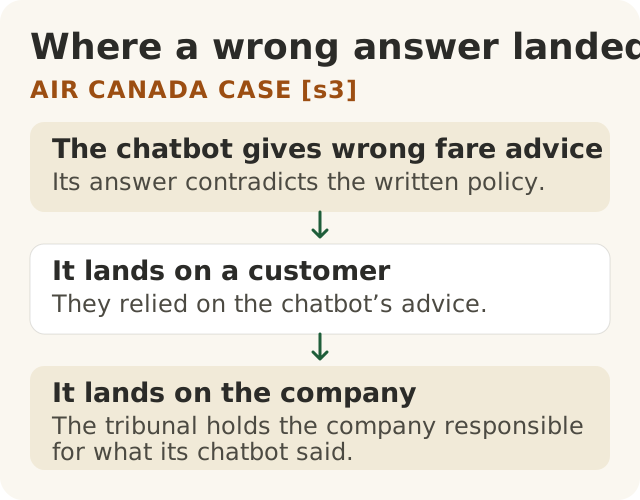
Figure data as text
Where it landed
- The Air Canada chatbot gives fare advice that contradicts the written policy. [s3]
- A customer relies on the chatbot’s advice. [s3]
- The tribunal holds the company responsible for what its chatbot said. [s3]
Objective: 100.R-b. Text equivalent of figures/where-it-landed.svg.
You have learned how AI works, where it breaks, and the three yeses:
- Get to Yes. Before the AI does anything, decide what it may do, how far it may go, and who answers for it.
- Stay at Yes. While you use it, keep checking that it still does only that.
- Recover to Yes. When something goes wrong, stop it, say who owns it, fix it, and change the rule. Show the proof before you say it is fixed.
Now you use all of that in your own job.
Big Widget Company has seventeen tracks. There is one for each team, one for leaders, and one for home and everyday life. Pick the track for your own team. If you only use AI at home, pick the home track. Then pick one more track from a different team. You will see why at the end.
When you finish, you can do two things:
- Name one good use of AI for your team or your home, one bad use, and the question that tells them apart.
- Explain how someone else's AI mistake could land on you.
Some people think AI rules are only for the IT team. Some people think another company's AI is not their problem. The real stories below show that both ideas are wrong.
One good use, one bad use, one question
Every track has three parts.
- A good use. AI does a job it is good at. It only sees safe information. A named person checks the work and owns the result.
- A bad use. AI does a job it is bad at. Or it sees secrets. Or nobody checks. Or it is used to fool people.
- The get-to-yes question. One question you ask before you start. It points at the check most likely to go wrong in this job.
A yes to that question is needed, but it is not enough on its own. All four checks from lesson 100.9 still have to pass:
- The job fits the tool.
- The information is safe to use.
- A named person owns the result.
- A written rule allows it.
People answer these checks. The AI does not get to say yes to itself.
There are four possible answers: go ahead, only this far, wait for a person, or no. If any check gets a no, or "we don't know yet", the answer is wait for a person. Write down who that person is. If nobody decides, the answer is no.
Here is Sam. Sam works in customer service at Big Widget Company. An AI helper suggests replies, and Sam decides what to send. That is a good use. Now picture a chatbot that answers customers alone and makes up a rule. That is a bad use. It is the same kind of tool. The difference is a choice people made before it started.
Sam's question: "Does a person decide what the customer is told?"
Saying yes once is not the end. If the tool, the information or the people change, ask the question again. That is staying at yes.
Real stories behind the tracks
A helper that made new workers better
Researchers studied 5,179 customer support workers at one company while an AI helper was brought in, in stages. They compared work with the helper and work without it.1 With the helper, workers solved more problems each hour.1 New and less skilled workers gained the most. The most experienced workers barely changed.1 The researchers think the helper passed on the best workers' habits to the newer ones.1
So the same tool helped some people a lot and others hardly at all.1 That is why you test it on your own team instead of guessing.
A chatbot that got it wrong
Source checked 18 Nov 2026.
In November 2022, Mr. Moffatt's grandmother died. Mr. Moffatt asked the chatbot on Air Canada's website about cheaper fares for people travelling after a death in the family.2 The chatbot said they could ask for the lower price after the trip, within 90 days of the date their ticket was issued.2 But the airline's own web page said you could not ask after the trip.2
Air Canada said it should not have to answer for what its chatbot said.2 In February 2024, a tribunal in British Columbia, Canada, said no. The chatbot is part of the airline's website, and the airline is responsible for everything on its website.2 Air Canada had to pay Mr. Moffatt.2
The mistake landed first on a sad customer. Then it landed on the company.
A helper for factory engineers
In October 2024, Siemens said more than 100 companies were using its AI helper for engineers.3 Siemens said the helper can write machine code that "requires only 20% adaptation".3 That is Siemens' own claim about its own product, in its own press release.3 The press release does not say who checks the code.3
A good use: the helper writes a first draft, and a trained engineer checks and tests it. A bad use: the code goes onto a running machine and nobody checks it. The question: "Has a trained person checked it before it touches a machine?" Until someone has, the answer is wait for a person.
Hiring software that turned older people away
A US government agency, the EEOC, said a company called iTutorGroup set up its job application software to turn away women aged 55 or older and men aged 60 or older, automatically.4 More than 200 qualified people in the US were turned away because of their age.4 In 2023, the company agreed to pay $365,000 to settle the case.4
The EEOC says the software was programmed to do this.4 The EEOC does not say AI was involved. But the lesson is the same for any software that decides things about people. The question: "Has it been tested for fairness, and can a person look at every no?"
Fake reviews
In 2024, the US Federal Trade Commission (FTC) made a rule about reviews.5 It says a business must not write, create or sell a review that seriously misleads about any one of these: whether the reviewer is a real person, whether they really used or dealt with the product, service or business, or what happened to them.5 Breaking just one is enough.
The FTC says reviews made by AI are covered too.5 The rule is about whether a review is true, not about which tool wrote it. A review from a "customer" who never existed is fake whether a person or an AI wrote it. And a real customer's true review does not become fake just because AI helped tidy the words. Other rules may still apply, so check with your legal team.
The question for marketing: "Is every review and quote from a real customer, about what really happened to them, used with their permission?" (The permission part is this course's advice, not part of the FTC rule.)
People who stopped watching
This story is about cars, not chatbots. Tesla's Autopilot can help steer, brake and speed up, but the driver is still in charge, with hands on the wheel at all times.6 In December 2023, Tesla said the checks on whether drivers were paying attention might not be enough to stop misuse.6 It recalled about 2 million vehicles.6 Tesla did not agree with the US safety agency's view, but it did the recall anyway.6 The fix was to be a free software update with more warnings and checks.6
The report says what the fix was meant to do.6 It does not say the fix worked. A planned fix is not proof that things are back to safe.
The question for safety teams: "How does the system keep people paying attention?"
Find your track
These examples are made up for Big Widget Company. Each one is a good use, a bad use and a question.
| Track | Good use | Bad use | Ask before you start |
|---|---|---|---|
| Home and everyday life | Plan a trip, then check the facts with the company | Trust a chatbot about a refund without reading the real rules | Did I check this against the company's own written rules? |
| Manufacturing | Explain a machine fault from the manuals | An unchecked fix goes onto a running line | Has a trained person checked it before it touches a machine? |
| Quality | Sum up thousands of warranty comments to find patterns worth a look, while serious reports still reach a person the usual way | Treat the summary as complete and miss one rare, serious fault it left out | What did the AI leave out, and how do rare, serious reports still reach a person? |
| Engineering and design | First drafts of code and test plans | Ship code nobody checked or tested | Who checks it, and how do we know it saves time? |
| Supply chain and buying | An AI makes small deals inside firm limits | Paste supplier prices into a public chatbot | What may it offer, and what may it see? |
| Forecasting and planning | Forecasts for products with years of history, with a range | One sure-sounding number for a brand-new product | What did it learn from, and how sure is it? |
| Sales and dealers | Answers from approved price lists | A chatbot promises a price the company never offered | Can it only quote approved prices and terms? |
| Customer service | A helper suggests; the person decides | A bot makes up a rule, and nobody can reach a person | Can every customer reach a person? |
| Marketing | Campaign ideas people shape and approve | Fake or misleading "customer" reviews, whether a person or an AI wrote them | Is every review and quote from a real customer, true, and used with their permission? |
| Brand and communications | First drafts, fact-checked before they go out | A wrong fact goes public | Who checks facts and tone before it goes out? |
| Legal | Find clauses in contracts; a lawyer checks | Court papers with sources nobody opened | Has a lawyer read every source? |
| IT | Help fixing code, in a safe test area with backups | An AI that can delete real data | What can it change, and can we undo it? |
| Cybersecurity | Sort alerts and spot fake emails faster | An AI that obeys orders hidden in an outside email | What can it read, and what can it do after reading it? |
| Safety | Find patterns in near-miss reports | People trust the machine and stop watching | How does it keep people paying attention? |
| HR | Draft job posts; answer policy questions with a link | Software that turns people away unfairly | Was it tested for fairness, and can a person check every no? |
| Finance | Explain why numbers changed, with each number traced | Pay a request because it looks and sounds real | Is every number traced, and do we call back before any odd payment? |
| Leaders | Start with clear jobs and measure results | Try AI with no way to tell if it worked | How will we know it worked, and who owns it? |
Two rules run through every row. The AI never says yes to itself; a named person does. And anything the AI cannot undo, like a payment, a public post or a change to real data, waits for a person.
Some rows come from the stories above. Home, sales and legal come from the Air Canada story.2 Manufacturing and engineering come from the Siemens claims.3 Customer service and leaders come from the study of support workers, and from Air Canada.12 Marketing comes from the FTC's review rule.5 Safety comes from the Tesla recall.6 HR comes from iTutorGroup.4
The other rows rest on earlier lessons: 100.2 for forecasting, 100.4 for quality, 100.6 for buying and IT, and 100.7 for cybersecurity and finance. Brand rests on 100.1 and 100.3, about how AI can sound sure and still be wrong. Legal and brand also draw on 100.8, about checking the work.
How someone else's AI mistake lands on you
You do not have to use AI to be hurt by it. Look at the stories again.
- As a customer. Mr. Moffatt did not build Air Canada's chatbot. Mr. Moffatt still got the wrong answer, and had to go to a tribunal to be paid.2
- As a job seeker. The older people who applied to iTutorGroup did not choose its software. They were still turned away.4
- As a shopper. If a review is fake, you could buy something because of an experience that never happened. The FTC's rule says writing or selling reviews like that is unfair or deceptive.5 This one is a rule about what could happen, not a story about a real shopper.
- As a driver. Tesla owners did not design the attention checks. Their cars were still part of the recall.6
The same thing happens inside a company. Here are made-up examples at Big Widget Company:
- Marketing posts a fake review an AI wrote. Legal has to answer for it. Customer service gets the angry calls.
- IT lets an AI tool change real data. Finance finds the mess when it closes the books.
- The service chatbot promises something the company never offered. Like Air Canada, the company answers for it.2
That is why you pick a second track from another team. Ask: "If their AI goes wrong, where does it land, and who would I tell?"
Sometimes there is no way for it to reach you. Then say so, and say why. "I don't know yet" is an honest answer too. Just name who you will ask.
Your turn
- Pick one row from your track. Or write a new one for your team or your home.
- Write the good use, the bad use and the question, in your own words.
- Turn it into a rule, like in lesson 100.9: This AI may [do what] for [whom] only when [this is true]. Otherwise it [goes only this far, waits for a person, or stops]. [This person] owns it. We keep [this record].
- Everyone does this one. Pick one of the four stories in "How someone else's AI mistake lands on you". Pretend you are the customer, job seeker, shopper or driver. Explain how the mistake got to you: whose AI or software made it, what carried it to you, and who should be told. You are showing how it could happen. You are not saying it happened to you.
- Read one other team's track. Write one way their AI mistake could land on you, and who you would tell. If you honestly cannot find a way, say so and say why. Do not make one up.
What goes in the record. The record says what was decided, who owns it and when. It never holds what you typed into the AI, what the AI said back, or anyone's private details. If your workplace lets you keep notes on those, keep them somewhere separate that your workplace controls. Do not put them in anything you share.
Bring your rule to the final project, 100.P. A person checks it there, not an AI.
Words to know
- Track: the part of this lesson for your own team, or for home.
- Get-to-yes question: one question, asked before you start, that points at the check most likely to go wrong. A yes is needed, but the other checks from 100.9 must pass too.
- The four answers: go ahead, only this far, wait for a person, no.
- Owner: the person who answers for what the AI does.
- Record (receipt): a note of what was decided, by whom, and when. It holds no private details.
- Recall: when a company fixes a safety problem in something people already own.6