
AI in your job (role tracks) · Standard gear
Reviewed and published, version 1.0.0. As of 16 November 2026. Big Widget Company and its people are made up. Every real organization and case below is real and cited. Where the course's source checker has not yet opened a source, this gear says "not checked". The role tracks, the three yeses, the four gate answers and the get-to-yes questions are this course's own practice, not a law or a standard.
What this module does
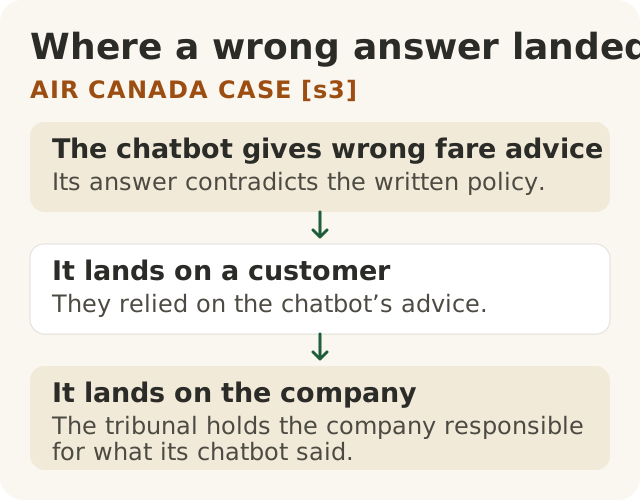
Figure data as text
Where it landed
- The Air Canada chatbot gives fare advice that contradicts the written policy. [s3]
- A customer relies on the chatbot’s advice. [s3]
- The tribunal holds the company responsible for what its chatbot said. [s3]
Objective: 100.R-b. Text equivalent of figures/where-it-landed.svg.
Modules 100.1 to 100.9 taught what generative AI is, why it works, where it breaks, and the three yeses:
- Get to Yes: before the AI acts, decide exactly what it may do, within what limits, and who answers for it.
- Stay at Yes: while it runs, keep checking that it still does only that.
- Recover to Yes: when it goes wrong, stop it, name the owner, fix it and change the rule. Show the evidence before you call it recovered.
This module puts those ideas into your own job.
Big Widget Company has seventeen tracks: one for home and everyday life, fifteen for its teams, and one for leaders. You take the track for your own team, or the home track if you use AI only at home. Then you take one other team's track, because AI mistakes often land in someone else's department.
By the end you will be able to:
- name one good use of AI for your team or household, one bad use, and the get-to-yes question that separates them (100.R-a);
- explain how an AI mistake made somewhere else, in another team or in a company you deal with, could land on you (100.R-b).
Two beliefs this module corrects:
- "AI rules are for the IT department, not my job." The cases below involve customer service, hiring, marketing, safety and legal work, and customers and job applicants. None of them was only an IT problem.
- "Someone else's AI is not my problem." In the three incidents below, the people affected were a customer, job applicants and vehicle owners. They did not build the system or design its safeguards.123
One good use, one bad use, one question
Every track has the same three parts.
| Part | What it is | Example (Big Widget Company, made up) |
|---|---|---|
| Good use | AI doing a job it is good at, with safe information, checked by a named person who owns the result | Sam in customer service gets a suggested reply and decides what to send |
| Bad use | The same tool on a job it is bad at, or with secrets it should not see, or with nobody checking, or used to fool people | A chatbot answers customers alone and makes up a policy |
| Get-to-yes question | The one question, asked before you start, that targets the check this job is most likely to fail | "Can it only quote our written policy, and can every customer reach a person?" |
The get-to-yes question is a focused check, not a permission slip. A yes to it is necessary but not sufficient. The use is on the good side only when all four checks from 100.9 pass:
- the task fits the tool;
- the data is allowed;
- a named person owns the result;
- a written rule allows the action.
People answer these checks. The AI does not approve its own use.
A gate gives one of four answers: go ahead (allow), only this far (constrain), wait for a person (hold) or no (deny). A no, or "we don't know yet", on any check means hold. The use waits until a named person fixes the gap or decides. Write down who that person is: "a human in the loop" is not enough if nobody knows who can release the hold. A hold is not a quiet yes. If nobody decides, the answer is no.
The rows below often differ in more than one way. The question names the difference that matters most for that team, not the only one.
The good use and the bad use are often the same tool. What separates them is a choice people make before the AI acts. That is why the question belongs to your team and not only to IT: you know which facts are secret in your job, what a wrong answer would cost, and who should check.
Getting to yes once is not the end. Staying at yes means asking the question again when the tool, the data or the people change.
Six documented cases behind the tracks
Each case below is real and documented by a court or tribunal, a regulator, a company's own filing or release, or a research paper. They are not all the same kind of evidence:
- A measured benefit: case 1, a research study.
- A vendor's own claim: case 3, a press release. Siemens says it. This release does not provide an independent measurement.4
- Incidents where someone was affected: cases 2 (a tribunal decision), 4 (a settled regulator lawsuit) and 6 (a safety recall).
- A rule that defines what is not allowed: case 5. It shows harm that could happen, not a recorded episode.
Case 2's source was checked 18 Nov 2026.
For each one: what happened, the good or bad use, the question that separates them, and where the mistake landed or could land.
1. Customer service: an AI helper that made new agents better (a good use)
Researchers used data on 5,179 customer-support agents at one company while a generative AI assistant was introduced in stages, comparing work with and without access to it.5 With access, agents resolved 14% more issues per hour on average.5 The gain was 34% for novice and low-skilled workers, with minimal impact on experienced and highly skilled workers.5 The researchers report suggestive evidence that the assistant spread the best practices of more able workers and helped newer workers move down the experience curve, that is, get better faster.5
- Good use: the AI suggests; the agent, a person, decides what the customer gets.
- What it does not show: that every team gains the same amount. The gain depended on who used it.5 Module 100.4 covers why you measure the effect on your own work instead of guessing.
- Get-to-yes question: Does a person decide what the customer is told, and are we measuring whether it helps our agents?
2. Customer service, sales and legal: the company answers for its chatbot (a bad use)
Source checked 18 Nov 2026.
In November 2022, after their grandmother died, Mr. Moffatt used the chatbot on Air Canada's website to ask about bereavement fares.1 The chatbot told them they could apply for the reduced fare after travelling, within 90 days of the date their ticket was issued.1 The airline's own bereavement-travel page, which the chatbot's answer linked to, said the policy did not apply to travel that had already happened.1
Air Canada argued that it could not be held liable for what its chatbot said.1 In a decision dated 14 February 2024, British Columbia's Civil Resolution Tribunal held that the chatbot is part of Air Canada's website and that Air Canada is responsible for all the information on its website, including what its chatbot says.1 It found negligent misrepresentation and ordered Air Canada to pay Mr. Moffatt C$650.88 in damages, plus interest and tribunal fees.1
- Bad use: a chatbot that answers customers alone, with nothing forcing its answer to match the written policy.
- Where it landed: first on a grieving customer who relied on it, then on the company, which had to pay and defend the answer before a tribunal.1
- Get-to-yes question: Can it only give answers that match our written policy, and who owns what it tells people?
The lesson travels to any team that lets AI speak for the company: sales and dealers quoting prices and terms, customer service, and legal, who will have to defend the answer. A chat window is not a limit on what the AI may say. The limit has to be a rule a person set and owns.
3. Manufacturing and engineering: a vendor's claims for an AI engineering assistant
On 24 October 2024, Siemens said that over 100 companies, including Schaeffler and thyssenkrupp Automation Engineering, were using its Siemens Industrial Copilot, a generative AI assistant used with its TIA Portal engineering software.4 Siemens said the assistant can "generate code that requires only 20% adaptation", and that its chat function gives answers that remove the need for lengthy searches.4
- These are Siemens' own claims, in a Siemens press release.4 They are not an independent measurement. Module 100.8 covers how to check a claim like "only 20%": out of how many, measured how, over how long?
- Good use (course guidance): the assistant drafts machine code and answers questions from the manuals; a qualified engineer reviews and tests the code before it touches a machine.
- Bad use (course guidance): generated code goes onto a live line with nobody reviewing it.
- Get-to-yes question: Has a qualified person checked it before it touches a machine?
- The gate (course guidance): until that engineer has reviewed and tested it, the answer is wait for a person. Code on a running machine may not be undoable, so it never goes straight from the model to the machine.
The press release does not say how the code is checked or who approves it.4 That is exactly the part your team has to decide.
4. HR: hiring software that turned older people away
In 2023, iTutorGroup agreed to pay $365,000 to settle a lawsuit brought by the US Equal Employment Opportunity Commission (EEOC).2 According to the EEOC's lawsuit, iTutorGroup programmed its tutor application software to automatically reject female applicants aged 55 or older and male applicants aged 60 or older.2 The EEOC said more than 200 qualified applicants in the United States were rejected because of their age, and the $365,000 is to be distributed to applicants who were automatically rejected because of their age.2
The EEOC describes software that was programmed to reject applicants by age.2 Its release does not mention AI and does not describe how the software was built, so this case gives no evidence that generative AI caused the rejections. It belongs in this module because the question is the same for any software that makes decisions about people.
- Bad use: software that screens people out, with nobody testing whether it treats groups fairly and nobody reviewing the rejections.
- Where it landed: on the applicants who were turned away, and on the company, which agreed to pay to settle.2
- Get-to-yes question: Has it been tested for fairness, and can a person review every rejection?
5. Marketing: fake or misleading customer reviews
The US Federal Trade Commission (FTC) published a rule on consumer reviews and testimonials on 22 August 2024, effective 21 October 2024.6 It says it is an unfair or deceptive practice for a business to write, create or sell a consumer review or testimonial that materially misrepresents any one or more of: that the reviewer exists; that the reviewer used or otherwise had experience with the product, service or business; or what that experience was.6
The FTC says AI-generated reviews are covered by the rule.6 The rule turns on whether the review misrepresents, not on who or what wrote it. A "customer" review about a customer who does not exist, or an experience that never happened, is covered whether a person or an AI wrote it. A real customer's accurate review is not made unlawful by AI help with the wording alone, though other rules may still apply. This is the course's reading of the rule, not legal advice. Rules change, so check what is in force today with your legal team.
- Good use (course guidance): AI helps draft campaign ideas; people shape and approve them; every customer review or quote is real, accurate, and used with the customer's permission. (Permission is course guidance, not a test in the rule.)
- Bad use: fabricated or materially misrepresented reviews or testimonials, whatever tool wrote them.
- Where it could land: on shoppers who could be misled, and on the business behind the reviews: the FTC says the rule lets it seek civil penalties against violators.6 This is a rule, not a recorded incident.
- Get-to-yes question: Is every review and quote from a real customer, accurate about their experience, and used with their permission?
6. Safety and quality: automation that let people stop watching
Tesla's recall report describes Autosteer, part of Autopilot, as a feature that can provide steering, braking and acceleration support to the driver under certain limited conditions.3 That is driver assistance, not generative AI. It is here for one lesson: what happens when people trust automation and stop paying attention.
The same report to the US National Highway Traffic Safety Administration (NHTSA) says the driver remains responsible for the vehicle, "with their hands on the steering wheel at all times".3 It says the prominence and scope of the feature's controls "may not be sufficient to prevent driver misuse", and that this could raise the risk of a collision.3 On 5 December 2023, while not agreeing with the agency's analysis, Tesla decided to voluntarily recall 2,031,220 vehicles.3 The report says the affected vehicles would receive an over-the-air software update, at no cost to customers, with additional controls and alerts to further encourage drivers to keep their hands on the wheel and pay attention.3
In this course's terms this is a Stay at Yes problem: a system that needs people to keep watching has to keep checking that they do. The report describes a planned fix.3 It does not show that the fix worked, so this module does not call it a completed recovery.
- Bad use: a system that lets people stop watching while it still needs them to watch.
- Where it landed: on more than two million vehicles and their owners, far from the team that designed the controls.3
- Get-to-yes question (safety): How does the system keep people paying attention?
- Get-to-yes question (quality): What did the AI leave out, and how do rare, serious reports still reach a person? Checking the reports behind the patterns the AI found does not show that it found every serious one.
The seventeen tracks
Each row is one track. The good and bad uses are made-up Big Widget Company examples, written as course guidance. Where a real case sits behind a row, the row cites it or names the module that teaches it. Rows without a cited case in this module rest on the earlier modules named in the last column.
| Track | Good use | Bad use | Get-to-yes question | Case or module |
|---|---|---|---|---|
| Home and everyday life | Plan a trip or compare offers, then check the facts with the company | Trusting a chatbot's word on a refund or fare without checking the written policy | Did I check this against the company's own written rules? | Air Canada1 |
| Manufacturing | Explain a machine fault from the manuals; draft machine code an engineer reviews | An unchecked fix goes onto a live line | Has a qualified person checked it before it touches a machine? | Siemens' claims4; 100.6 |
| Quality | Summarize thousands of warranty comments to surface candidate patterns, while serious reports still reach a person by the normal route | Treating the summary as complete; a rare, serious defect it left out is never seen | What did the AI leave out, and how do rare, serious reports still reach a person? | 100.4 (jagged frontier) |
| Engineering and design | First drafts of code and test plans | Shipping code nobody reviewed or tested | Who reviews it, and how do we measure the time saved? | Siemens' claims4; 100.4, 100.5 |
| Supply chain and procurement | An agent negotiates small contracts inside firm limits | Supplier prices pasted into a public chatbot | What may it offer, and what data may it see? | 100.6 (agents), 100.7 (secrets) |
| Forecasting and planning | Forecasts for products with years of history, with an honest range | One confident number for a brand-new widget with no history | What did it learn from, and how sure is it? | 100.2 (training data) |
| Sales and dealers | Answers from approved price lists and specs | A chatbot promises a price or term the company never offered | Can it only quote approved terms? | Air Canada1 |
| Customer service | A helper suggests answers; the agent decides | A bot invents a policy, and there is no way to reach a person | Can every customer reach a person? | Support agents study5; Air Canada1 |
| Marketing | Campaign ideas that people shape and approve | Fabricated or misrepresented "customer" reviews, whoever or whatever wrote them | Is every review and quote real, accurate, and used with the customer's permission? | FTC review rule6; 100.8 |
| Brand and communications | First drafts, fact-checked before anything goes public | A wrong fact or a tone-deaf AI message in public | Who checks facts and tone before it goes out? | 100.1, 100.3 (confident and wrong); 100.8 |
| Legal | Summarize contracts and find clauses; a lawyer checks | Filings with citations nobody opened | Has a lawyer read every source cited? | Air Canada1; 100.8 |
| IT | Help writing and fixing code; agents in a safe test area with backups | An agent that can delete live data | What can it change, and can we undo it? | 100.6 (agents) |
| Cybersecurity | Sort alerts and spot phishing faster | An assistant that obeys instructions hidden in outside email | What outside content can it read, and what can it do after reading it? | 100.7 (hidden instructions, deepfakes) |
| Safety | Find patterns in near-miss reports | People trust automation and stop watching | How does the system keep people paying attention? | Tesla recall3; 100.9 |
| HR | Draft job posts; answer policy questions with links to the policy | Automated screening that treats people unfairly | Has it been tested for fairness, and can a person review every rejection? | iTutorGroup2; 100.7 |
| Finance | Explain variances and draft close notes, with every number traced | Paying on a request that looks and sounds real | Is every number traced, and does every unusual payment get a call-back? | 100.7 (deepfakes), 100.8 |
| Leaders | Start with clear jobs, measure results, scale what works | Pilots with no measure of success | How will we know it worked, and who owns it? | Support agents study5; Air Canada1; 100.4 |
Two course rules run through every row. First, the AI never approves its own use: a named person does. Second, anything the AI cannot undo, such as a payment, a public post or a change to live data, stops and waits for a person.
For leaders, the two cited cases make two points. Gains from the same AI helper differed sharply by who used it, so measure rather than assume.5 And the organization answers for what its AI tells people, so every AI use needs a named owner.1
How someone else's AI mistake lands on you
The cases above show four routes by which an AI or automation mistake made somewhere else can reach a person who had no part in it. Three rows are documented incidents; the shopper row is a possible harm described by a rule, not a recorded episode.
| Route | You are... | Case | What it cost, or could cost |
|---|---|---|---|
| Through a company you deal with | A customer | Air Canada's chatbot gave a grieving customer a wrong answer1 | Mr. Moffatt had to take the airline to a tribunal to be paid1 |
| Through a decision about you | An applicant or employee | The EEOC said iTutorGroup's software rejected older applicants automatically2 | More than 200 qualified people were turned away because of their age2 |
| Through what you read | A shopper | The FTC rule bans reviews that misrepresent whether the reviewer exists, whether they had experience with the product, service or business, or what that experience was6 | Possible harm: you could choose on the strength of an experience that never happened |
| Through a product you use | An owner or user | Tesla's driver-attention controls might not prevent misuse3 | 2,031,220 vehicles were included in the recall3 |
Inside Big Widget Company the same routes run between teams. Some made-up examples:
- Marketing to legal and customer service. Marketing publishes a fake "customer" review that an AI wrote. Legal now has to answer for it, and customer service takes the calls from people who relied on it.
- IT to finance. IT gives an AI agent too much access, and it changes data finance uses to close the books. Finance finds the error at month end.
- Procurement to engineering. A buyer pastes a supplier's drawings into a public chatbot. Engineering now has to explain to the supplier where its drawings went.
- The service chatbot to everyone. The chatbot promises a warranty term the company never offered. As in the Air Canada case, the company, not the chatbot, answers for it.1
This is why each learner takes a second team's track. The question to ask about another team's AI is the same as for your own: if this goes wrong, where does it land, and who would I tell?
Some uses really are sealed off from you. If you look and find no route, say so and say why, rather than inventing one. "I don't know yet" is also an honest answer, as long as you name who you will ask.
Your track exercise
Every track ends with the same short exercise. Bring it to the capstone (100.P).
- Pick one row from your own track, or write a new row for your team or household.
- Write its good use, its bad use and its get-to-yes question in your own words.
- Write it as a rule with the 100.9 template: This AI may [do what] for [whom] only when [condition]. Otherwise it [falls back to what: only this far, wait for a person, or no]. [Named person] owns it. We keep [this receipt].
- One documented route (everyone does this). Pick one of the four routes in the table above. Take the role it names: customer, applicant, shopper or owner. Explain how the mistake travelled: whose AI or automation made it, what output carried it, who it reached, and who should be told. You are explaining how it could land on someone in that role. Do not claim it happened to you.
- One other team. Read one other team's track. Name one way an AI mistake there could land on you, and who you would tell. If you look and find no route, say so and say why. Do not invent one.
What the receipt holds. A receipt records the decision, not the content: what was asked to run, the gate's answer, who owns it, and when. It never holds prompts, AI answers, customer details or other personal data. If your workplace allows you to keep notes on the prompt, the answer and your check, keep them in a separate work record that your workplace controls. Do not paste them into anything you share.
At 100.P, a person reviews your rule. An AI does not.
What this module does not claim
- It does not say Tesla's Autopilot or iTutorGroup's screening software is generative AI. Tesla's report describes a driver-assistance feature, and the EEOC's release describes programmed age cut-offs and does not mention AI. They are here because the questions about over-trust and fairness are the same.23
- It does not treat every case as an incident. The support-agent study is a measured benefit, and the FTC rule describes possible harm, not a recorded episode.56
- It does not treat Siemens' figures as measured results. They are the company's own claims.4
- It does not treat Tesla's planned fix as a proven recovery. The report describes a remedy to come, not its results.3
- It does not give legal advice. The Air Canada decision is one tribunal's decision on one case in British Columbia, and the FTC rule is a US rule.16
- It does not claim the Air Canada details are checked. They are not, yet.
Words to know
- Role track: the part of this module for your own team, or for home.
- Get-to-yes question: the one question, asked before you start, that targets the check a use is most likely to fail. Necessary, not sufficient: all four 100.9 checks must still pass.
- Gate answers: go ahead (allow), only this far (constrain), wait for a person (hold), no (deny).
- Hold: the gate answer that stops a use until a named person decides. If nobody decides, it becomes a no.
- Owner: the named person who answers for what an AI use does.
- Receipt: the record of a gate decision: what was asked, what was decided, who owns it, when. It holds no private content.
- Negligent misrepresentation: in law, a careless, untrue statement that someone reasonably relies on and is harmed by. This is what the tribunal found in the Air Canada case.1
- Recall: a maker's fix for a safety problem in a product people already have, like the one in Tesla's recall report.3