
AI in your job (role tracks) · Technical gear
Reviewed and published, version 1.0.0. As of 16 November 2026. Big Widget Company is fictional. Every real organization, record and figure below is cited to a primary source. Claims resting on a source the course's checker has not yet opened are marked "not checked". The track structure, the three yeses, the gate answers and the formal notation are this course's own design, not a standard.
Scope
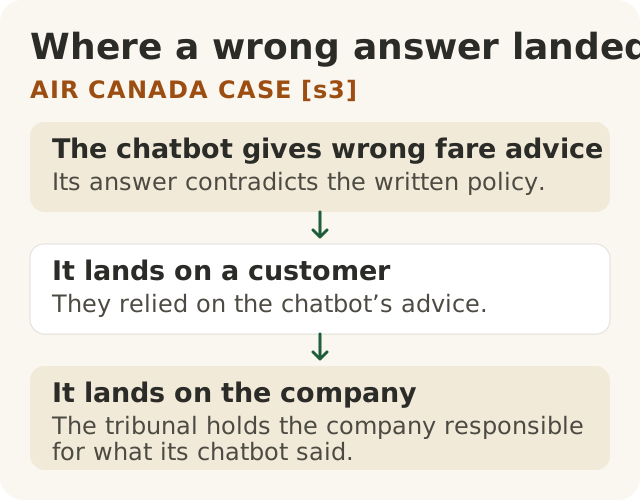
Figure data as text
Where it landed
- The Air Canada chatbot gives fare advice that contradicts the written policy. [s3]
- A customer relies on the chatbot’s advice. [s3]
- The tribunal holds the company responsible for what its chatbot said. [s3]
Objective: 100.R-b. Text equivalent of figures/where-it-landed.svg.
This gear treats the role tracks as a decision problem. For each team (or a household), it asks for a pair of uses of the same capability, one acceptable and one not, and a focused question about the precondition most likely to separate them, which supplements but does not replace the full acceptance test (100.R-a). It then models how failures propagate from the party that deploys an AI or automated system to parties that did not (100.R-b).
| Objective | Formal object | Primary evidence used |
|---|---|---|
| 100.R-a | A use $u$, its acceptance predicate, and the one discriminating precondition | Brynjolfsson, Li and Raymond (NBER w31161)1; Siemens release2; 16 CFR 465.23; EEOC iTutorGroup release4 |
| 100.R-b | A dependency graph over teams and external parties; the exposed set of a use | Moffatt v. Air Canada5; Part 573 report 23V-8386; EEOC iTutorGroup release4; 16 CFR 465.23 |
Two misconceptions are targeted: that AI governance is an IT function (100.R-a), and that a failure in another party's system is not your exposure (100.R-b).
1. The acceptance predicate and the discriminating question
Module 100.9 defines getting to yes as four conditions on a use $u$. In this course's notation:
\text{yes}(u) = \text{fit}(u) \land \text{data}(u) \land \text{owner}(u) \land \text{rule}(u)where $\text{fit}$ means the task is inside the model's demonstrated competence, $\text{data}$ means the inputs are permitted for this tool, $\text{owner}$ means a named person checks and answers for the output, and $\text{rule}$ means a written rule authorizes this action before it runs.
A track row is an illustrative pair $(u^+, u^-)$ of uses of the same capability, intended so that $\text{yes}(u^+) = 1$ and $\text{yes}(u^-) = 0$. The get-to-yes question $q$ for the row is a test of one conjunct $c$ (or a narrower test inside it) that the row's author judges most likely to fail for that team. It is a focused diagnostic, not a decision rule:
q(u) = 1 \;\not\Rightarrow\; \text{yes}(u), \qquad \text{yes}(u) \Rightarrow c(u)A positive answer to $q$ establishes at most $c(u)$. The use is acceptable only if the other three conjuncts also hold; for example $\text{fit} = \text{data} = \text{owner} = 1$ with $\text{rule} = 0$ gives $\text{yes} = 0$ even when an owner-focused $q$ is answered yes. Any conjunct that is false or unknown holds the use. The rows are not controlled pairs: many differ on more than one conjunct (the procurement row changes both the action limit and the data exposed), and the question names the difference the course treats as most important for that team, not the only one.
$q$ is useful only if it is answerable before deployment and by the team that owns the work, which is the reason the question sits in the business team and not only in IT: the team holds the knowledge that decides $\text{fit}$, $\text{data}$ and $\text{owner}$ for its own work.
1.1 The gate decision and who sets it
The predicate feeds a gate whose output is one of four answers (plain words in brackets):
g(u) \in \{\text{allow (go ahead)},\ \text{constrain (only this far)},\ \text{hold (wait for a person)},\ \text{deny (no)}\}If any conjunct is $0$ or unknown, $g(u) \ne \text{allow}$; an unknown gives $\text{hold}$, and a hold names the person who can release it. In this course a hold that nobody resolves decays to $\text{deny}$: it is never a deferred allow. $\text{owner}$ and $\text{rule}$ are set by named people, never by the model whose action is being gated; a system prompt or a chat interface is not itself a permission boundary. Any action that cannot be undone (a payment, a public post, a write to production data) has no direct model-to-tool path: it holds for a person.
1.2 The three yeses as a time-indexed check
Write $\text{yes}_t(u)$ for the predicate evaluated at time $t$.
- Get to Yes: $g_{t_0}(u)$ is decided before the first action, with explicit scope and owner.
- Stay at Yes: $\text{yes}_t(u)$ is re-evaluated while $u$ runs, in particular when the tool, the data or the people change. An initial allow is conditional, not a standing licence.
- Recover to Yes: when $\text{yes}t(u)$ falls to $0$, stop or contain, name the owner, repair and revise $\text{rule}$. A stop or an announced repair is not by itself evidence that $\text{yes}{t'}(u) = 1$ again; recovery is claimed only with evidence.
1.3 What the receipt carries
Each gate decision leaves a receipt $r(u)$. In this course $r(u)$ is decision metadata: which action was proposed, the gate's answer, the rule version it was checked against, the owner, and the time. It excludes prompts, model outputs, payloads and personal data. Notes on prompts, outputs and checks, where a workplace permits them, belong in a separately controlled work record, not in the shareable receipt.
2. Evidence for the rows
The sources are of different kinds: a measured study (§2.1), a vendor claim (§2.2), a tribunal decision (§2.3), a settled regulator lawsuit (§2.4), a rule (§2.5) and a safety recall report (§2.6).
2.1 Measured, heterogeneous gains: customer support (fit, owner)
Brynjolfsson, Li and Raymond study the staggered introduction of a generative AI conversational assistant using data from 5,179 customer-support agents.1 The 5,179 is the study sample, not the number of agents given the tool; the design compares agents and periods with and without access. In the NBER working paper (April 2023, revised November 2023; the 34% figure is in the revision), access raises productivity, measured as issues resolved per hour, by 14% on average, by 34% for novice and low-skilled workers, and with minimal impact on experienced and highly skilled workers.1 The authors report suggestive evidence that the model disseminates the best practices of more able workers and helps newer workers move down the experience curve.1
Two consequences for the tracks:
- The treatment effect is heterogeneous: $\tau(\text{novice}) \gg \tau(\text{experienced}) \approx 0$.1 An average effect does not predict the effect on a particular team, so the leaders' and engineering rows ask how the gain will be measured rather than assumed.
- The assistant suggests and the agent decides. That keeps $\text{owner}(u)$ with a person. The paper is evidence for the assisted configuration, not for an autonomous one.
This gear uses the working-paper figures only. The later journal version reports a different sample and estimates and is not quoted here.
2.2 Vendor claims: manufacturing and engineering (fit, owner)
On 24 October 2024 Siemens stated that over 100 companies, including Schaeffler and thyssenkrupp Automation Engineering, were using Siemens Industrial Copilot, a generative AI assistant used with the TIA Portal engineering software.2 Siemens claims the assistant can "generate code that requires only 20% adaptation" and that its chat function removes the need for lengthy searches.2
Epistemic status: these are first-party claims in a press release.2 The "20%" has no stated denominator, method or period in the release, so it cannot be compared with a measured effect such as §2.1. The release also does not specify who validates generated code before deployment.2 For the manufacturing row, $u^+$ and $u^-$ differ only in $\text{owner}$: generated control code is reviewed and tested by a qualified engineer before it reaches equipment, or it is not. Until it is, $g(u) = \text{hold}$. That precondition is the course's, not Siemens'.
2.3 Attribution of output to the deployer: service, sales, legal, home (owner, rule)
Source checked 18 Nov 2026.
Moffatt v. Air Canada, 2024 BCCRT 149. In November 2022 the claimant, Mr. Moffatt, asked Air Canada's website chatbot about bereavement fares and was told they could apply for the reduced fare after travel, within 90 days of the date their ticket was issued.5 The airline's bereavement-travel page, linked from the same answer, said the policy did not apply to completed travel.5 Air Canada argued it could not be held liable for information provided by the chatbot.5 The tribunal (decision of 14 February 2024) held that the chatbot is part of Air Canada's website and that Air Canada is responsible for all information on it, whether from a static page or a chatbot.5 It found negligent misrepresentation and awarded C$650.88 in damages, plus pre-judgment interest and tribunal fees.5
For the tracks this fixes the attribution rule used throughout: the output of a deployed assistant is the deployer's representation. The discriminating precondition for the service and sales rows is a constraint on the output space, that answers are restricted to approved policy text or approved terms, together with an escalation path to a person. That precondition is the course's design inference from the case, not a holding of the tribunal. The decision is one tribunal's ruling in British Columbia, not a general statement of law.
2.4 Automated decisions about people: HR (fit, rule)
The EEOC alleged that iTutorGroup programmed its tutor-application software to automatically reject female applicants aged 55 or older and male applicants aged 60 or older, rejecting more than 200 qualified US applicants because of their age.4 The 2023 settlement provides $365,000 for distribution to applicants automatically rejected because of their age.4
The EEOC describes a programmed age cut-off as the alleged decision criterion.4 The release does not mention AI and does not document the software's internals; a settlement is not a forensic finding about them. So the case gives no evidence that generative AI, or any learned model, made these decisions, and it does not prove that none was present elsewhere in the system. It is included because the preconditions for any system making decisions about people are the same: pre-deployment testing of outcomes across protected groups, and human review of adverse decisions. 100.7 covers those checks.
2.5 Fabricated testimonials: marketing (rule)
16 CFR Part 465, published at 89 FR 68034 on 22 August 2024 and effective 21 October 2024.3 §465.2(a) makes it an unfair or deceptive act or practice for a business to write, create or sell a consumer review or testimonial that materially misrepresents (1) that the reviewer or testimonialist exists, (2) that they used or otherwise had experience with the product, service or business, or (3) their experience.3 The alternatives are disjunctive: misrepresenting any one is enough. The FTC states that the rule will enable it to seek civil penalties against violators.3
The FTC states that AI-generated reviews are covered by the final rule.3 The test is material misrepresentation, not authorship by a particular tool. A model-generated "customer" testimonial attributed to a person who does not exist meets (1); one attributed to a real person but describing an experience that did not occur meets (3). Conversely, AI assistance with the wording of a real customer's accurate review does not by itself meet any limb, though other requirements may apply; this is not a claim of a safe harbour. The mapping is the course's reading, not a regulator's finding about any specific AI product, and not legal advice; confirm the rule's current status with counsel. The brand row does not rest on this rule: an unchecked fact or tone in a corporate message need not be a review or testimonial.
2.6 Over-trust in automation: safety, quality (owner)
Tesla's Part 573 report 23V-838 describes Autosteer, part of Autopilot, as providing steering, braking and acceleration support subject to limited operating conditions, with the driver responsible and "with their hands on the steering wheel at all times".6 It states that the prominence and scope of the feature's controls "may not be sufficient to prevent driver misuse", with a possible increased risk of collision.6 On 5 December 2023 Tesla determined to voluntarily recall 2,031,220 vehicles, while not concurring with NHTSA's analysis.6 The report describes a planned over-the-air remedy at no cost to customers, adding controls and alerts, with eventual suspension from Autosteer for drivers who repeatedly fail to demonstrate continuous and sustained driving responsibility.6
This is driver assistance, not generative AI. The structural lesson carries over: when a system relies on a human monitor, the system must be designed to keep that monitor engaged, and a failure there lands on the end user population rather than on the design team. In §1.2's terms it is a Stay at Yes failure: the condition the design relied on (an attentive driver) had to be re-checked in use. The report describes a planned remedy;6 it does not establish that the remedy worked, so this gear does not treat it as a demonstrated return to $\text{yes}$.
3. The track matrix
Rows are course guidance for the fictional company. The last column gives the conjunct the question tests and the evidence or prior module it rests on. Per §1, each question is a focused diagnostic: a yes is necessary for $\text{yes}(u^+)$, not sufficient.
| Track | $u^+$ | $u^-$ | Discriminating question | Conjunct; evidence |
|---|---|---|---|---|
| Home and everyday life | Plan or compare, then verify against the provider's written terms | Act on a chatbot's statement about a refund or fare | Did I check it against the company's own written rules? | rule; §2.35 |
| Manufacturing | Fault explanation from manuals; draft control code for engineer review | Unreviewed fix deployed to a live line | Has a qualified person checked it before it touches a machine? | owner; §2.22 |
| Quality | Cluster warranty text to surface candidate patterns; severe reports keep an independent route to a person | Treat the clusters as complete screening; a rare severe defect outside every cluster is never examined | What did the AI not surface, and how do rare severe reports reach a person? | owner, fit; 100.4 |
| Engineering and design | Draft code and test plans | Ship unreviewed, untested code | Who reviews it, and how is time saved measured? | owner, fit; §2.11, §2.22 |
| Supply chain and procurement | Agent negotiates within hard concession limits | Supplier pricing pasted into a public tool | What may it offer, and what data may it see? | rule, data; 100.6, 100.7 |
| Forecasting and planning | Forecast with interval for products with long history | Point forecast for a new product with no history | What did it learn from, and how sure is it? | fit; 100.2 |
| Sales and dealers | Answers restricted to approved price lists and specs | Assistant commits to unoffered price or terms | Can it only quote approved terms? | rule; §2.35 |
| Customer service | Suggestions; agent decides | Autonomous bot invents policy; no human escalation | Can every customer reach a person? | owner, rule; §2.11, §2.35 |
| Marketing | Ideation shaped and approved by people | Fabricated or materially misrepresented reviews or testimonials, by any author or tool | Is every review and quote real, accurate, and used with permission? | rule; §2.53 |
| Brand and communications | Drafts fact-checked before release | Unchecked fact or tone in public | Who checks facts and tone before release? | owner; 100.1, 100.3, 100.8 |
| Legal | Clause extraction with lawyer review | Filings with unverified citations | Has a lawyer read every cited source? | owner; §2.35, 100.8 |
| IT | Coding help; agents sandboxed with backups | Agent with write access to production data | What can it change, and can we undo it? | rule; 100.6 |
| Cybersecurity | Alert triage, phishing detection | Assistant acting on instructions embedded in untrusted content | What untrusted content can it read, and what can it do afterwards? | data, rule; 100.7 |
| Safety | Pattern-finding in near-miss reports | Operators disengage from automation | How does the system keep people attentive? | owner; §2.66 |
| HR | Job-post drafts; policy answers linked to source | Automated screening with disparate outcomes | Tested for fairness, and is every rejection reviewable? | fit, owner; §2.44 |
| Finance | Variance explanations with every figure traced | Payment on an unverified, convincing request | Is every number traced, and is every unusual payment called back? | owner, rule; 100.7, 100.8 |
| Leaders | Defined jobs, measured outcomes, scale on evidence | Pilots with no success measure | How will we know it worked, and who owns it? | fit, owner; §2.11, §2.35 |
Two constraints from §1.1 apply to every row: the model never sets its own $\text{owner}$ or $\text{rule}$, and any action it cannot undo holds for a named person.
4. Propagation: how a failure elsewhere reaches you
Model the organization and its counterparties as a directed graph, built per use. For a use $u$ deployed by $d(u)$, let $G_u = (V, E_u)$, where $V$ contains internal teams and external parties (customers, applicants, shoppers, product users) and an edge $(a, b) \in E_u$ means $b$ consumes or relies on an output that carries the effect of $u$. A team's other, unrelated outputs do not create edges in $G_u$. The potentially exposed set is:
X(u) = \{\, v \in V : d(u) \leadsto_{G_u} v \,\}$X(u)$ is potential exposure, a conservative over-approximation: a path means a mistake in $u$ could reach $v$, not that harm has occurred or will occur. When edges are uncertain, include them and label them as assumptions.
The misconception "someone else's AI is not my problem" is the unchecked assumption that $\text{me} \notin X(u)$. That is distinct from $X(u) = \{d(u)\}$ (no external exposure at all): other parties may be exposed while I am not. The documented cases show that $X(u)$ routinely contains parties other than the deployer, with different edge types:
| Edge type | Deployer $d(u)$ | Party $v \in X(u)$, $v \ne d(u)$ | Status | Evidence |
|---|---|---|---|---|
| Organization to customer (reliance on a representation) | Air Canada | A customer who relied on the chatbot's answer and had to bring a claim5 | Decided incident | §2.3 |
| Organization to applicant (decision about a person) | iTutorGroup | More than 200 qualified US applicants rejected because of age4 | Alleged; settled | §2.4 |
| Seller to consumer (information used to choose) | A business publishing fabricated reviews | Consumers who could decide on a misrepresented experience3 | Possible harm defined by a rule; no specific episode cited | §2.5 |
| Manufacturer to product user | Tesla | Owners of 2,031,220 recalled vehicles6 | Recall | §2.6 |
Liability also flows back up the graph. In Moffatt the cost of the chatbot's output returned to the deployer.5 Inside the fictional company the same structure has internal edges: marketing's fabricated review reaches legal and customer service; an IT agent's write access reaches finance's close; procurement's data handling reaches engineering's supplier relationships. For a use $u$ owned by another team, the learner either names one justified path $d(u) \leadsto \text{me}$ in $G_u$, stating the output that carries the effect and the person they would notify, or reports "no path established" with the reason (for example, the use's output stays in an isolated sandbox). A path must not be invented to complete the exercise; "unknown, will ask [named person]" is also an honest result.
Because an honest no-path finding is allowed for that use, the exercise separately requires every learner to explain one positive path from the documented edges above. The learner takes the role of $v$ in one row (customer, applicant, shopper or owner) and states $d(u)$, the carrying output and the edge, and who should be notified. That shows how a mistake elsewhere could reach someone in that role. It is not a claim that the learner was harmed.
5. Exercise and hand-off to 100.P
- Choose a row from your track, or write $(u^+, u^-)$ for your own team or household.
- State the discriminating question and which conjunct of $\text{yes}(u)$ it tests.
- Express $u^+$ in the 100.9 rule form: do what, for whom, only when, otherwise, owner, receipt. "Otherwise" names the fallback gate answer (constrain, hold or deny). The receipt carries decision metadata only (§1.3), never prompts, outputs or personal data.
- Required positive path. Choose one documented edge from the §4 table, take the role of $v$, and state $d(u)$, the carrying output, the edge type, and who should be notified.
- Other team. From another team's track, identify one justified path in $G_u$ from their use to you, and the first person you would notify; or state that no path is established, and why.
At 100.P a person reviews the rule; a model does not mark it.
Limits of the evidence
- Two cases (§2.4, §2.6) are not generative AI. They are used for the decision structure only.46
- §2.2 is a first-party claim, not a measurement.2
- §2.3 and §2.5 are jurisdiction-specific and are not legal advice.53
- §2.3's source was checked 18 Nov 2026.
- §2.6 documents a planned remedy, not its effect; it is not evidence of a completed recovery.6
- §2.1 is one firm and one task family; its effects should not be transferred to another team without measuring there.1
- §2.1 is a measured benefit and §2.5 a rule describing possible harm; only §2.3, §2.4 and §2.6 are incidents in which identified parties bore a cost.13
- §2.4 rests on the EEOC's description of programmed age cut-offs; it says nothing either way about learned components.4
Further learning (not a citation)
MIT OpenCourseWare, The Analytics Edge (15.071, Spring 2017), is optional background on applied analytics and machine learning across business domains. It predates current generative AI and is not a source for any claim in this module.