
Gen AI in your role (role tracks) · Plain gear
Reviewed and published, version 1.0.0. As of 18 November 2026. Big Widget Company and the people in it are made up. The real cases are real, and each one is cited. The task card, the four checks, the gate answers and the track lines are this course's own ideas, not a law.
What this part is for
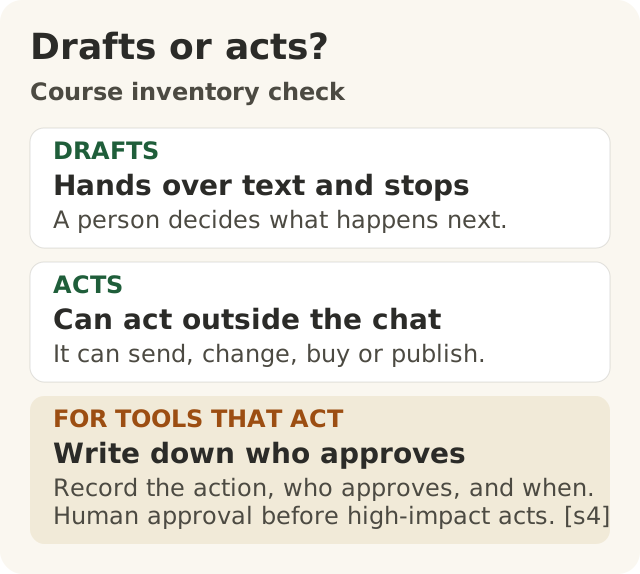
Figure data as text
Course inventory check
| Part | What it means |
|---|---|
| DRAFTS | Hands over text and stops. A person decides what happens next. |
| ACTS | Can act outside the chat. It can send, change, buy or publish. |
| FOR TOOLS THAT ACT | Write down who approves. Record the action, who approves, and when. Human approval before high-impact acts. [s4] |
So far in Level 200 you learned how to write prompts that hold up, how to tie an answer to your own documents, how to test an answer, how to protect data, and how to put a rule in front of a tool. Now you use all of that in your own job.
Big Widget Company has seventeen tracks. There is one for each team, one for leaders, and one for home. Pick the track for your team. If you only use AI at home, pick the home track. Then read one more track from a different team.
When you finish, you can do two things:
- For one task you do again and again, write down four things: what you ask, where the answer must come from, how you check it, and what information you may put in.
- Name which of your team's AI tools can do things (send, change, buy or publish), and the person who has to say yes first.
Some people think using AI well looks the same in every job. It does not. A lawyer must open every case the AI cites. Some lawyers who did not were punished by a court.1 A planner must redo the numbers. A communications lead must read for tone. Even in one job, one AI helper helped some customer-support workers more than others.2
Some people think their AI tools only make suggestions. Some do. Others can send, change, buy or publish. A tool you only use to sum up your email might still be able to send or delete email, unless someone turned that off.3
The task card
Pick a task you do every week or every month. Write a card for it with four parts.
- What I ask. The same words each time, with blanks for the parts that change.
- Where the answer comes from. One document or system, and the person who keeps it right.
- How I check it. What I do before I use the answer.
- What I may put in. What is allowed in this tool, what is never allowed, and what I do instead.
What I ask
Write the request once. Say what the job is, who will read it, which facts to use, show one example, say what shape the answer should take, and say what to do when it is not sure. You learned this in lesson 200.2.
This course has a rule here: decide how you will check the answer before you polish the request. Better wording can help. But it does not replace a check.
Where the answer comes from
Name the document the answer must come from. For example: today's price list, or the signed contract. Name the person who keeps it up to date.
Here is why this matters. Air Canada's website chatbot told a customer they could claim a cheaper bereavement fare after they travelled. The airline's own policy page said they could not.4 A tribunal said the airline, not the chatbot, was responsible for what its website said, including the chatbot.4 The decision does not say how the chatbot got its answer wrong.4 It does show that the company answers when its tool and its own rules disagree.
How I check it
This is the part that changes most from job to job. There are four kinds of check in this course.
- Citation check. Open every source the answer points to. Does it really say that?
- Numbers check. Work out every number again, from the real source, with a calculator.
- Tone check. A person reads it the way the reader will, before it goes out.
- Legal review. A qualified person checks anything that makes a promise or changes someone's rights.
A US government standards body, NIST, lists risks that AI creates or makes worse.5 One is AI saying wrong things with confidence.5 Citation and numbers checks catch that. Another is writing that does not separate fact from opinion.5 A tone check helps there. NIST's list is guidance, not a law.5 Matching each check to a risk is this course's idea.
Most tasks need more than one check. Your card names the main one: the check that would stop the worst mistake in your job.
A check is done by a person, or by a fixed step like a calculator. Asking the same AI "are you sure?" is not a check.
Lawyers learned this the hard way. In a New York court case, lawyers filed a list of past cases that did not exist. ChatGPT had made them up.1 The court found that one of the lawyers, Mr. LoDuca, did not review any of the cases cited before signing.1 The court punished the lawyers.1
What I may put in
Write one or two lines. What is allowed in this tool? What is never allowed? What do you do instead, like using a made-up example or blanking out a name? You learned this in lesson 200.5. NIST warns about private details leaking out, and about company secrets being exposed.5
Priya's card (made up)
Priya works in customer service at Big Widget. Every day she answers dealers about warranty claims.
- What I ask: "Write a reply to a dealer about this warranty claim. Use only the warranty policy below. Keep it short and polite. Quote the policy line you used. If the policy does not cover it, write 'Needs a person' and stop."
- Where the answer comes from: the current warranty policy. Dev, on the warranty team, keeps it.
- How I check it: Priya opens the policy line it quoted and makes sure it says that. Then she reads it for tone.
- What I may put in: the dealer's name and claim number are fine in the company's approved AI tool. The car owner's name and address never go in. She writes "the owner" instead.
Does the tool write, or does it do?
Some AI tools only write. They hand you words. You decide what happens next.
Other tools do things. They send a message. They change a record or a setting. They buy or pay. They publish something other people will see.
A security group called OWASP warns about AI tools that can do too much.3 It says there are three ways this happens: the tool has abilities the job does not need, it has more access than the job needs, or it takes big steps without a person saying yes.3
"Our tools only make suggestions"
Ask what the tool can do, not just what you use it for. OWASP gives an example: a tool that reads your email to sum it up only needs to read. It should not also be able to send or delete email.3 If nobody switched those abilities off, your summing-up tool can act.
Watch for three more things:
- Auto-send. A reply tool that sends by itself is no longer just writing.
- Links to other systems. A tool linked to email or files might be able to change them.
- Outside messages. This course treats anything a tool reads from outside, like other people's email, as something that might try to trick it. A real flaw shows the kind of risk. In June 2025, a US government database recorded an "AI command injection" flaw in Microsoft 365 Copilot. It said an attacker could get information out.6 The record does not say how the attack got in.
Who says yes?
For each tool that does things, write down what it does and who must say yes first. OWASP says a person should approve big actions before they happen,3 and tools should only have the abilities and access they really need.3
"A human checks it" is not enough. Write a name, or a job title. The AI never says yes for itself. An instruction in the request, like "always ask first", is not a gate either: the tool's settings must stop the action until the person says yes. This course's rule is: no straight path from the AI to an action that matters.
For each action, the person gives one of four answers (from lesson 200.8):
- Go ahead. It may run.
- Only this far. It may run, but only inside a limit, like "send to dealers, never to car owners".
- Wait for a person. It stops until the named person says yes.
- No. It never runs.
If you cannot find out who says yes, say so. "I don't know yet" is a fine answer, as long as you write down who you will ask. Until someone is named, the answer is "wait for a person".
Setting up a tool is an action too. In 2012, a trading firm called Knight Capital put new software on its computers. One of eight servers was missed. Nobody was required to double-check the work.7 In 45 minutes, its system sent millions of orders and the firm lost over $460 million.7 That was not AI, and the firm did not admit or deny these findings.7 But the lesson fits: turning on auto-send or giving a tool more access also needs someone to say yes.
A UK government AI safety team tested an AI agent with loose rules on purpose. In their test, the agent made a harmful change request (a "malicious pull request") on a real, public software project.8 The team says some of the actions it found had a small real-world effect, in contained ways, and it found no real-world harm.8 Afterwards, the team decided that internet access must now be justified, not given by default.8 The idea fits your tools too: access the job does not need should stay off.
Sorting your team's tools (made up)
- Company chat assistant. Used to draft replies. Cannot send. Writes. No approver needed: a person sends.
- Email helper. Used to sum up the inbox. Can also send and delete. Does. Rosa, the service manager, must say yes to any send (wait for a person). Delete is switched off (no).
- Dealer website bot. Answers dealers' price questions live. Does. It may only answer from the approved price list (only this far). The sales operations owner says yes to every price rule.
If you are not sure what a tool can do, treat it as a tool that does things until its owner tells you.
The three yeses
A yes is for one tool, one job and one limit. It is not a yes forever.
- Get to Yes (before you use it): the card is written, and the source's keeper is named. For a tool that does things, every action has an answer and a named person.
- Stay at Yes (while you use it): did the tool get auto-send, a new link or more access? Did the source change? Then go back to Get to Yes. An old yes does not cover a changed tool.
- Recover to Yes (when something goes wrong): stop the tool or the task. Tell the person who said yes. Fix the source, the card or the setting. Switched off is not the same as fixed: show what you checked before you say it is fixed. If you do not know yet, say "not known yet".
Keep the decision, not the secret
Your card and your tool list are work notes. Keep them where your team's rules say. If you record a gate answer as a receipt, the receipt holds the decision and the rule it followed. It never holds the request, the AI's answer, or anyone's personal details.
The seventeen tracks
Each line is a made-up Big Widget example. It shows one task, the main check, and whether a tool for that team might act. The checks and the "who says yes" parts are this course's advice. Where a real case fits a track, it is named after the advice. Your own team's list decides the real answer.
- Home: Check a company's refund rule before you buy. Main check: citation, against the company's own policy page. A booking or payment tool acts: you say yes to each payment. Real case: Air Canada's chatbot and its policy page disagreed.4
- Manufacturing: Explain a machine fault from the manual. Main check: citation. Any change to a machine waits for a qualified technician.
- Quality: Sum up warranty comments. Main check: numbers. Remove owners' details first.
- Engineering and design: Draft a test plan from the specification. Main check: legal review of safety claims, numbers for limits.
- Supply chain and procurement: Compare supplier quotes. Main check: numbers. Supplier prices stay in approved tools only. That is this course's rule. NIST names the risk of company secrets getting out.5 A buying tool acts: a named buyer says yes to each order.
- Forecasting and planning: Draft the monthly plan notes. Main check: numbers.
- Sales and dealers: Answer dealer questions on price. Main check: citation, against the approved price list. A dealer website bot publishes: the sales operations owner says yes to its rules. Real case: the Air Canada chatbot, above.4
- Customer service: Draft warranty replies. Main check: citation, then tone. Auto-send acts: the service manager says yes. Real case: in one study, an AI helper helped some support workers more than others,2 so measure what it does for your own team.
- Marketing: Draft product copy. Main check: legal review of any claim about what the product does. The FTC said a company called DoNotPay did not test whether its chatbot was as good as a human lawyer.9 Those are the FTC's claims. The company did not admit or deny them. Under the FTC's final order it must pay $193,000.10
- Brand and communications: Draft a public statement. Main check: tone. In January 2024 the BBC reported that the delivery firm DPD switched off part of its chatbot after it swore at a customer.11 DPD blamed an error after a system update.11 The report does not say which control failed.
- Legal: Sum up a contract. Main check: legal review, and open every case cited. Real case: the New York lawyers, above.1
- IT: Draft a change to a system. Main check: a second person reviews it before the change. An agent that can change systems acts: the change owner says yes. Access it does not need stays off. Real cases: Knight Capital7 and the UK test,8 above.
- Cybersecurity: Sum up suspected scam emails. Main check: go back to the original message. Treat outside email as untrusted. That is this course's rule.
- Safety: Sum up near-miss reports. Main check: numbers, and a person reads every serious report.
- HR: Draft a job post. Main check: legal review for fairness. Employees' private details never go in an unapproved tool. That is this course's rule. NIST names the risk of private details leaking out.5 No tool turns people away without a person checking.
- Finance: Explain month-end differences. Main check: numbers, every figure traced. A payment tool acts: a named person says yes, and unusual payments get a phone call back.
- Leaders: Weekly briefing from team reports. Main check: citation back to each report. Leaders make sure every tool that acts has a named person who says yes.
Your exercise
Bring this to the project, 200.P.
- Pick one task you do again and again.
- Write its card: what I ask, where the answer comes from (and who keeps it right), how I check it, and what I may put in.
- Try your request on at least three made-up examples, including a tricky one. Never use real customer records.
- List your team's AI tools. For each one, write what it can do, whether it writes or does, who says yes, and the answer for each action: go ahead, only this far, wait for a person, or no. If you do not know, write "not known yet: ask [name]".
- Read one other team's track. What is its main check? Why is it different from yours?
Keep your notes private. Do not paste real requests, answers or customer details into anything you share.
What we are not saying
- The four checks are this course's idea, not a law. NIST names risks, not these checks.5
- We do not know how Air Canada's or DPD's chatbots went wrong inside. The sources do not say.411
- We do not know how the 2025 Copilot flaw's attack got in. The record does not say.6
- Knight Capital was not AI.7
- The FTC's points about DoNotPay are claims the company did not admit.910
- The UK test was set up loosely on purpose. It is not proof about other systems.8
- OWASP's advice is advice, not law.3
Words to know
- Task card: four written parts for a task you do often.
- Main check: the check that stops the worst mistake in your job.
- Writes (drafts): the tool gives you words, and you decide.
- Does (acts): the tool sends, changes, buys or publishes by itself.
- Approver: the named person who must say yes first.
- Gate answers: go ahead, only this far, wait for a person, no.
- Receipt: a record of the decision. It never holds requests, answers or personal details.