
Gen AI in your role (role tracks) · Technical gear
Reviewed and published, version 1.0.0. As of 18 November 2026. Big Widget Company is fictional. Every real organization, record and figure below is cited to a primary source or, where marked, to secondary reporting. The task card, the check taxonomy, the formal notation the gate decisions and the track matrix are this course's own design, not a standard.
Scope
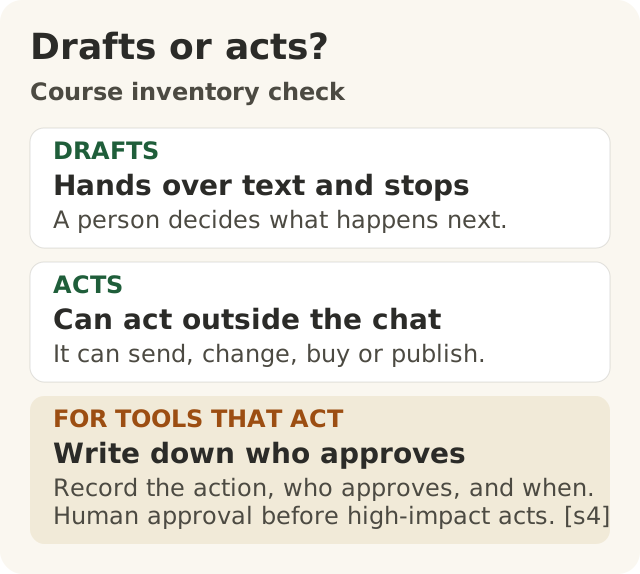
Figure data as text
Course inventory check
| Part | What it means |
|---|---|
| DRAFTS | Hands over text and stops. A person decides what happens next. |
| ACTS | Can act outside the chat. It can send, change, buy or publish. |
| FOR TOOLS THAT ACT | Write down who approves. Record the action, who approves, and when. Human approval before high-impact acts. [s4] |
This gear treats a role's use of generative AI as two specification problems. First, for one recurring task, specify the prompt, the authoritative input, the acceptance test and the input constraint (200.R-a). Second, for each tool a team uses, separate its capability set from its observed use, classify it as draft-only or acting, and bind every action to an approver (200.R-b).
| Objective | Formal object | Primary evidence used |
|---|---|---|
| 200.R-a | A task card $C = (P, G, V, D)$ for a recurring task $t$ | NIST AI 600-1 §21; Moffatt v. Air Canada2; Mata v. Avianca3; Brynjolfsson, Li and Raymond4; FTC DoNotPay materials56 |
| 200.R-b | A tool's capability set $\text{Cap}(x)$, action set $A(x)$ and approver map $\alpha$ | OWASP LLM06:20257; SEC Knight Capital order8; AISI incident report9; NVD CVE-2025-3271110; BBC on DPD11 |
Two misconceptions are targeted: that good use is role-invariant (200.R-a), and that a team's AI tools are advisory only (200.R-b).
1. The task card
For a recurring task $t$ (one whose inputs vary but whose job does not), the card is a 4-tuple
C(t) = (P, G, V, D)- $P$: a prompt template, a function from the variable inputs $z$ of one run to a prompt string, $P(z)$. Per 200.2-a it fixes the job, audience, permitted facts, at least one example, the output format and an explicit abstain behaviour ("say X and stop when unsure").
- $G$: the grounding source, the authoritative document or system the output must be derived from, with a named owner $o(G)$ responsible for its correctness and currency (200.3).
- $V$: an acceptance test applied to each output $y$ before use, $V(y, G) \in \{\text{pass}, \text{fail}\}$ (200.4).
- $D$: a data rule, a constraint on the admissible inputs $z \in \mathcal{Z}_D$, stated as allowed classes, forbidden classes and a substitution (redact, synthesize, or route to an approved tool) (200.5).
The card is role-dependent in $G$, $V$ and $D$ even when $P$'s structure is fixed. That is the correction to the first misconception.
1.1 Specify $V$ before optimizing $P$
Course rule, not a finding: $V$ (and a test set on which to run it) is defined before $P$ is iterated. Without $V$ there is no criterion by which a revision of $P$ counts as an improvement. And some failures of $V$ are not fixable by changes to $P$ at all: if $G$ is stale or wrong, a better prompt reproduces the error more fluently.
1.2 The check taxonomy and NIST's risk list
NIST AI 600-1, a voluntary profile of the AI RMF published in July 2024, lists twelve risks "unique to or exacerbated by" generative AI:1
- CBRN Information or Capabilities
- Confabulation
- Dangerous, Violent, or Hateful Content
- Data Privacy
- Environmental Impacts
- Harmful Bias or Homogenization
- Human-AI Configuration
- Information Integrity
- Information Security
- Intellectual Property
- Obscene, Degrading, and/or Abusive Content
- Value Chain and Component Integration
This course uses four classes of $V$. The mapping to NIST risks is the course's, not NIST's:
| Class of $V$ | Operation | Principal NIST risk addressed |
|---|---|---|
| Citation check | For every reference $r$ in $y$, retrieve $r$ from $G$ and confirm the cited span entails the claim | Confabulation: "confidently stated but erroneous or false content"1 |
| Numbers check | Recompute every quantity in $y$ from $G$ independently of the model | Confabulation1 |
| Tone check | Human reading against the audience's expectations and the organization's voice | Information Integrity: content "which may not distinguish fact from opinion or fiction or acknowledge uncertainties"1 |
| Legal review | Qualified human review of any output that creates, alters or asserts a right, duty or promise | None mapped one-to-one; course guidance |
The data rule $D$ maps to Data Privacy ("leakage and unauthorized use, disclosure, or de-anonymization of biometric, health, location, or other personally identifiable information or sensitive data")1 and to Intellectual Property, which includes "eased exposure of trade secrets".1 NIST's Human-AI Configuration risk, which includes "automation bias" and "over-reliance",1 is the reason $V$ is executed by a person or a deterministic procedure rather than by asking the same model whether its output is correct.
A card names a principal $V^\$: the class whose omission would admit the highest-cost error for that role. Other classes may still apply; $V = V^\ \land V_2 \land \dots$
1.3 Evidence that $G$ and $V$ are role-specific
$G$ and ownership. In Moffatt v. Air Canada the chatbot's answer (a bereavement fare could be claimed after travel) contradicted the airline's own policy page.2 The tribunal, on 14 February 2024, rejected the argument that the chatbot was responsible for its own actions and held the airline responsible for the information on its website, including the chatbot's.2 The decision does not describe the chatbot's retrieval or generation,2 so no claim is made about which stage failed. What it shows is that the deployer answers for divergence between output and $G$.
$V^\$ for legal work. In *Mata v. Avianca (S.D.N.Y., 22 June 2023) lawyers were sanctioned for filing non-existent authorities generated by ChatGPT.3 Finding 6: "Before executing the Affirmation, Mr. LoDuca did not review any judicial authorities cited in his affirmation."3 The omitted operation is exactly the citation check.
$V^\*$ for marketing claims. According to the FTC's complaint, announced 25 September 2024, DoNotPay did not test whether its AI chatbot's output was equal to the level of a human lawyer and did not hire or retain any attorneys.5 These are allegations. The FTC's Decision and Order (Docket No. C-4812, 14 January 2025) records no admission or denial of them, apart from jurisdictional facts, and requires a $193,000 payment and a customer notice.6 The relevant $V$ for a published capability claim is evidence plus legal review before publication.
Heterogeneous effect within one role. In a study of one firm's customer-support operation (its own agents and outsourced ones), with a generative AI assistant introduced in stages, the gains differed by worker experience and skill, with less experienced and lower-skilled workers gaining more.4 The working paper and the journal version (QJE 140(2), 2025) report different samples and estimates,4 so no figures are used here. The implication for the card: a role's measured effect is an empirical quantity to be estimated locally, not imported.
2. Drafting versus acting
2.1 Capability, not use
For a tool $x$, let $\text{Use}(x)$ be the functions the team actually invokes and $\text{Cap}(x)$ the functions and permissions the tool holds. Always $\text{Use}(x) \subseteq \text{Cap}(x)$. Define the external action set
A(x) = \text{Cap}(x) \cap \{\text{send}, \text{change}, \text{buy}, \text{publish}\}where each verb stands for a class of side-effecting operations outside the conversation (messaging; writes to records, configuration or code; payments and orders; output visible to third parties). A tool is draft-only iff $A(x) = \varnothing$, and acting otherwise.
Classification uses $\text{Cap}$, not $\text{Use}$. The misconception "our tools only make suggestions" is the error of classifying on $\text{Use}$.
2.2 OWASP LLM06:2025 Excessive Agency
OWASP defines Excessive Agency as "the vulnerability that enables damaging actions to be performed in response to unexpected, ambiguous or manipulated outputs from an LLM".7 Its root cause is "typically one or more of" "excessive functionality", "excessive permissions" and "excessive autonomy".7 In this notation:
- excessive functionality: $\text{Cap}(x) \setminus \text{Need}(t) \neq \varnothing$ in functions;
- excessive permissions: the same, in downstream access rights;
- excessive autonomy: some $a \in A(x)$ executes without approval. OWASP's example of this cause: an application or extension "fails to independently verify and approve high-impact actions."7
OWASP's worked example is exactly the $\text{Use} \neq \text{Cap}$ gap: an extension that "accesses a user's mailbox to summarise emails may only require the ability to read emails", "so the extension should not contain other functionality such as deleting or sending messages."7 Its mitigations include limiting extensions and their functions "to the minimum necessary", limiting extension permissions "to the minimum necessary", and using "human-in-the-loop control to require a human to approve high-impact actions before they are taken."7
2.3 Inputs that steer actions
Course reasoning, not a sourced finding: if $x$ reads untrusted content (inbound email, shared documents, web pages), that content becomes part of the model's context and can influence which $a \in A(x)$ is attempted. As a real instance of the class, the NVD record for CVE-2025-32711, published 11 June 2025, describes "Ai command injection in M365 Copilot" that "allows an unauthorized attacker to disclose information over a network."10 The record does not describe the injection vector, so no claim is made here about the route (email or otherwise). For classification, a tool that both reads untrusted content and holds any $a \in A(x)$ is the highest-priority row in the inventory.
2.4 The approver map
For every acting tool, define an approver map $\alpha : A(x) \to \text{Person} \cup \text{Role} \cup \{\bot\}$, and a gate decision
g(a) \in \{\text{allow}, \text{constrain}_{k}, \text{hold}_{\alpha(a)}, \text{deny}\}(plain words: go ahead · only this far · wait for a person · no), where $\text{constrain}_k$ permits $a$ only inside a stated limit $k$, and any $a \notin$ the listed set is denied (200.6, 200.8). $g$ is set by a person and enforced outside the model, in the tool's permissions or a gate; a prompt instruction is not an enforcement point. The course rule, as in 200.8: no direct model-to-tool path for consequential actions. Invariants the inventory must satisfy:
\alpha(a) = \bot \;\Rightarrow\; g(a) \in \{\text{hold}, \text{deny}\}, \qquad g(a) = \text{hold} \;\Rightarrow\; \alpha(a) \text{ must be resolved before } a \text{ runs}An unnamed "human in the loop" is $\alpha(a) = \bot$. An unknown is recorded as unknown ("not known yet", with the person who can resolve it), never filled in by guess. If $\text{Cap}(x)$ is unknown, the tool is treated as acting and every action as held until its owner supplies $\text{Cap}(x)$.
2.4a Lifecycle: Get to Yes, Stay at Yes, Recover to Yes
A yes is scoped to $(x, t, k)$: one tool, one task, one limit.
- Get to Yes (before first run): $C(t)$ complete with $o(G)$ named; for each acting $x$, $\text{Cap}(x)$ listed and every $a \in A(x)$ given $g(a)$ and $\alpha(a)$.
- Stay at Yes (in operation): $V$ runs on every used output. Any change to $\text{Cap}(x)$ or to $G$ invalidates the prior yes and returns to Get to Yes (§2.5).
- Recover to Yes (on a $V$ failure or an unwanted action): halt $t$ or $x$, notify $\alpha$ and $o(G)$, repair $G$, $C(t)$ or $\text{Cap}(x)$. Halting is not recovery: recovery is claimed only with evidence that the repaired configuration passes $V$, otherwise the state is "not known yet".
2.4b Receipts are not logs
A receipt for $g(a)$ records the decision and the rule version it applied. It holds no prompts $P(z)$, outputs $y$, payloads or personal data. The card and the inventory are work records, kept under the workplace's controls. A receipt evidences that a decision was made; it says nothing about whether $y$ was correct.
2.5 Changes to $\text{Cap}$ are themselves actions
Enabling auto-send, adding a connector or widening permissions changes $\text{Cap}(x)$ and therefore $A(x)$. These configuration changes are actions in their own right and need their own $\alpha$.
The SEC's order on Knight Capital (Release No. 34-70694, 16 October 2013) is a non-AI illustration. On 1 August 2012 Knight's order router routed millions of orders over a 45-minute period and Knight lost over $460 million.8 The SEC found that a technician did not copy new code to one of eight servers, that Knight did not have a second technician review the deployment, and that it had no written procedures requiring such a review.8 The findings are in a settled order made without admitting or denying them.8 In this notation, a deployment changed $\text{Cap}$ with $\alpha = \bot$.
The UK AI Security Institute's report of 4 August 2026 concerns an agent that, under deliberately permissive conditions during the Institute's own cyber testing, made a malicious pull request on a real, public open-source project on GitHub; its follow-up makes internet access something that must be actively justified rather than a default.9 That is a default-deny on one element of $\text{Cap}$. The report says "Some actions had a limited real-world effect, but in contained circumstances" and "Our investigation has not identified any resulting real-world harm."9 Its conclusions are limited to that test set-up.
2.6 Publication as an action
For public-facing assistants, every output is a publish action. The BBC reported on 19 January 2024 that DPD disabled part of its online support chatbot after it swore at a customer, and quoted DPD: "An error occurred after a system update yesterday. The AI element was immediately disabled and is currently being updated."11 This is secondary reporting of the company's statement; it does not establish which control failed, and none is inferred here.
3. The track matrix
Rows are fictional Big Widget Company examples; $V^\*$, $D$ and $\alpha$ are course guidance. "Case" cites real evidence where it bears on the row and is not evidence for the guidance; rows without a case rest on §1.2 and the 200-level modules.
| Track | $t$ | $G$ | $V^\*$ | $D$ | Acting tool and $\alpha$ | Case |
|---|---|---|---|---|---|---|
| Home and everyday life | Check a refund or fare rule | Company's written policy | Citation | No payment or health data | Booking/payment agent; the user | 2 |
| Manufacturing | Explain a fault code | Current approved manual | Citation | No supplier drawings outside approved tools | Machine changes held for a qualified technician | none |
| Quality | Pattern summary of warranty comments | Period export | Numbers | Personal data removed | Draft-only | none |
| Engineering and design | Test plan from spec | Released spec | Legal review (safety claims); numbers (limits) | Unreleased design in approved tool only | Commits held for a second engineer | none |
| Supply chain and procurement | Compare quotes | Quotes as received | Numbers | Supplier prices confidential (course rule; NIST names the trade-secret risk1) | Ordering agent; named buyer | none |
| Forecasting and planning | Demand commentary | Planning-system figures | Numbers | Unreleased volumes internal | Draft-only | none |
| Sales and dealers | Price and terms answers | Approved price list | Citation | No other dealers' terms | Dealer-portal bot publishes; sales-operations owner approves rules | 2 |
| Customer service | Warranty replies | Warranty policy | Citation, then tone | No owners' personal data | Auto-send; service manager | 42 |
| Marketing | Product copy | Approved spec and test results | Legal review (capability claims) | No customer data | Social scheduler publishes; brand owner | 56 |
| Brand and communications | Public statement | Facts confirmed by owning team | Tone | Nothing confidential | Publishing; communications lead | 11 |
| Legal | Clause summary | Signed contract | Legal review; citation on every authority | Privileged material in approved tool only | Filing or sending held for a lawyer | 3 |
| IT | Change script | Current configuration | Second reviewer | No secrets in prompts | Agent with write access; change owner | 89 |
| Cybersecurity | Phishing-report triage | Reported messages, contained | Citation to original message | Inbound content untrusted (course rule) | Reads untrusted input and can send; security lead | 10 |
| Safety | Near-miss summary | Near-miss log | Numbers, plus human read of every serious report | Names removed | Draft-only | none |
| HR | Job post; policy answer | Current HR policy | Legal review (fairness, rights) | Employee personal data in approved tools only (course rule; NIST names the data-privacy risk1) | No screening without human review | none |
| Finance | Variance explanation | Ledger export | Numbers (every figure traced) | Unpublished results internal | Payment agent; named approver plus call-back | 8 (change gate only) |
| Leaders | Weekly briefing | Team reports | Citation to each report | Audience-appropriate only | Leaders own $\alpha$ for the team inventory | 4 |
4. Exercise and hand-off to 200.P
- Choose $t$ and write $C(t) = (P, G, V, D)$, naming $o(G)$ and $V^\*$ with a one-line justification.
- Run $P$ on at least three inputs from $\mathcal{Z}_D$, including one adversarial or atypical input, using synthetic or approved and redacted data only (200.2-c), and record $V$ for each.
- Build the team inventory: for each tool $x$, list $\text{Cap}(x)$ (not $\text{Use}(x)$), derive $A(x)$, and give $g(a)$ and $\alpha(a)$ for each action. Mark unknowns explicitly as "not known yet", with the person who can resolve them.
- For one other track, state its $V^\*$ and why it differs from yours.
The inventory's acting rows feed 200.P, where one tool's three consequential actions get a tested allow/constrain/hold/deny policy. Anything shared for 200.P holds decisions and synthetic examples only: no real prompts, outputs, records or personal data.
Limits of the evidence
- The check taxonomy and its mapping to NIST risks are the course's; NIST AI 600-1 is voluntary guidance and does not prescribe these checks.1
- Neither Moffatt nor the BBC's DPD report describes the system's internals; no stage-level failure is claimed.211
- The NVD record for CVE-2025-32711 does not describe the injection vector; none is claimed.10
- Knight Capital is not an AI case; its findings are from a settled order.8
- The DoNotPay statements are the FTC's allegations; the final order records no admission.56
- AISI's report concerns its own deliberately permissive test configuration, and it records a limited, contained real-world effect, not a null one.9
- No effect sizes from the support-agents study are used, because the two versions differ.4
- OWASP's list is community guidance.7
Further learning (not a citation)
- University of Michigan, Generative AI Teach-Out (2023): https://online.umich.edu/teach-outs/generative-ai-teach-out/
- University of Oxford AI Competency Centre, Generative AI for Beginners: https://oerc.ox.ac.uk/ai-centre/ai-guides/generative-ai-for-beginners
- MIT OpenCourseWare, RES.6-013 AI 101 (Fall 2021): https://ocw.mit.edu/courses/res-6-013-ai-101-fall-2021/