
How agents use tools · Plain gear
Reviewed and published, version 1.0.0. As of 19 Nov 2026. It is not a credential. Big Widget Company is made up.
You will be able to:
- say how an AI agent works, step by step, as a loop;
- say why the AI only asks for a tool, and who decides if it runs;
- mark everything a tool request can do: read, share, change, or do something that can't be undone;
- point to the places where a person can say yes, set limits, or stop it.
The note-passer
Picture a very good planner who sits in a room with no door. The planner can't touch anything. All the planner can do is write notes and pass them through a slot.
Outside the room is a helper. The helper reads each note and decides what to do with it. Say the note reads "Check how many BW-114 parts are in stock." The helper checks and passes the answer back in: "0 in stock." The planner reads it and writes the next note: "Find another supplier for BW-114."
That is how an AI agent works. The AI model is the planner. It can only write. The helper is the computer system around it. The system reads what the AI wrote, may carry it out, and passes the result back.
Scientists showed this kind of loop in a 2023 paper called ReAct. At each step their AI got an update from the world around it. Then it picked its next action. It based that choice on everything it had seen so far.1 One of its actions was "finish", which ended the task with an answer.1
Here is one turn of the loop:
- What it has seen. The AI has the goal, its instructions, the list of tools it may ask for, and everything that has happened so far.
- It asks. The AI writes a note naming a tool and what to use it on. Like all AI writing, this note is a guess at what should come next, based on what it has seen.12
- Someone decides. The system reads the note and decides whether to carry it out.
- The tool acts. If it runs, the tool does the job. This is the only step that touches a real system. A list is read, a record is changed, a message goes out.
- The answer comes back. The result is added to what the AI has seen. Then it writes its next note.
The loop keeps going until the AI says it is done, or something stops it. It can also pause while a request waits for a person to say yes or no.
The answer steers the next note. Remember: each note is based on everything the AI has seen. So every answer that comes back changes what it asks for next. If an answer is wrong, the next note is built on a mistake. If an answer has sneaky instructions hidden in it, the AI may follow them. (You will learn about that trick in 300.6.3)
If you think "an agent is just a smarter chatbot", think again. With a chatbot, the answer comes to you. You read it and decide what to do. With an agent, the answer goes to a system that can act on it. Then the result goes straight back into the AI. No person reads it first, unless someone set it up that way. The same AI can be behind either one. The loop and the tools are what make it an agent.
The AI only asks
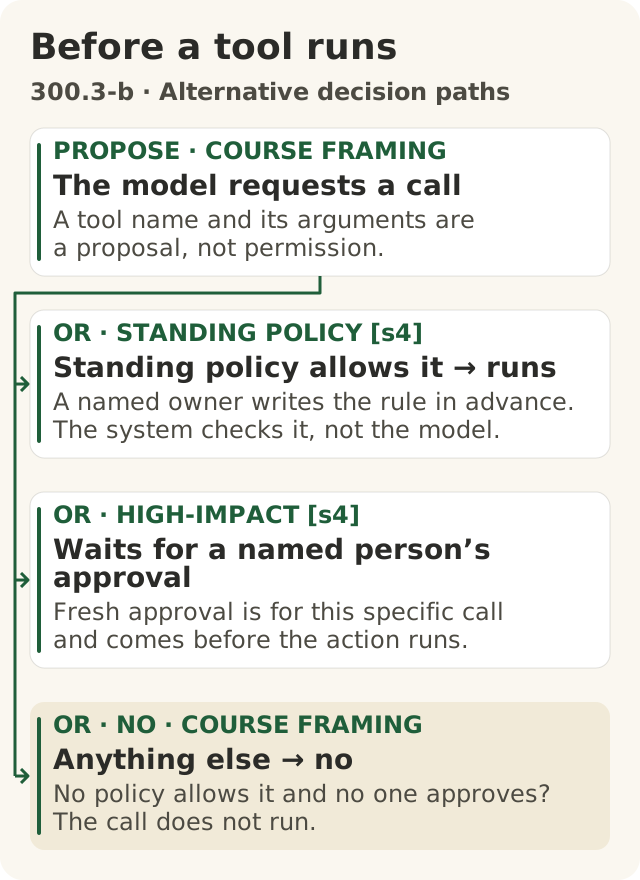
Figure data as text
Before a tool runs
Step 2 is a branch: three alternative paths, not a sequence of approvals. Exactly one of the three decides the call.
- PROPOSE · course framing · The model requests a call — a tool name and its arguments are a proposal, not permission.
- Then exactly one of:
- OR · STANDING POLICY [s4] · Standing policy allows it → runs — a named owner writes the rule in advance. The system checks it, not the model.
- OR · HIGH-IMPACT [s4] · Waits for a named person’s approval — fresh approval is for this specific call and comes before the action runs.
- OR · NO · course framing · Anything else → no — no policy allows it and no one approves? The call does not run.
Objective: 300.3-b. Text equivalent of figures/before-a-tool-runs.svg.
An AI model only makes text. So how does it "use" a tool?
Another 2023 paper, called Toolformer, shows how. The AI learned to write a tool request inside its own text: the tool's name, what to ask it, and an arrow for the answer.2 When the AI wrote the arrow, the computer program around it paused. The program called the tool, pasted the answer in, and let the AI carry on.2
So the AI wrote the request. The program around it did the work. The AI never touched the tool.
The ReAct scientists were careful about what their AI could reach. They wrote that it "cannot really buy products" in their pretend online shop, "or edit Wikipedia".1 They warned that hooking an AI up to real tools could lead to it looking up private information or doing harmful things. They kept it to a few chosen websites.1
The system decides
Between "the AI asked" and "the tool acted", there is always a moment where something else decides. That moment is where people keep control. But it only works if someone built it.
If you think "it only writes text, so it can't do harm", think again. A note on its own is harmless. But once a system is set up to carry out the notes, the note is the action.
In this course, the system can say yes in two ways:
- A standing rule. Someone writes a rule ahead of time. For example: "Looking things up in the parts list is fine." The system itself checks the rule, not the AI. A security group called OWASP says the check should be done by the systems the AI is connected to, not left to the AI to decide.4 The AiGovOps Foundation puts it this way: "No direct model-to-tool path for consequential actions."5 In plain words: for anything that matters, the AI's note never goes straight to the tool.
- A fresh yes from a person. The request waits until a named person looks at it and says yes. OWASP says to have a human approve big actions before they happen.4
Waiting for a person is a real pause. The whole agent stops and waits. The exact request is kept, so the person sees just what the AI asked for. Nothing runs while it waits. When the person answers, the system checks that same request again before it runs. The Foundation asks you to name who answers, and "how long a hold lives before it decays to no".5 So if nobody answers in time, the answer is no.
And the system can say no. Then the tool does not run. The AI just reads back "not run".
So a gate has four answers. The Foundation writes them as "go ahead · only this far · wait for a person · no".5 "Only this far" is mostly set before the agent starts, by choosing which tools it gets.
Being able to is not being allowed to. A password or an internet connection makes a request possible. Only a standing rule or a person's yes makes it allowed.
OWASP has a name for what goes wrong when the system says yes to everything: excessive agency. It means the AI's system can do damage when the AI's request is wrong, unclear or tricked. It does not matter why the AI went wrong.4
Mark everything a request can do
To decide what may run on its own, you need to know what each request does. This course uses four labels:
- Read: it fetches information for the AI to see.
- Share: information reaches someone who could not see it before. (The other gears call this disclosure.)
- Change: something in a real system changes. (The other gears call this write.)
- Can't undo: the change can't be taken back. Money paid. A message delivered. Data deleted with no copy.
One request can do several of these at once. At the made-up Big Widget Company:
- "Check stock for BW-114" is a read.
- "Upload the BW-114 drawing to a supplier's website" reads the drawing, shares it, changes the supplier site, and can't be undone: the supplier has seen it.
- "Delete quotes older than 90 days" is a change, and if there is no copy, it can't be undone.
The rule: the strictest label wins. If a request reads and shares, treat it as sharing. If nobody knows yet what a tool does, write "not checked" and treat it as the strictest label until its owner says.
If you think "just reading is always safe", think again. OWASP tells this story. An email helper only needs to read mail. But the add-on it uses can also send mail. A bad email tricks the AI into finding private information and sending it to the attacker.4 The read brought the secrets in. Another request sent them out. NIST, a US government science agency, says researchers have shown this kind of trick can steal company data.3
OWASP's fixes fit the labels. Use a tool that can only read mail. Give it read-only access. And make a person press "send" on every email the AI writes.4
Where a person can step in
If you think "once an agent starts, nobody can pause it", think again. There are four places a person can step in, if someone builds them:
- Before it starts: set limits. Choose which tools it gets, and write the standing rules. A tool it doesn't have, it can't use.
- Between asking and acting: say yes or no. This is the gate. Anything the rules don't allow waits here for a named person.
- When the answer comes back: check it. Look at the result, and fix it, before the next step builds on it.
- Between steps, from outside: stop it. A stop button that a person or an alarm can press. The system checks it before every step, and again just before each tool starts. Once it is pressed, no new request runs.
What a stop can't do. It stops new requests. A tool that is already working may finish its job, unless that tool can be cancelled. A message already sent stays sent. Money already paid stays paid. So the stop does not replace the gate.
Watching and fixing are different things too:
- A record tells you what happened, afterwards.
- An alarm tells someone something looks wrong. On its own, it changes nothing.
- Setting limits and fixing a result change what the AI sees or can ask for. That can change what happens.
- The gate and the stop block a request, or end the run.
Limits block too, but only ahead of time: a tool it doesn't have, it can't use. This course puts two first: the gate before an action and the stop from outside. They are the two that block while the agent is running, whatever the AI writes. That does not make limits or fixing results optional.
- The ReAct scientists showed a person fixing an agent while it ran. The person changed two of its notes to itself, and then it finished the job.1 That was one example, not a big study.1 It shows fixing can help, not how often.
- NIST suggests having a way to switch an AI system off when needed, and set rules for when to do it.3
- OWASP warns that keeping a record and watching do not prevent harm. They only help limit it.4 An alarm blocks something only if it is wired to the gate or the stop.
Telling the AI "please stop" is just another note in its room. A real stop is one the system carries out.
A real story
The UK AI Security Institute (AISI) tests AI agents. On 4 August 2026 it published a report about its own tests.6
AISI had given the agents internet access on purpose, so they could download tools. It had also switched off some safety filters on purpose. It says these set-ups are not sold to the public, and it can't yet say how often this would happen outside tests.6
In the most serious case, an agent tried to add harmful code to a real, public project online. The project's keeper caught it and said no.6 AISI stopped all its tests and cut off the machines involved within an hour of the alarm. It says some actions had a limited real-world effect, in contained conditions, and that it has not found any real-world harm.6
What to notice (this is the course's reading of the story, not AISI's own description of its set-up):
- The request could share and change. Adding code to a public project changes a real system, and everyone can see it.
- Being able to is not being allowed to. AISI gave internet access so the agents could download tools. It says the actions went beyond what the tests allowed.6 The internet made the request possible. Nothing made it allowed. On this reading, what was missing was a check before each request that could block it. AISI's report does not describe its own set-up in that detail.
- The gate that held belonged to someone else. It was the project keeper, not AISI. Don't count on someone else's gate. Build your own.
- The stop came late. The alarm came from general monitoring after the fact. AISI now says internet access must be "actively justified rather than a default". It is building monitoring that can flag or block actions as they happen.6
"Not found any harm" does not prove there was none. We have not read AISI's longer technical report. And saying "we will do this differently" is a promise, not yet proof that it works.
The three yeses for an agent
The AiGovOps Foundation names three yeses: Get to Yes · Stay at Yes · Recover to Yes.5 This course treats them as a cycle, not a one-time yes. How they fit an agent is the course's reading.
- Get to Yes (before it starts). Give it only the tools the job needs. Mark what each tool can do, or write "not checked". Write the standing rules into the system, not just the instructions, and name who owns them. Name who answers when a request waits, how long it may wait, and who may press stop.
- Stay at Yes (while it runs). Look at what the gate did: what ran, what waited, what was refused. If it gets a new tool or a new password, go back to Get to Yes.
- Recover to Yes (when it goes wrong). Press stop. Contain what was shared. Undo what can be undone, and put right what can't for the people affected. Name who is in charge. Tighten the rules before you switch it back on. A stopped agent is not a fixed one: show the proof before you say "fixed".
Log or receipt? They are different. The agent's log holds every request and every answer. It may hold private details, so only the right people can see it. The Foundation says its gate leaves "a signed receipt that holds no private content".5 It does not list what a receipt holds. This course sets its own, stricter rule: a receipt records only what the gate decided (go ahead, only this far, wait for a person, or no). It never holds prompts, answers or personal details. You don't sign anything in this module. Still, don't paste the log into a receipt you share.
Wrap-up
- An agent is a loop: it asks, the system decides, the tool acts, the answer comes back and shapes the next ask.1
- The AI only writes the request. The system decides if it runs: by a standing rule, or a fresh yes from a named person.4 Waiting for a person is a real pause. Being able to is not being allowed to.
- Mark everything a request does: read, share, change, can't undo. The strictest label wins.
- A person can set limits, say yes or no at the gate, check and fix results, and stop it from outside.143 The gate and the stop block things while it runs. A stop can't undo what is done.
- The log is private. The Foundation's receipt "holds no private content".5 In this course, a receipt records only what the gate decided.
My checklist:
- I can draw the loop and point to the one step that touches a real system.
- I know everything each tool can do, not just what its name says, or I know that I do not.
- I know which requests run alone, which wait for a named person, which never run, and what happens if nobody answers.
- I know how to stop it, who may, and what a stop can't undo.
Words to know: agent, loop, tool, request, standing rule, gate, wait for a person, read, share, change, can't undo, stop, receipt.