
The EU AI Act for builders · Plain gear
Reviewed and published, version 1.0.0. As of 18 Nov 2026. It is not a credential. This is not legal advice. It helps you spot the rules that may apply, so you know what to ask, and who to ask. Big Widget Company is made up.
You will be able to:
- say how the EU's AI law sorts AI by risk, list the rules that may apply to a build on a given day, with the right date, and say what you have not checked;
- say whether Big Widget Company is the maker, the user, or both, for a tool it built or set up;
- spot when a chatbot needs to say "I am AI", and write that line;
- say what real human oversight and record-keeping mean, how they link to the operate gate, and what the gate does not cover.
A law that sorts AI, like a building code
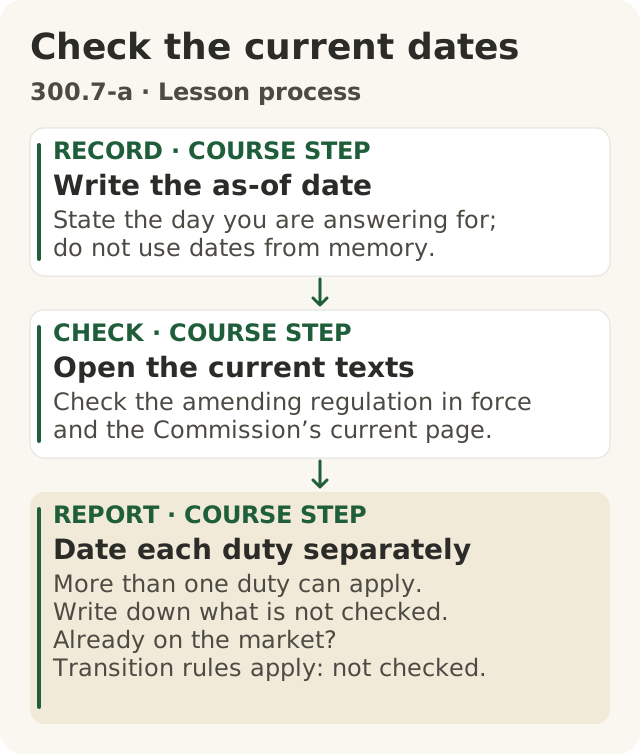
Figure data as text
Check the current dates
- RECORD · course step · Write the as-of date — state the day you are answering for; do not use dates from memory.
- CHECK · course step · Open the current texts — check the amending regulation in force and the Commission’s current page.
- REPORT · course step · Date each duty separately — more than one duty can apply. Write down what is not checked. Already on the market? Transition rules apply: not checked.
The method is the course’s; it follows the amending regulation and Commission overview discussed in the gear (s2).
Objective: 300.7-a. Text equivalent of figures/check-the-current-dates.svg.
The European Union has a law about AI. People call it the AI Act. Some people think it bans AI. It does not.
Think of a building code. A garden shed needs almost no paperwork. A school needs a lot. A few things are simply not allowed. The AI Act works like that. It sorts AI into four levels of risk.1
- Not allowed. A short list of uses is banned.1 One example: using AI to guess how workers or students feel, except for medical or safety reasons.2
- High risk. Some uses need a lot of care. Using AI to sort job applications is one of them.1
- Must say it is AI. Tools that chat with people, or that make pictures, sound, video or text, have to be open about it.2
- Minimal risk. Most AI. This level adds no extra rules of its own.1
There is also a set of rules for the big AI models that many tools are built on.2
One rule covers all AI: learning about it. Even a minimal-risk tool is not rule-free. Any company that makes or uses an AI tool must take steps to help its staff, and others who run or use the tool for it, learn enough about AI for the job. The law calls this AI literacy.2 It does not have to make sure each person reaches a set level. It has to take the steps.2 This rule started on 2 February 2025.1
So the building code has one more line: everyone who works on the building learns the basics, shed or school.
It is not just for EU companies. The law can apply to a company outside the EU, if its AI is used in the EU.2 The EU says the law covers people and groups "inside and outside the EU".3
One tool can be in more than one group. One rule looks at what the tool is for. Another looks at whether it chats with people.42 A tool can do both. So do not pick one box. List every rule you find.
The dates moved
The law was written in 2024. It set dates for each part. But in 2026 the EU passed a change to the law.5 That change moved some dates.52
So the dates in the 2024 law are not always right any more. Here is what the change and the EU's own pages say, as of 18 November 2026:
- Banned uses, and the AI literacy rule: since 2 February 2025.1 A few new bans start on 2 December 2026.52
- Rules for big AI models: since 2 August 2025.1
- "Say it is AI" rules: since 2 August 2026.3
- High-risk tools like hiring tools: from 2 December 2027. The 2024 law had said 2026; the 2026 change moved it.452
- AI inside products like machines: from 2 August 2028.52
The dates have moved once already.1 They could move again. So check the newest change to the law, and the EU's own page, on the day you ask. (That is this course's advice.)
Some tools were already in use before these dates. Special rules can give them different deadlines. For example, a tool that makes AI pictures, sound, video or text, and was already on the market before 2 August 2026, has until 2 December 2026 to add its machine-readable label.5 This lesson has not checked the rest of those rules, or whether any real tool fits them. If your tool was already out there, ask before you use these dates.
Four questions for any build:
- What is it for?
- Where are the people who use it?
- What date are you asking about?
- What are all the rules you can find, and when does each start? What have you not checked?
Try it. It is 18 November 2026. Big Widget builds a tool that sorts job applications (people call these CVs or résumés). It also chats with people who apply from the EU.
- Big Widget makes and uses an AI tool. So the AI literacy rule applies. It already started, in February 2025.21
- Sorting job applications is high risk.1 Those rules start on 2 December 2027. That date comes from the 2026 change, not the 2024 law.52
- It chats with people. So the "say it is AI" rule applies. It already started, on 2 August 2026.3
So the answer is more than one rule. Two of them apply right now. And this list may not be the whole list. Write "not checked" for what you did not look at, and ask your legal team.
Maker or user? Or both?
The law has two main roles. It calls them provider and deployer. In plain words:
- The provider is the maker. It builds an AI tool, or has one built, and puts it out under its own name.2 That counts even if the only user is the maker's own company.2
- The deployer is the user. It uses an AI tool for its work.2
The EU gives an example. A company that makes a tool to sort job applications (CVs) is the maker. A bank that uses that tool is the user.3
Some people think only the AI company has to follow the rules. Others think you are either a maker or a user, never both. Both ideas are wrong.
Think of a bakery that bakes bread and serves it at its own staff lunch. It is the baker and the eater. A company that builds an AI tool and uses it itself is the same.
At Big Widget Company:
- The hiring team (HR) buys a hiring tool and uses it as it comes. Big Widget is the user. One duty: give the job of watching the tool to people with the right skills, training and power to act.2
- The computer team (IT) builds its own hiring tool on a bought AI model, puts Big Widget's name on it, and uses it on Big Widget's own job seekers. Big Widget is the maker and the user.2 As maker, it must build the tool so people can watch over it and step in.2 As user, it must keep the tool's records for at least six months.2
- Someone puts Big Widget's name on another company's high-risk tool. Now Big Widget counts as the maker.2
In every case, Big Widget also has the AI literacy rule.2
And the company that made the AI model underneath? First ask what kind of model it is. Buying a model does not tell you that. The law has extra rules for big, all-purpose models that can do many different jobs.2
- If it is one of those, its maker has its own duties. For example, it must give information to the people who build tools on its model.2
- If it is not, its maker does not have those extra duties. But it may still owe help. When a company makes a high-risk tool, it and the company that supplies parts for the tool (such as the model) must agree in writing what information and help the tool's maker needs. Some free, open-source parts are left out of that rule.25
Your legal team checks which rules fit. Either way, Big Widget still has its own duties.
Say it is AI
Some people think everyone always knows when they are talking to AI. They do not. A chat window with a friendly name and a smiling photo can look like a person.
So the law says a chatbot's maker must make sure people are told they are talking to AI. The only exception is when it is obvious anyway.2 The message must be clear, and it must come at the start, by the first chat at the latest.2 Pictures, sound, video and text made by AI must also carry a label that computers can read.2 And fake videos of real-looking people, called deep fakes, must be shown as fake.2 There are some exceptions, so check the rule for your case.3
At Big Widget Company: the dealer chat. Big Widget built a chat helper for its dealer website. The first screen says "Hi! How can I help with your widget today?" There is a cheerful name and a photo. Nothing says it is AI. That is the missing notice.
A plain line to add, at the very start:
You're chatting with Big Widget's AI assistant, not a person. It can get things wrong. To reach a person, type "agent".
The first sentence is what the law asks for. The other two are this course's good habits. Only offer "type agent" if a real person will answer. And one good line does not make the whole tool legal. It answers one rule.
A person who can really step in
Some people think "human oversight" means someone could look if they wanted to. For high-risk AI, the law asks for much more.
Think of a driving instructor's car. It has a second brake on the instructor's side. The instructor is not just watching. They can stop the car.
For high-risk AI, the law says people must be able to:2
- understand what the tool is doing;
- remember that it is easy to trust a computer too much;
- ignore it, overrule it, or undo what it decided;
- stop it with a "stop" button that brings it to a safe halt.
The tool must also keep records of what it did, by itself, for its whole life.2 The records must help people trace what the tool did and spot when it might be causing harm.2 The company using it must keep those records for at least six months.2 It must also tell workers before it uses such a tool at work.2
Which one is real oversight?
- There is a screen anyone in HR could open. No: nobody is in charge.
- A named recruiter sees every rejection, but cannot undo it. No: a person, but no power.
- A named, trained recruiter sees each suggestion and why, can change it, and can pause the tool. Every step is recorded. Yes.2 Nothing reaches a job seeker until the recruiter says go ahead, changes it, or says no.
The link to the operate gate. In 300.8 you will learn this course's operate gate. It asks for a named person who holds the system, a stop that fails safe, and a receipt for every decision. For high-risk AI, the law asks for some of the same things.2 The gate goes further in some ways, and this course uses it for every system, high risk or not.
But the gate is not the whole law. A maker of high-risk AI must also do things the gate does not cover. It must run a plan for finding and handling risks. It must have a quality system, keep paperwork, and have the tool checked before it goes out.2 So passing the gate does not mean you follow the law. Ask your legal team to check the law's list separately.
And a gate receipt is not the same as the law's records. The receipt holds the decision only: the gate's answer, which rule it used, and who approved. It never holds the words of the request, job applications, chats, scores or anyone's details. The law's records may need more detail. Those are kept somewhere else, under lock, by the rules.
A US guide called the NIST AI Risk Management Framework has similar ideas. It is not a law, and it is not what the EU law says.6
Get to yes, stay at yes, recover to yes
This course has three steps for any AI tool. (These are the course's words, not the law's.)
- Get to Yes (before it starts). Answer the checklist below. Name the person who can step in and stop it. Write the "I am AI" line. Send anything you are not sure about to your legal team. Until they answer, the answer is wait for a person or only this far. For example, the chat can go live with its notice while the sorting stays off. If nobody ever answers, that wait does not turn into a yes. It turns into a no.
- Stay at Yes (while it runs). Check that the named person really looks, and does not just click yes. Check that the "I am AI" line still shows first. If the tool gets a new job or a new name, start again at Get to Yes. That can make Big Widget the maker.2
- Recover to Yes (when it goes wrong). Press stop. Tell the owner and the legal team. Use the records to find who was affected, and put it right. Stopping is not the same as being back at yes. You are back at yes when someone shows the fix works and the owner agrees.
Who decides? Not the AI, and not this lesson. The gate decides each step. A named person can lift a hold. Your legal team decides how the law applies.
Your checklist
- What is it for, where are its users, and what is today's date?
- List every rule you can find, with the date from the newest change to the law.52 Start with AI literacy.2
- Is Big Widget the maker, the user, or both?2
- Does it chat with people? Write the "I am AI" line.2
- Who can really step in and stop it, and where are the records?2
- What did you not check? Write "not checked", and ask your legal team. "I don't know yet" is an honest answer.
Further learning (not a source for this lesson): University of Helsinki, Ethics of AI, a free online course (https://ethics-of-ai.mooc.fi/). It covers fairness and who is responsible. It does not teach this law.