
The EU AI Act for builders · Standard gear
Reviewed and published, version 1.0.0. As of 18 Nov 2026. It is not a credential. Not legal advice: this module teaches you to spot the duties that may apply and to take them to the right person. It does not decide them, and you should not decide them alone. Big Widget Company is made up; its builds are examples written for this lesson.
You will be able to:
- explain how the EU AI Act sorts AI by risk and, for a build, list the duties that may apply on a given date, check each date against the latest amendment, and say which routes you have not checked (300.7-a);
- decide whether Big Widget Company is the provider, the deployer or both for a system it built or configured, and name one duty that follows from each (300.7-b);
- spot when a chatbot or generated content needs a notice that it is AI, and write one (300.7-c);
- explain human oversight and record-keeping as duties for high-risk systems, link them to the operate gate, and say what the gate does not cover (300.7-d).
This module folds in the Foundation's Learn 103, EU AI Act for builders. It sits in the governing strand next to 300.8, the operate gate. The Act is the law. The gate is this course's way of holding a system. They ask for some of the same things, but holding the gate is not the same as complying with the Act. Section 5 shows where they differ.
1. How the Act sorts AI
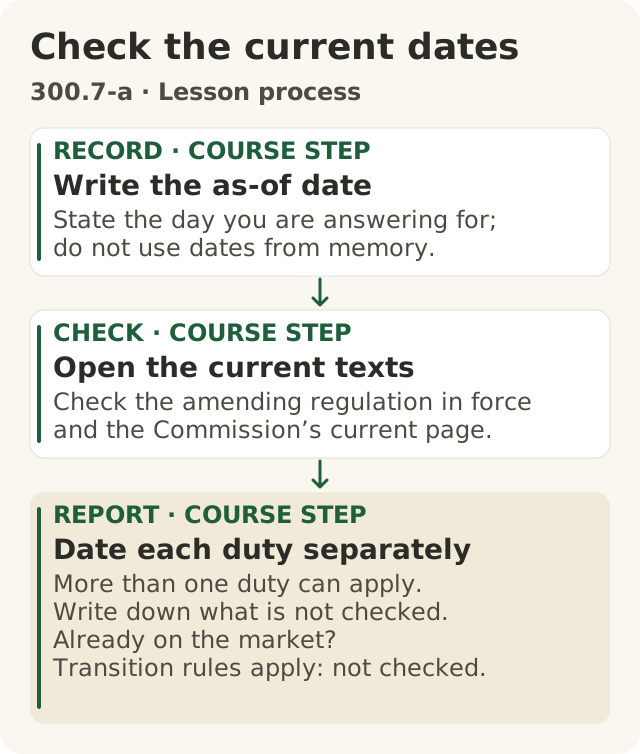
Figure data as text
Check the current dates
- RECORD · course step · Write the as-of date — state the day you are answering for; do not use dates from memory.
- CHECK · course step · Open the current texts — check the amending regulation in force and the Commission’s current page.
- REPORT · course step · Date each duty separately — more than one duty can apply. Write down what is not checked. Already on the market? Transition rules apply: not checked.
The method is the course’s; it follows the amending regulation and Commission overview discussed in the gear (s2).
Objective: 300.7-a. Text equivalent of figures/check-the-current-dates.svg.
Three misconceptions come up first. The AI Act bans AI. It only applies to EU companies. Each system goes in exactly one box. All three are wrong.
It sorts by risk. It does not ban AI. The European Commission describes the Act as defining four levels of risk for AI systems: unacceptable risk, high risk, transparency risk, and minimal or no risk.1 For the last level, "The AI Act does not introduce rules for AI that is deemed minimal or no risk."1 Only the first level is banned.1
Read that "no rules" carefully. It means the minimal-risk level adds no rules of its own. It does not mean a minimal-risk system carries no duty under the Act. One duty, AI literacy, is set for providers and deployers of AI systems in general, not for one risk level (Article 4, below).2
The parts a builder meets are:
| Part of the Act | What it covers | Where |
|---|---|---|
| AI literacy | Providers and deployers of AI systems "shall take measures to support the development of AI literacy" of their staff and others who operate or use the systems on their behalf | Article 42 |
| Prohibited practices | A short list of banned uses, with narrow exceptions written into some of them: for example social scoring, or inferring the emotions of a person "in the areas of workplace and education institutions" (except for medical or safety reasons) | Article 52 |
| High-risk systems | Uses listed in Annex III are high-risk;2 the Commission's examples include AI for employment, such as CV-sorting software for recruitment.1 AI intended to be used as a safety component of a product can also be high-risk, under the two conditions of Article 6(1) and Annex I2 | Article 6 with Annexes I and III32 |
| Transparency duties | Systems that talk with people, and systems that generate or manipulate content | Article 502 |
| General-purpose AI models | Models that display "significant generality" and can perform "a wide range of distinct tasks"; their providers keep technical documentation and give information to the providers who build on them | Articles 3(63) and 532 |
AI literacy (Article 4). As the Service Desk shows it, marked as amended in 2026, Article 4 says providers and deployers of AI systems "shall take measures to support the development of AI literacy of their staff and other persons dealing with the operation and use of AI systems on their behalf", taking into account their knowledge, experience, education and training and the context of use.2 It adds: "This obligation does not require providers or deployers to guarantee any specific level of AI literacy of any individual."2 The Commission dates the AI literacy obligations to 2 February 2025.1 So a quiet, minimal-risk tool that never talks to anyone still sits under this duty for the company that builds or uses it. The duty is to take measures, not to promise that each person reaches a set level.
Being on the Annex III list is not quite the end of it. Article 6(3) lets an Annex III system escape high-risk status where "it does not pose a significant risk of harm to the health, safety or fundamental rights of natural persons", under listed conditions, but an Annex III system "shall always be considered to be high-risk where the AI system performs profiling of natural persons".2 A tool that scores job applicants is likely to profile them, so do not count on that exit. Whether it applies is a question for your legal owner, answered in writing.
It is not only for EU companies. The Act covers providers that place AI systems on the EU market "irrespective of whether those providers are established or located within the Union", deployers in the EU, and providers and deployers in a third country "where the output produced by the AI system is used in the Union".2 The Commission puts it simply: the framework "applies to both public and private actors inside and outside the EU".4 Where a company has its head office does not settle the question. For any real build, ask where its users are and where its output is used.
One system, several duties. The parts are triggered by different facts. Article 6 asks what the system is used for.32 Article 50 asks whether it interacts with people or generates content.2 Article 4 asks only whether you provide or deploy an AI system.2 One system can meet several triggers, so list every duty you find, not one box.
2. Dates move: check the amendment, not the 2024 text
The fourth misconception is the 2024 dates still hold. They do not all hold.
As published in 2024, Article 113 made the Act apply generally from 2 August 2026, with Article 6(1) from 2 August 2027.3 Then Regulation (EU) 2026/1744, the Digital Omnibus on AI, dated 8 July 2026, replaced Article 113's point (c).5 The Commission says the Omnibus "entered into force on 27 July 2026".1 As amended:
| What | Applies from | Source of the date |
|---|---|---|
| Prohibited practices and AI literacy | 2 February 2025 | Commission overview1 |
| Some new prohibitions added by the Omnibus | 2 December 2026 | Regulation (EU) 2026/1744;5 consolidated Article 113(a)2 |
| Rules for general-purpose AI models | 2 August 2025 | Commission overview1 |
| Transparency duties (Article 50) | 2 August 2026 | Commission FAQ;4 amended Article 113 names no separate date for Article 502 |
| High-risk systems under Article 6(2) and Annex III (for example, hiring tools) | 2 December 2027 | Regulation (EU) 2026/1744;5 consolidated Article 113(c)2 |
| High-risk systems under Article 6(1) and Annex I (AI in regulated products) | 2 August 2028 | Regulation (EU) 2026/1744;5 consolidated Article 113(c)2 |
The dates have moved once already.1 They could move again, so check the newest amendment and the Commission's current page on the day you answer. (That last sentence is this course's advice, not a quotation.)
Two cautions. First, the amending regulation and the Commission's page are what move the date; an article you read in a 2024 copy may be out of date, and the Commission's own overview attributes its high-risk dates to "the political agreement" while the regulation is the adopted text.15 Second, systems already on the market have their own transition rules (Article 111), and the Omnibus changed them. Two examples show why the table is not enough for them. A provider of a system that generates synthetic audio, images, video or text, placed on the market before 2 August 2026, has until 2 December 2026 to comply with the marking duty in Article 50(2) (new Article 111(4)).5 And for a high-risk system placed on the market or put into service before the high-risk date (other than the systems Article 111(1) deals with), the Act applies to its operators only if the system later goes through "significant changes in their designs", the prohibitions aside; high-risk systems meant for public authorities must comply by 2 August 2030 (amended Article 111(2)).5 This module has not checked whether any real system qualifies for these rules, the other parts of Article 111, or what the Omnibus's new Article 50(7), on codes of practice, changes in practice.5 Do not apply the table to a system that was on the market before these dates until someone has checked. Not checked means: look it up, or ask, before you rely on it.
The method. For any build, write down four facts and then list duties:
- Intended use. What is it for? Is that use on the prohibited list, in Annex III, or a safety component of an Annex I product?
- Where its users are, and where its output is used.2
- The as-of date you are answering for.
- Every duty you can find (more than one can apply), each with the date it applies, taken from the amending regulation in force and the Commission's current page, not from memory or a 2024 copy. Start with AI literacy, which applies to every provider and deployer.2 Then write down what you have not checked.
Worked example (as of 18 November 2026). Big Widget builds a tool that screens CVs (job applications, also called résumés) and also chats with applicants in the EU.
- AI literacy. Big Widget builds and uses an AI system, so Article 4 applies: it must take measures to support the AI literacy of the staff who run and use the tool.2 That has applied since 2 February 2025.1
- High-risk use. Recruitment is an employment use the Commission lists as high-risk,1 and a tool that scores applicants is likely to profile them, which would rule out the Article 6(3) exit.2 Its high-risk duties apply from 2 December 2027, a date set by Regulation (EU) 2026/1744, not by the 2024 text.52
- Transparency duty. It chats with people, so Article 50 applies, and has since 2 August 2026.4
- So the answer is several duties, each with its own date. "High-risk, so we have until December 2027" is wrong: the chat notice and the literacy measures are due now.
- Not checked here: transition rules, exceptions, and the deployer duties you will meet in sections 3 and 5. The list is where your legal owner starts, not where they finish.
3. Provider, deployer, or both
The misconception: only the model vendor has duties, and a company is either the provider or the deployer, never both. The Act's definitions say otherwise.
- A provider is one who "develops an AI system or a general-purpose AI model or that has an AI system or a general-purpose AI model developed" and places it on the market or puts it into service "under its own name or trademark, whether for payment or free of charge" (Article 3(3)).2
- Putting into service includes "the supply of an AI system for first use directly to the deployer or for own use in the Union" (Article 3(11)).2 Building a tool for your own staff counts.
- A deployer is one "using an AI system under its authority", except in "a personal non-professional activity" (Article 3(4)).2
The Commission's own example: a developer of a CV-screening tool is a provider, and a bank using the tool is a deployer.4
When a deployer becomes a provider. Under Article 25(1), a distributor, importer, deployer or other third party "shall be considered to be a provider of a high-risk AI system" if it puts "their name or trademark on a high-risk AI system already placed on the market or put into service", makes "a substantial modification to a high-risk AI system", or changes the intended purpose of a system, including a general-purpose one, so that it "becomes a high-risk AI system in accordance with Article 6".2 The first provider then "shall no longer be considered to be a provider of that specific AI system", though it must still cooperate.2 Each of these routes has its own conditions; a legal owner confirms which one, if any, fits.
At Big Widget Company: three builds. (HR is the hiring team; IT is the computer team.)
| Build | Capacity | One duty that follows |
|---|---|---|
| HR buys a vendor's CV-screening tool and uses it as sold | Deployer | Assign human oversight to people "who have the necessary competence, training and authority" (Article 26(2))2 |
| IT builds a hiring tool on a bought model, puts Big Widget's name on it, and uses it on Big Widget's own applicants | Provider (it developed the system and put it into service for own use under its name) and deployer (it uses it under its authority)2 | As provider: design it so people can effectively oversee it (Article 14).2 As deployer: keep its automatic logs for at least six months (Article 26(6)).2 |
| Procurement takes a vendor's high-risk tool and relabels it as Big Widget's | Provider under Article 25(1)(a)2 | The provider duties now sit with Big Widget for that system2 |
In all three, Big Widget also owes the Article 4 literacy measures, as provider, deployer or both.2
And the model vendor? First ask what kind of model it is. Buying a model does not by itself make it a general-purpose AI model: that depends on whether it "displays significant generality" (Article 3(63)).2 Two cases:
- If it is a general-purpose AI model, its provider has its own duties, for example to keep technical documentation and to make information available "to providers of AI systems" who build on the model (Article 53(1)).2 Ask the vendor for that information; you will need it.
- If it is not, the vendor is not a general-purpose model provider. That does not mean it owes nothing. For a high-risk system, the provider and a third party that supplies an AI system, AI model, tools, services or components used in it must agree in writing the information and help the provider needs to comply (Article 25(4)). Some suppliers of free and open-source components are excepted.2 The words "AI model" were added by the 2026 amendment.35
Either way, Big Widget has its own duties. Which of the vendor's duties apply is a question for your legal owner, answered in writing; this lesson has not checked any real vendor.
Where a hiring tool's high-risk duties are not yet in application (see section 2), name the capacities now anyway. They decide who must do what on the day the duties apply.
4. Telling people it is AI
The misconception: people always know when they are talking to AI. The Act does not assume so.
- Chatbots (Article 50(1)). Providers must design systems that interact directly with people so that the people are "informed that they are interacting with an AI system", unless that is obvious to someone "reasonably well-informed, observant and circumspect" in the circumstances.2
- Generated content (Article 50(2)). Providers of systems that generate synthetic audio, images, video or text must make sure the outputs "are marked in a machine-readable format and detectable as artificially generated or manipulated".2
- Deep fakes and public-interest text (Article 50(4)). For deep fakes, deployers "shall disclose that the content has been artificially generated or manipulated". For AI text "published with the purpose of informing the public on matters of public interest", they "shall disclose that the text has been artificially generated or manipulated", subject to the article's conditions.2
- How (Article 50(5)). "In a clear and distinguishable manner at the latest at the time of the first interaction or exposure", and meeting accessibility requirements.2
"Specific exceptions apply to all the transparency obligations mentioned," the Commission notes, so check the article for your case.4 These duties have applied since 2 August 2026.4
At Big Widget Company: the dealer chat. Big Widget builds a chat assistant on its dealer website. Big Widget built it, so it is the provider, and Article 50(1) is its duty.2 Its first screen says "Hi! How can I help with your widget today?" with a cheerful name and a photo. Nothing says it is AI. That screen is missing the notice.
A plain-words notice, shown before or with the first message:
You're chatting with Big Widget's AI assistant, not a person. It can get things wrong. To reach a person, type "agent".
The first sentence is the disclosure the Act asks for. The other two are this course's good practice, not a quotation of the law: say what it can get wrong, and give a way to a person. Only promise a way to a person if one really exists: someone has to answer when a customer types "agent". A notice on screen does not by itself make the whole chat lawful; it answers one duty.
5. Human oversight and records, and the operate gate
The misconception: human oversight means someone could look at it if they wanted to. For high-risk systems, the Act asks for far more.
Oversight built in (provider, Article 14). High-risk systems must be designed so "they can be effectively overseen by natural persons during the period in which they are in use".2 The people overseeing must be able, among other things:2
- to remain aware of over-relying on the output, which the Act calls "(automation bias)";
- "to decide, in any particular situation, not to use the high-risk AI system" "or to otherwise disregard, override or reverse the output";
- to "interrupt the system through a ‘stop’ button or a similar procedure" "that allows the system to come to a halt in a safe state".
Records (provider, Article 12; deployer, Article 26). "High-risk AI systems shall technically allow for the automatic recording of events (logs) over the lifetime of the system."2 Those logs have a purpose. "In order to ensure a level of traceability of the functioning of a high-risk AI system" that suits its intended purpose, they must record events relevant for spotting situations where the system may present a risk, for post-market monitoring, and for the deployer's monitoring of its operation (Article 12(2)).2 Deployers must use the system "in accordance with the instructions for use", assign oversight to people "who have the necessary competence, training and authority", "monitor the operation", and keep the logs the system generates for "at least six months, unless provided otherwise in applicable Union or national law".2 Employers must inform "workers’ representatives and the affected workers" before using a high-risk system at work, and deployers of Annex III systems that make or help make decisions about people must "inform the natural persons that they are subject to the use of the high-risk AI system".2
Three setups. Which is oversight?
- A dashboard exists. Anyone in HR could open it.
- A named recruiter reviews every rejection, but the tool sends rejections at once and the recruiter cannot reverse them.
- A named, trained recruiter sees each recommendation with its reasons, can override it, and can pause the tool, which then stops sending anything; every action is logged.
Only setup 3 lets a person understand, override and stop the system, as Article 14 describes.2 Setup 1 is "someone could look". Setup 2 has a person but no power. In gate terms, setup 3 turns each recommendation into wait for a person: nothing goes to an applicant until the recruiter says go ahead, changes it (only this far) or says no. (The gate words are this course's, not the Act's.)
The link to the operate gate. 300.8 teaches the gate this course uses to hold a running system. Some of the Act's oversight and record duties line up with parts of it:
| Operate gate (course) | The Act, for high-risk systems |
|---|---|
| A named holder, with an approval that expires | Oversight assigned to people with competence, training and authority (Article 26(2))2 |
| A rubber stamp is not review | Awareness of automation bias (Article 14(4)(b))2 |
| A stop that fails closed | A stop that brings the system "to a halt in a safe state" (Article 14(4)(e))2 |
| A receipt for every gate decision, holding no private content | Automatic logs (Article 12(1)) that record the events Article 12(2) names, kept by the deployer (Article 26(6))2 |
The last row is a link, not a match. The gate's receipt holds the decision as metadata (the gate's answer, the rule it applied, who approved, and hashes rather than content), never the request's words, applicants' details or the model's output. Logs that let someone trace how the system worked and spot risks may need more than that. Those logs are a separate, controlled work record, kept as the law and your workplace require. Whether your logs give the traceability Article 12(2) asks for is a question to check, not something the receipt proves.
What the gate does not cover. Running the gate is not the same as complying with the Act. A provider of a high-risk system has duties the gate does not touch, among them:2
- a risk management system that "shall be established, implemented, documented and maintained" (Article 9(1));
- "a quality management system in place which complies with Article 17" (Article 16(c));
- keeping the required documentation (Article 16(d));
- the relevant conformity assessment procedure before the system is placed on the market or put into service (Article 16(f)), an EU declaration of conformity and the CE marking (Article 16(g), (h));
- "the necessary corrective actions" when something is wrong (Article 16(j)).
The gate is stricter than the law in places: its approvals expire, and this course uses it for every system, high-risk or not. It is silent in others. So keep two things apart: the gate, which is the course's habit for holding any system, and a use-specific check of what the Act requires, done with your legal or compliance owner. Neither replaces the other.
For comparison only: the US NIST AI Risk Management Framework is voluntary and creates no legal duty, but it also asks organisations to govern AI risk and to manage systems after release.6 It is not evidence of what the Act requires.
6. Get to Yes, Stay at Yes, Recover to Yes
This module's work fits the course's lifecycle: Get to Yes · Stay at Yes · Recover to Yes. A yes is not a blanket licence. It covers this use, these users and this date, and a named person gives it. (This section is the course's own framing, not the Act's.)
- Get to Yes (before it ships). Run the checklist below. Every duty you found has a date and an owner. The notice is written and shown at the first interaction. The oversight holder is named, can override and can stop. Every not checked item has gone to the legal owner. Until each has an answer, the gate's answer is wait for a person or only this far: for example, the chat may go live with its notice while the scoring stays off. A hold that nobody answers does not turn into a yes; if it stays unanswered, treat it as no.
- Stay at Yes (while it runs). Check that the named holder is really reviewing, not stamping. Check after each release that the notice still appears first. Re-check dates when the law changes. A new use, a new name on the tool or a substantial change can change who is the provider (Article 25),2 so it sends you back to Get to Yes.
- Recover to Yes (when it goes wrong). Use the stop. Tell the named owner and the legal or compliance owner. Use the logs to find what the tool decided and for whom, and put it right for the people affected. A provider of a high-risk system also has its own duty to take corrective action and give information (Article 16(j)).2 Stopping is not the same as being back at yes. You are back at yes when someone can show that the fix works and the owner agrees.
Who decides. The gate decides each action; a named person can release a hold. Your legal or compliance owner decides how the Act applies to a real build. An AI assistant does not decide any of these, and neither does this course.
Keep the decision, not the secret. A shareable receipt of a gate decision holds the decision, never CVs, chat transcripts, scores or anyone's personal details. Those belong in the separate, controlled logs and work records the law and your workplace require. (This is a course rule.)
Not sure? "I don't know yet" is an honest answer. Write not checked, and take it to the owner before it ships.
7. Your checklist
For any Big Widget build:
- Use, users, date. Write the intended use, where the users and output are, and the as-of date.
- Every duty, every date. AI literacy? Prohibited? Annex III or Annex I? Talks to people or generates content? List all that may apply, each dated from the amending regulation in force and the Commission's current page.512
- Capacities. Provider, deployer, or both? Did anyone relabel, substantially modify or repurpose a system?2
- Notice. If it talks to people, write the notice and show it at the first interaction.2
- Oversight and records. Who holds it, can they override and stop it, and where are the logs? Link each answer to the operate gate, then list what the gate does not cover.2
- Not checked. Write down every route you did not check (transitions, exceptions, other provider and deployer duties) and take the list to your legal or compliance owner. This module is not legal advice.
Words to know: provider, deployer, putting into service, AI literacy, high-risk, Annex III, Annex I, transparency duty, general-purpose AI model, human oversight, automation bias, logs, traceability, risk management system, conformity assessment, amending regulation.
Further learning (not a source for this module): University of Helsinki, Ethics of AI, a free online course (https://ethics-of-ai.mooc.fi/, CC BY-NC-SA 4.0), for background on accountability and human review. It does not teach the Act.