
The EU AI Act for builders · Technical gear
Reviewed and published, version 1.0.0. As of 18 Nov 2026. It is not a credential. Not legal advice. Article text is quoted from the Commission's AI Act Service Desk, which reproduces the EUR-Lex consolidated version as at 27 July 2026;1 the Official Journal texts (s1, s6) are authoritative. Big Widget Company is made up.
Objectives:
- 300.7-a Model the Act as a set of independently triggered duty families (a cross-cutting AI literacy duty, prohibited practices, high-risk requirements, transparency obligations, general-purpose AI model obligations), and for a given (intended use, user location, as-of date) return the duties that may apply with their application dates resolved against the amending regulation in force, and an explicit list of routes not modelled.
- 300.7-b Determine Big Widget's capacities (provider, deployer, or both) for a system it built or configured under Articles 3 and 25, and derive one duty per capacity.
- 300.7-c Identify Article 50 triggers for interactive systems and generated content, and write a first-interaction notice that supplies the disclosure Article 50(1) asks for.
- 300.7-d Specify human oversight (Article 14) and record-keeping (Articles 12 and 26) as high-risk duties, map them to the operate gate (300.8), and state what the gate does not cover.
1. Duty families and their triggers
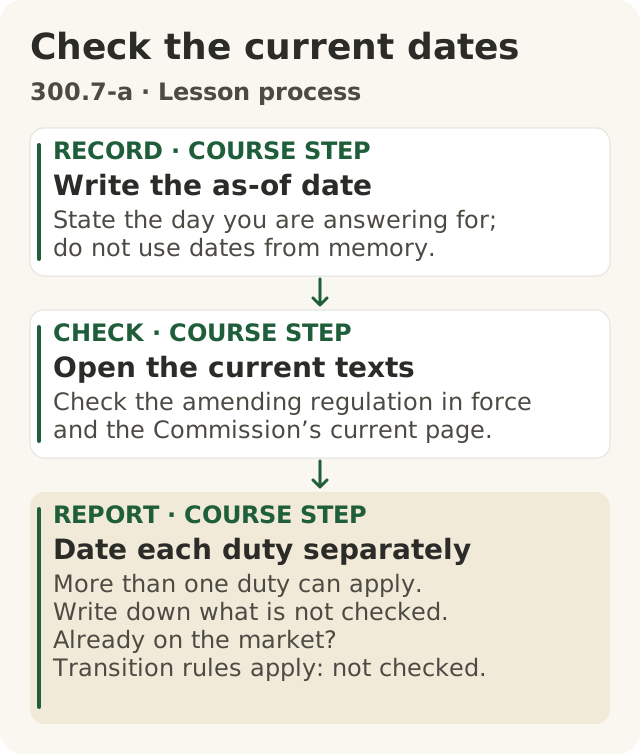
Figure data as text
Check the current dates
- RECORD · course step · Write the as-of date — state the day you are answering for; do not use dates from memory.
- CHECK · course step · Open the current texts — check the amending regulation in force and the Commission’s current page.
- REPORT · course step · Date each duty separately — more than one duty can apply. Write down what is not checked. Already on the market? Transition rules apply: not checked.
The method is the course’s; it follows the amending regulation and Commission overview discussed in the gear (s2).
Objective: 300.7-a. Text equivalent of figures/check-the-current-dates.svg.
The Commission frames the Act around four risk levels: unacceptable, high, transparency, and minimal or no risk, with no new rules for the last.2 Read that as "no additional requirements from the minimal-risk level", not "no duty": Art. 4 binds providers and deployers of AI systems without reference to a risk level.1 For an engineer the useful model is not a single classifier output but a set of predicates, each with its own trigger and date:
| Family | Trigger | Provisions |
|---|---|---|
| AI literacy | Actor is a provider or deployer of an AI system. Duty: "shall take measures to support the development of AI literacy" of staff and others operating or using the systems on their behalf | Art. 41 |
| Prohibited practices | The practice is listed, e.g. inferring "emotions of a natural person in the areas of workplace and education institutions", save "for medical or safety reasons"; several points carry their own exceptions or conditions | Art. 5(1)1 |
| High-risk | Art. 6(2): "AI systems referred to in Annex III shall be considered to be high-risk", subject to the Art. 6(3) derogation; Art. 6(1) and Annex I for safety components of regulated products, where both Art. 6(1) conditions hold13 | Chapter III |
| Transparency | Interacts directly with natural persons; generates or manipulates content; deploys deep fakes | Art. 501 |
| GPAI model | A model that "displays significant generality and is capable of competently performing a wide range of distinct tasks" | Art. 3(63), Art. 531 |
The families are not mutually exclusive: Art. 6 keys on intended purpose,31 Art. 50 on interaction and output modality,1 Art. 4 on the actor's role.1 A system can satisfy several predicates, so the output is a set, not a label.
Art. 6(1a)–(1c), new. The Omnibus (Art. 1(8)) narrows "safety component", including for the Annex I route: AI systems "solely used for non-safety related aspects of user assistance, performance optimisation, service efficiency, automation or convenience or quality control shall not qualify as safety components", unless their "failure or malfunctioning … would endanger health and safety" (6(1b)). 6(1c) excludes products that need third-party conformity assessment "solely due to risks other than risks to health and safety" from condition (b).4 Whether a real product component falls inside is a legal-owner question.
Art. 4 as amended. The Service Desk marks Art. 4 amended. Its first paragraph now reads that providers and deployers "shall take measures to support the development of AI literacy of their staff and other persons dealing with the operation and use of AI systems on their behalf", taking into account their technical knowledge, experience, education, training and the context of use, and "This obligation does not require providers or deployers to guarantee any specific level of AI literacy of any individual."1 The Commission dates the AI literacy obligations to 2 February 2025.2 Model it as an obligation to take measures, not as an outcome to certify.
The Art. 6(3) derogation. An Annex III system is not high-risk where "it does not pose a significant risk of harm to the health, safety or fundamental rights of natural persons" under the listed conditions, but "an AI system referred to in Annex III shall always be considered to be high-risk where the AI system performs profiling of natural persons".1 Applicant-scoring systems are likely to profile; treat the derogation as unavailable unless a legal owner documents otherwise.
Territorial scope (Art. 2(1)). In scope: providers placing systems on the Union market "irrespective of whether those providers are established or located within the Union"; deployers established or located in the Union; and third-country providers and deployers "where the output produced by the AI system is used in the Union".1 The Commission: the framework "applies to both public and private actors inside and outside the EU".5 Headquarters location alone does not resolve the predicate.
2. Resolving application dates
The 2024 Art. 113 set general application from 2 August 2026 and Art. 6(1) from 2 August 2027.3 Regulation (EU) 2026/1744 (Digital Omnibus on AI, 8 July 2026) replaced Art. 113 point (c) and dated certain new Art. 5 prohibitions.4 The consolidated Art. 113 now reads, in the parts that matter here:1
- general application: "It shall apply from 2 August 2026.";
- (a) Chapters I and II from 2 February 2025, except Art. 5(1) points (ba) and (bb) and Art. 5(1a) and (1b), "which shall apply from 2 December 2026";
- (b) Chapter III Section 4, Chapters V, VII and XII and Art. 78 "shall apply from 2 August 2025, with the exception of Article 101";
- (c) Chapter III Sections 1 to 3, except Art. 6(5): "2 December 2027 as regards AI systems classified as high-risk pursuant to Article 6(2) and Annex III" and "2 August 2028 as regards AI systems classified as high-risk pursuant to Article 6(1) and Annex I".
Art. 50 sits outside Chapters I to III and is not named in any amended point, so it falls under the general date; the Commission's FAQ states Art. 50 obligations "will become applicable on 2 August 2026".15 The dates have already moved once;2 re-resolve them against the amending regulation in force on every as-of date (course practice, not a quoted rule).
Legacy systems (Art. 111). The Omnibus also amended the transitions, so the table above is not a valid answer for a system already on the market. Two amended points, read in the amending text:4
- new Art. 111(4): providers of systems "generating synthetic audio, image, video or text content, that have been placed on the market before 2 August 2026 shall take the necessary steps in order to comply with Article 50(2) by 2 December 2026". This shifts the 50(2) marking deadline for those systems only; it does not move 50(1);
- replaced Art. 111(2): high-risk systems (other than those in 111(1)) placed on the market or put into service before the Chapter III date are in scope "only if, as from that date, those systems are subject to significant changes in their designs", without prejudice to Art. 5; those "intended to be used by public authorities" must comply "by 2 August 2030".
The Omnibus also replaced Art. 50(7) (codes of practice).4 Not checked by this module: the rest of Art. 111, any system's eligibility for these transitions, and the effect of the 50(7) change. Resolve a legacy system's Art. 111 position with the legal owner before using the table.
A teaching sketch, as pseudo-code. It is not a duty resolver or a legal classifier: it models Art. 4, Art. 5, Art. 6(1)/(2) and Art. 50(1)/(2) only, and it says so in its output. Every date must come from the amending regulation in force or the consolidated text, never a 2024 copy:
NOT_MODELLED = [
    "Art. 53 GPAI model duties (upstream)",
    "Art. 50(4) deployer disclosure (deep fakes, public-interest text)",
    "Art. 26 deployer duties; Art. 25 role transfers",
    "Art. 111 transitions for systems already on the market",
    "exceptions and conditions inside Arts. 5 and 50",
]

def duty_sketch(system, as_of):
    """Illustration only. An empty duty list must never be read as 'no duties'."""
    if not system.scope_resolved:          # Art. 2(1): EU market, EU deployer, or output used in EU
        return {"duties": [], "not_checked": ["Art. 2 scope: ask the legal owner"] + NOT_MODELLED}
    out = [("AI literacy measures", date_for("Art. 4"))]                  # every provider/deployer
    if is_prohibited(system.intended_use):                                # Art. 5
        out.append(("prohibited", date_for("Art. 5", system.intended_use)))
    if annex_i_safety_component(system):                                  # Art. 6(1): both conditions
        out.append(("high-risk, Annex I", date_for("Art. 113(c)(ii)")))   # 2028-08-02 as amended
    if in_annex_iii(system.intended_use) and not derogation_documented(system):  # Art. 6(2), 6(3)
        out.append(("high-risk, Annex III", date_for("Art. 113(c)(i)")))  # 2027-12-02 as amended
    if system.interacts:                                                  # Art. 50(1)
        out.append(("transparency: AI interaction notice", date_for("Art. 50")))
    if system.generates:                                                  # Art. 50(2)
        out.append(("transparency: machine-readable marking", date_for("Art. 50")))
    duties = [(d, when, "in application" if when <= as_of else "not yet") for d, when in out]
    return {"duties": duties, "not_checked": NOT_MODELLED}
Design notes. The function never returns a bare empty list: the not_checked field travels with every answer, so a consumer cannot mistake "outside this sketch" for "no duties". The helper predicates (is_prohibited, annex_i_safety_component, in_annex_iii, derogation_documented) are where the legal judgement lives; in a real build each one is a recorded answer from a named legal owner, not code.
Worked case, as of 2026-11-18. A Big Widget CV screener that also chats with EU applicants. Big Widget builds and uses it, so Art. 4 attaches, in application since 2025-02-02.12 Recruitment is an employment use the Commission lists as high-risk ("CV-sorting software for recruitment");2 the high-risk set applies from 2027-12-02, a date set by Regulation (EU) 2026/1744, not by the 2024 text.41 The chat triggers Art. 50(1), in application since 2026-08-02.5 Result: {AI literacy (in application), high-risk Annex III (not yet), transparency (in application)}, plus the not_checked list for the legal owner.
3. Capacities: provider, deployer, or both
Definitions (Art. 3):1
- Provider (3(3)): one that "develops an AI system or a general-purpose AI model or that has an AI system or a general-purpose AI model developed" and places it on the market or puts it into service "under its own name or trademark, whether for payment or free of charge".
- Putting into service (3(11)): "the supply of an AI system for first use directly to the deployer or for own use in the Union" "for its intended purpose".
- Deployer (3(4)): "using an AI system under its authority", "except where the AI system is used in the course of a personal non-professional activity".
Capacities are attributes of an actor relative to a system, not exclusive types. An in-house build used internally satisfies 3(3) via 3(11) "own use" and 3(4).1 The Commission's example separates them across two firms (a CV-screening tool's developer as provider, a bank using it as deployer),5 but nothing in the definitions forbids one firm holding both.
Role transfer (Art. 25). A distributor, importer, deployer or other third party "shall be considered to be a provider of a high-risk AI system" where it (a) puts "their name or trademark on a high-risk AI system already placed on the market or put into service", (b) makes "a substantial modification to a high-risk AI system", or (c) modifies "the intended purpose of an AI system, including a general-purpose AI system" so that it "becomes a high-risk AI system in accordance with Article 6".1 The initial provider then "shall no longer be considered to be a provider of that specific AI system for the purposes of this Regulation" (Art. 25(2), marked amended by the Omnibus on the Service Desk), with a duty to cooperate.1 Each limb has its own conditions; route the determination to the legal owner.
Upstream. Classify the model before assigning upstream duties: whether a bought model is a GPAI model is a 3(63) question ("significant generality"), not implied by the purchase.1
- If 3(63) is met: the GPAI model provider must, among other things, "draw up and keep up-to-date the technical documentation of the model" and "draw up, keep up-to-date and make available information and documentation to providers of AI systems" (Art. 53(1)(a), (b)).1 Rules for GPAI models have applied since August 2025.2 Request the 53(1)(b) package; your own provider duties depend on it. Art. 53(2) exempts some models released under a free and open-source licence with their weights made public from 53(1)(a) and (b), but not GPAI models with systemic risk;3 whether any real model qualifies is not checked here.
- If 3(63) is not met: the vendor carries no Art. 53 duties, but a non-GPAI supplier is not thereby duty-free. For a high-risk system, Art. 25(4), as amended by the Omnibus (Art. 1(12)(b)), requires the provider and "the third party that supplies an AI system, AI model, tools, services, components, or processes that are used or integrated in a high-risk AI system" to "specify the necessary information, capabilities, technical access and other assistance" by written agreement, with an exception for some free and open-source supplies (other than GPAI models).14 The 2024 text did not name an "AI model"; the amendment names a model supplier outright.34
The classification and which supplier duties attach are legal-owner determinations; this module has not checked any real vendor.
| Big Widget build | Capacity | One duty per capacity |
|---|---|---|
| Bought high-risk screener, used as supplied | Deployer | Art. 26(2): oversight by persons "who have the necessary competence, training and authority"1 |
| In-house hiring tool on a bought model, Big Widget-branded, used on own applicants | Provider and deployer1 | Provider: Art. 14 design for effective oversight. Deployer: Art. 26(6) retain logs "of at least six months"1 |
| Vendor's high-risk tool relabelled as Big Widget's | Provider via Art. 25(1)(a)1 | Provider duties for that system, including Art. 12 logging capability1 |
| A general-purpose assistant repurposed to rank applicants | Provider via Art. 25(1)(c), if it thereby becomes high-risk under Art. 61 | As above |
Every row also carries Art. 4 for each capacity Big Widget holds.1
4. Article 50 transparency
Triggers and duty-holders:1
- 50(1), provider: systems "intended to interact directly with natural persons" are designed so people are "informed that they are interacting with an AI system", unless obvious to a person who is "reasonably well-informed, observant and circumspect".
- 50(2), provider: synthetic audio, image, video or text outputs "are marked in a machine-readable format and detectable as artificially generated or manipulated".
- 50(4), deployer: for deep fakes, "shall disclose that the content has been artificially generated or manipulated"; likewise for text "published with the purpose of informing the public on matters of public interest", subject to the article's conditions.
- 50(5), form and timing: "in a clear and distinguishable manner at the latest at the time of the first interaction or exposure"; "The information shall conform to the applicable accessibility requirements."
"Specific exceptions apply to all the transparency obligations mentioned."5
Dealer chat, Big Widget as provider. A persona with a name and avatar and no disclosure fails 50(1) unless AI interaction is obvious, which a human-styled persona works against.1 A notice rendered before the first model turn, as text (so screen readers can announce it; this helps with 50(5)'s accessibility clause but is not a full accessibility conformance test):
You're chatting with Big Widget's AI assistant, not a person. It can get things wrong.
To reach a person, type "agent".
Sentence one supplies the disclosure 50(1) asks for. Sentences two and three are course practice, not statutory text, and sentence three is only honest if a staffed handoff route exists. A correct notice answers one duty; it does not certify the system. Record that the notice was rendered per session as a content-free event (session id, notice version, timestamp), never the chat transcript; that record is your evidence it was shown.
5. Oversight and records for high-risk systems
Art. 14 (provider design duty). Systems are built so "they can be effectively overseen by natural persons during the period in which they are in use".1 Art. 14(4) requires that overseers be enabled, as appropriate and proportionate, to understand and monitor the system; to stay aware of over-reliance, "(automation bias)"; to interpret output; "to decide, in any particular situation, not to use the high-risk AI system" "or to otherwise disregard, override or reverse the output"; and to "interrupt the system through a ‘stop’ button or a similar procedure" "that allows the system to come to a halt in a safe state".1
Art. 12 (logging capability). "High-risk AI systems shall technically allow for the automatic recording of events (logs) over the lifetime of the system."1 Art. 12(2) gives the purpose: "In order to ensure a level of traceability of the functioning of a high-risk AI system" "that is appropriate to the intended purpose of the system", logging "shall enable the recording of events relevant for" identifying risk situations (Art. 79(1)) or substantial modification, post-market monitoring (Art. 72), and deployer monitoring (Art. 26(5)).1 Lifetime logging capability is not lifetime retention of all content.
Art. 26 (deployer duties). Use "in accordance with the instructions for use" (26(1)); assign oversight to persons with "competence, training and authority" (26(2)); "monitor the operation" (26(5)); keep the automatically generated logs "of at least six months, unless provided otherwise in applicable Union or national law" (26(6)); employers "inform workers’ representatives and the affected workers" before workplace use (26(7)); and "inform the natural persons that they are subject to the use of the high-risk AI system" (26(11)).1
Evaluating an oversight design. Score each setup on three properties derived from Art. 14(4): understand (output plus reasons visible to a named overseer), override (the overseer can reverse before effect), stop (a halt that leaves the system in a safe state). Only a design with all three meets the description.1 The course's every-recommendation gate is one way to get there, not a statutory workflow.
| Setup | Understand | Override | Stop |
|---|---|---|---|
| Dashboard any HR user may open | no named overseer | no | no |
| Named recruiter sees rejections after they are sent | partly | no (already effective) | no |
| Named, trained recruiter gates each recommendation with reasons; pause halts all sends; every action logged | yes | yes | yes |
In gate terms, the third design returns hold (wait for a person) on every recommendation; the recruiter resolves it to allow, constrain or deny. Nothing reaches an applicant on the model's say-so.
Mapping to the operate gate (300.8).
| Gate element (course) | Act anchor (high-risk) |
|---|---|
| Named holder with expiring approval | Art. 26(2) assigned overseers with competence, training, authority1 |
| Rubber-stamp detection | Art. 14(4)(b) automation bias1 |
| Fail-closed stop | Art. 14(4)(e) "halt in a safe state"1 |
| Receipt per gate decision, holding no private content | Art. 12(1) automatic logs serving the Art. 12(2) purposes; Art. 26(6) retention1 |
The last row is an interface, not an equivalence. In this course a gate receipt carries hashes, the decision, the tier, the policy hash and the key id: no prompts, outputs, payloads or personal data. Art. 12(2) traceability may need richer event data. Keep that in a separately controlled log under the retention rules that apply, and treat "do our logs record the events 12(2) names?" as an open question for the legal owner, not something the receipt answers.
What the gate does not establish. Holding the gate is not AI Act compliance, now or when the high-risk dates arrive. A high-risk provider's obligations under Art. 16 include, among others:1
- 16(a) compliance with the Section 2 requirements, which include the Art. 9 risk management system ("established, implemented, documented and maintained", run as "a continuous iterative process" over the lifecycle);1
- 16(c) "a quality management system in place which complies with Article 17";
- 16(d) documentation under Art. 18; 16(e) logs "when under their control";
- 16(f) the relevant conformity assessment procedure before placing on the market or putting into service; 16(g) EU declaration of conformity; 16(h) CE marking; 16(i) registration;
- 16(j) "the necessary corrective actions".
Two asymmetries follow. The gate is stricter in selected respects (approval expiry, content-free receipts, applied to every system), and silent on most of the list above. And the Act's Annex III high-risk duties are not in application until 2027-12-02.41 So build to the gate now as the course's operating habit, and run a separate, role- and use-specific gap assessment against the Act with the legal owner, including whether your actual logs give the traceability Art. 12(2) needs.
The NIST AI RMF is a voluntary, non-EU framework whose GOVERN and MANAGE functions cover similar ground; it creates no legal obligation and is not evidence of what the Act requires.6
6. Get to Yes, Stay at Yes, Recover to Yes
The course's lifecycle applied to an Act-scoped build. (Course framing, not the Act's.) A yes is scoped: this use, these users, this as-of date, this approver.
- Get to Yes (pre-ship).
duty_sketchoutput plus itsnot_checkedlist is reviewed by the legal owner; every helper predicate has a recorded answer and owner. Notice renders before the first model turn. Oversight holder named, with override and a fail-closed stop tested. Until every open item is answered the gate answer is hold or constrain (for example: chat live with notice, scoring disabled). A hold has a lifetime; an unanswered hold decays to deny, never to allow. - Stay at Yes (operate). Monitor override and pause rates for rubber-stamping; regression-test the notice on every release; re-resolve dates on each amendment. A new intended purpose, rebrand or substantial modification can move the provider capacity (Art. 25),1 so it re-enters Get to Yes.
- Recover to Yes (incident). Stop to a safe state; notify the named owner and the legal or compliance owner; reconstruct affected decisions from the controlled logs; remediate for affected people. A high-risk provider has its own corrective-action and information duty (Art. 16(j)).1 A halted system is not a recovered one: recovery needs evidence the fix works and the owner's yes.
Decision rights. The gate decides each action; a named person releases holds; the legal owner decides how the Act applies. No model output, and no part of this course, makes that determination.
Receipts versus records. Shareable receipts hold metadata only, never CVs, transcripts, scores or personal data. Event logs needed for Art. 12 and Art. 26 are a separate controlled work record. (Course rule for receipts; the legal retention duty is Art. 26(6).)1
Unknowns. Emit "not checked" rather than an empty set, and route it to an owner.
7. Checklist
- Inputs: intended use, user and output location, as-of date.
- Duty set: Art. 4, Art. 5, Art. 6(1) and 6(2) with 6(3), Art. 50(1)/(2)/(4), GPAI upstream; each dated from the amending regulation in force and the Commission's current page.421
- Capacities per system: 3(3) with 3(11), 3(4), 25(1)(a)-(c).1
- Notice at first interaction, accessible;1 render recorded without content (course practice).
- Oversight properties (understand, override, stop) and log retention, mapped to the gate; the Art. 16 items the gate does not cover listed separately.1
- Unknowns written as "not checked" and routed to the legal owner.
Further learning (not a source for this module): University of Helsinki, Ethics of AI (https://ethics-of-ai.mooc.fi/, CC BY-NC-SA 4.0): background on accountability and review of automated decisions. It does not teach the Act.