
Building in your job (role tracks and prep rails) · Plain gear
Reviewed and published, version 1.0.0. As of 18 November 2026. It is not a credential. Big Widget Company and the people in it are made up. The real cases are real, and each one is cited. The tracks, the gate and the prep-rail rules are this course's own way of working, not a law.
What this part is for
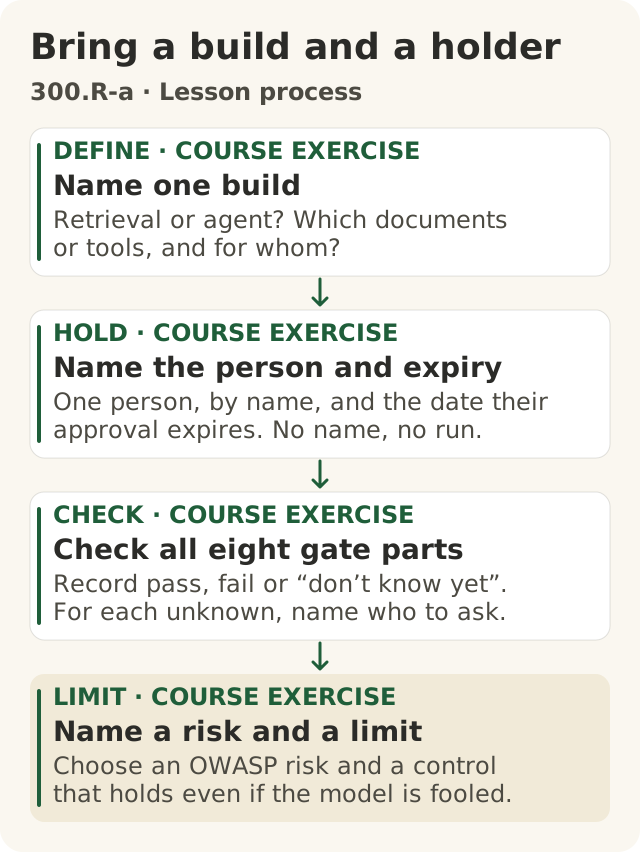
Figure data as text
Bring a build and a holder
- DEFINE · course exercise · Name one build — retrieval or agent? Which documents or tools, and for whom?
- HOLD · course exercise · Name the person and expiry — one person, by name, and the date their approval expires. No name, no run.
- CHECK · course exercise · Check all eight gate parts — record pass, fail or “don’t know yet”. For each unknown, name who to ask.
- LIMIT · course exercise · Name a risk and a limit — choose an OWASP risk and a control that holds even if the model is fooled.
Course track exercise using the OWASP risk list (s3).
Objective: 300.R-a. Text equivalent of figures/bring-a-build-and-a-holder.svg.
In Level 300 you learned to build two kinds of things:
- A retrieval assistant. It finds pages in a set of documents you chose, then writes an answer from them.
- An agent. It suggests actions, like "draft this order". A gate outside the AI decides whether each one runs.
You also learned the operate gate. Before a system runs on its own, one named person holds it.
Now you use all of that in your own job. Big Widget Company has eleven tracks, one for each kind of role. Pick yours. Then read one more, from a different team.
When you finish, you can do two things:
- Name one thing worth building in your job, the one person who holds it, and the gate it must pass first.
- Explain what a prep rail is. It helps you get ready for a company's exam. It does not give you that company's certificate.
Some people think building with AI is only for programmers. It is not. The person who owns the work often knows best which files are private, which actions can't be undone, and who should check. A US government guide on AI risk, from the standards agency NIST, says people's roles in managing AI risk should be written down and clear across the whole organization.1 Not just in IT (information technology: the team that runs the company's computers and logins).
Where this sits in the three yeses. Lesson 100.9 taught three moves: Get to Yes, Stay at Yes and Recover to Yes.
- Get to Yes, before it runs: name the build, the holder and what it may do. That yes has conditions and an end date.
- Stay at Yes, while it runs: the gate checks every action, every time. One good day is not a yes for ever.
- Recover to Yes, when something goes wrong: it stops, the holder decides, someone fixes it, and you show the evidence before it runs again. Stopping is not the same as fixed.
A build, a holder, a gate
Every track has three parts.
- The build. One retrieval assistant or one agent, for a real job you do.
- The holder. One person, by name. Not "the team". Their yes also has an end date.
- The gate. The checks the build must pass before it runs on its own.
For each action, the gate gives one of four answers: go ahead, only this far, wait for a person, or no.
Here is the gate. It has eight checks.
- Holder. Who holds it, and when does their yes run out?
- Allowed actions. What may it do alone? What needs a named person to approve first? What may it never do? "Never" means no, every time. Nobody can approve it, not even the holder. Anything not on the list is also a no.
- Second channel. For big moves you can't undo, like paying money, check on a second channel the asker does not control. Call back on a number you already have.
- Limit. How many actions per hour, per person and in total? What happens past the limit?
- Judgment. Where does the AI only help, while a trained person decides?
- Stop. What stops it? If something is missing, it stops. It does not carry on.
- Receipt. A short record of each decision: what, who held it, which approval, the result, and how to undo it. It holds no private details: no customer names, no document text, no prompts or AI answers.
- Count. Everything the build really did must have gone through the gate first. Check one by one: each action in the build's own record should match a gate answer from just before it. Use the gate's latest answer, not an older one. If the gate said yes, then later said no, the no is the answer that counts. The old yes stays written down, but it no longer lets anything run. Then say how many matched, out of how many it did. Two totals that happen to be equal are not enough. Things the gate said no to don't go in the count, because they never happened. If one happened anyway, that is a bigger problem, and the build stops. If you can't check yet, say "can't count yet". That is the honest answer, and it means the build waits.
Each track marks the two or three checks most likely to go wrong. But all eight must pass. "Don't know yet" is always allowed, but it always comes with a name: who will find out. Until then the build waits, and the holder decides what happens next. If nobody holds it, it does not run.
A line in the AI's instructions that says "never pay" does not stop it paying. Not giving it a way to pay does. The gate decides. A person holds the build. The AI decides nothing and signs nothing.
Why one name? Picture an alarm at 2 a.m. It can ring the team's on-call phone. That is fine. But someone has to be the one who decides: stop it, or let it run again. "The team owns it" does not say who. So this course names one holder, with an end date, and writes down who the on-call person calls. NIST's guide says the people who answer for AI risk should be clear to everyone, both people and teams, and that leaders take responsibility for decisions about it.1 It does not say "only one name". That rule is ours. NIST's guide is something companies choose to follow, not a law.2
Why your job? A security group called OWASP lists the top ten risks for AI apps like these. Some of them are: hidden instructions that trick the AI, private data leaking out, and an AI that can do too much.3 All of those depend on what the build may read and do. You know that better than anyone.
Three true stories behind the tracks
A fake video meeting
In 2024, the Hong Kong Government told its lawmakers about a fraud. Someone used deepfakes to make a fake, pre-recorded video meeting.4 The faker pretended to be the company's top finance boss. The worker on the call sent money to five bank accounts. The loss was about 200 million Hong Kong dollars.4 The record does not name the company, and neither do we.
The lesson: a face on a screen is not proof. If a build can move money, it needs a second channel.
Cigna and the 1.2 seconds
In 2023, people sued the insurer Cigna. Their court papers say that in two months of 2022, Cigna's doctors turned down over 300,000 payment requests. The papers say that, on average, each one got about 1.2 seconds.5 These are claims in a lawsuit, not a court's findings. This lesson does not say how the case turned out: we have not checked. The papers got the numbers from a news story.5
The lesson: lots of small decisions add up. A build that decides many things needs a limit. A very quick sign-off is a warning sign, but it is not proof on its own. Someone might read for two minutes, then sign in one second. So look at what the person really read, and whether they could say no.
nH Predict
Also in 2023, the estates of two patients sued the insurer UnitedHealth.6 (An estate is what a person leaves behind when they die. The people who manage it can go to court for them.) Their court papers say it used an AI tool called nH Predict to overrule patients' own doctors about care. The papers claim the tool has a "90% error rate".6 These are claims, not findings.6 Lesson 300.8 also shows what the company said back.
The lesson: where a trained person's judgment is the decision, the AI may help. It may not take over.
The eleven tracks
The builds and the people are made up. Each track names its riskiest checks. All eight checks still apply.
- Makers and citizen developers. Build: answers from the plant's safety rules, showing which rule it used, and saying "I can't find that" when nothing fits. Holder: Dana, the safety lead. Watch: it may only read; someone keeps the rules up to date; count what it can't answer. An old rule left in the pile can give a wrong answer (lesson 300.2).
- IT admins. IT admins are the people who set up computers and decide who can log in to what. Build: an agent that drafts tickets for access changes. Holder: Raj, who runs logins. Watch: no admin powers; a person approves every real change; it has its own login, never yours. OWASP says to give an agent only the tools and powers it needs, and to have a person approve big actions.7
- Early developers. Build: an assistant over engineering documents. It checks, every time, who may see each one. Holder: Mei, who owns the assistant. Watch: private data leaking to the wrong person.3
- Cybersecurity. Build: an agent that reads reported phishing emails and labels them for an analyst. (Phishing emails are fake emails that try to trick you into clicking a link, paying, or giving away a password.) Holder: Tomás, the security lead. Watch: it may only label. No replies, no forwards, no deletes. A bad email can hide instructions for the AI.8
- Quality. Build: answers from warranty notes that point out possible faults. Holder: Grace, the quality manager. Watch: the engineer decides, not the AI; ask what it left out. (The nH Predict lawsuit claims a model overruled doctors.6 Our rule: the AI helps, a person decides.)
- Engineering and design. Build: answers from approved drawings and specs, naming the version. Holder: Hana, who controls the documents. Watch: only approved versions; two versions of the same spec can give two answers (lesson 300.2).
- Supply chain and procurement. Build: an agent that drafts orders under a set amount, for a buyer to approve. Holder: Priya, the buying manager. Watch: it never pays; a change to a supplier's bank details gets a call-back on a known number. (Like the fake meeting.4)
- Customer service. Build: an agent that sorts warranty claims and flags some for a person. Holder: Luca, the warranty manager. Watch: a limit per reviewer per hour; real review, not a stamp; a receipt for each one. (Like the Cigna claims.5)
- Finance. Build: an agent that matches bills to orders and flags the ones that don't match. Holder: Aisha, who runs bill payments. Watch: it never pays; urgent or unusual payments get a call-back on a known number. (Like the fake meeting.4)
- HR. HR (human resources) is the team for staff policies, hiring and pay. Build: answers to policy questions from the HR handbook only. No access to staff files. Holder: Sofia, who owns HR policy. Watch: stay out of hiring decisions. In Europe, AI that sorts job applications is "high-risk" under the EU AI Act.9
- Legal. Build: finding clauses in contracts, only for the cases each lawyer may see. Holder: Daniel, who runs legal operations. Watch: a lawyer reads every clause it cites. The EU says people should be told when they are talking to a chatbot.9
Three rules for every track:
- The AI never says yes to itself. A named person does.
- Anything that can't be undone waits for a person.
- If the holder, the approval or the record is missing, it stops.
A date to know. As of 18 November 2026, the European Commission says EU rules for high-risk uses like hiring tools start on 2 December 2027.9 Dates like this have changed before. Lesson 300.7 shows how to check.
Your track exercise
You will bring this to the project, 300.P. A person reviews it there. An AI does not.
- Pick one build from your track, or make up a new one for your job.
- Say in one line what it is: retrieval or agent, over which files or with which tools, and for whom.
- Name the holder: one person, and the date their yes runs out. If you can't name anyone, it does not run. Write down who you will ask.
- Go through the eight checks. For each, write pass, fail or "don't know yet". Circle the two or three riskiest. For each "don't know yet", write who could find out.
- Pick the OWASP risk most likely for your build.3 Write one limit that still works even if the AI is tricked.
- Read one other team's track. Could their build touch your files or your decisions? Who would you tell? If you can't find a way, say so. Don't make one up.
Use made-up examples only. Never paste real files, logs, prompts or private details. If your workplace lets you keep notes on a real prompt or answer, they stay in your workplace's own records, never in a receipt or anything you share.
Prep rails
From Level 300 on, the course has prep rails. A prep rail is practice that lines up our lessons with the topics of a company's certification exam. The company runs the exam and watches you take it. That is called a proctored exam.
Level 300 has two rails. As of 18 November 2026, we do not name the companies or exams yet. Bob Rapp has to clear each name first.
- Rail 1 uses lessons 300.1 to 300.6: building and securing.
- Rail 2 uses lessons 300.6 to 300.9: rules and running systems.
What a prep rail does. It shows which lessons match which exam topics. It gives you practice questions in our own words. It shows where you are weak before you book.
What a prep rail does not do. These are the course's rules.
- It does not give you the certificate. Only the company's own exam does. You book it and you sit it yourself.
- The Foundation does not sit the exam for you. It does not hand out the certificate. It does not vouch for the exam.
- It never uses real exam questions.
- It does not mean the company supports this course. No company logos.
A person reviews your Level 300 project, and a host marks it. The AI marks nothing. If you earn the Level 300 badge, it shows you finished our level and project. It is about what you can do, not proof that any system is safe. It is not the company's certificate.
The Foundation already says the same about university courses it lists. Its page says those courses are not degrees, that "none of them gives credit or a certificate through us", and that no university designed or endorses them.10 A prep rail works the same way. It is real learning toward someone else's certificate. Only they can give it.
What this lesson does not say
- It does not say who is right in the Cigna or nH Predict lawsuits. Both are claims, not findings.56 How they turned out is not checked here.
- It does not name the company in the Hong Kong case.4
- It does not say any build is safe. A build may run on its own only when its gate passes, with a named holder. Even then, that is our rule for running, not proof it is safe.
- It is not legal advice. The EU dates are what the Commission's page said on 18 November 2026.9
- It does not name any exam company, or promise you will pass any exam.
Words to know
- Build: one retrieval assistant or one agent, set up for a real job.
- Holder: the one named person who holds a running system. Their yes has an end date.
- Operate gate: the eight checks a system must pass before it runs on its own.
- Go ahead, only this far, wait for a person, no: the gate's four answers for each action.
- Fails closed: when something is missing, it stops.
- Receipt: a short record of what the gate decided. It holds no private details.
- Count: how many of the things the build did went through the gate first, out of how many it did, using the gate's latest answer before each one. Or "can't count yet".
- Get to Yes, Stay at Yes, Recover to Yes: the three yeses: before it runs, while it runs, and after something goes wrong.
- IT: information technology, the team that runs the company's computers and logins.
- HR: human resources, the team for staff policies, hiring and pay.
- Phishing: fake emails that try to trick you into clicking, paying or giving away a password.
- Prep rail: practice for a company's exam. It gets you ready. It does not certify you.
- Proctored exam: an exam the company runs and watches. You book it and take it yourself.
Want to learn more?
Extra reading for this lesson is on hold. A link to an outside course can carry company and exam names, and Bob Rapp clears those first. Until then, the sources below are your reading list.