
Building in your job (role tracks and prep rails) · Standard gear
Reviewed and published, version 1.0.0. As of 18 November 2026. It is not a credential. Big Widget Company and its people are made up. Every real organization, record and case below is real and cited; the outcomes of the two lawsuits are not checked. The role tracks, the operate gate, the named-holder rule and the prep-rail rules are this course's own practice, not a law or a standard.
What this module does
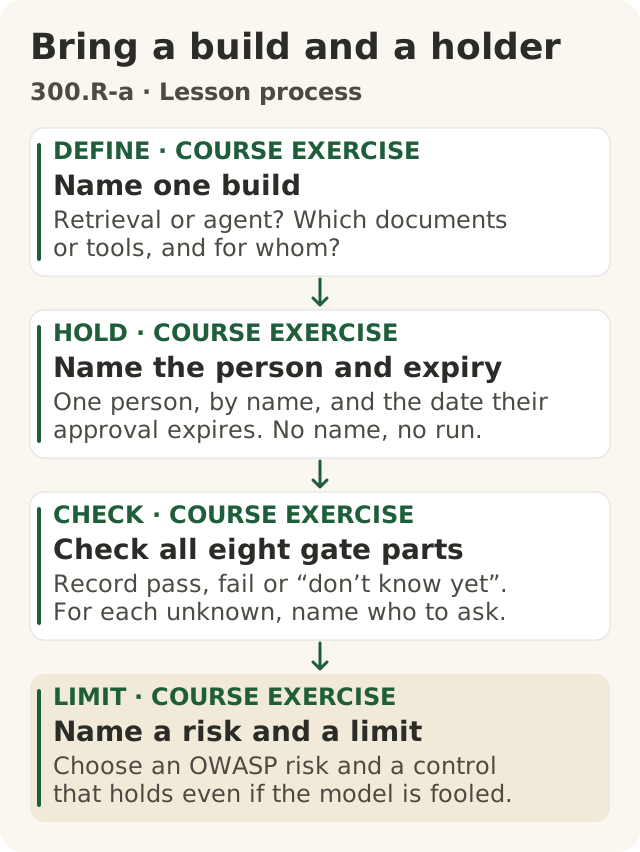
Figure data as text
Bring a build and a holder
- DEFINE · course exercise · Name one build — retrieval or agent? Which documents or tools, and for whom?
- HOLD · course exercise · Name the person and expiry — one person, by name, and the date their approval expires. No name, no run.
- CHECK · course exercise · Check all eight gate parts — record pass, fail or “don’t know yet”. For each unknown, name who to ask.
- LIMIT · course exercise · Name a risk and a limit — choose an OWASP risk and a control that holds even if the model is fooled.
Course track exercise using the OWASP risk list (s3).
Objective: 300.R-a. Text equivalent of figures/bring-a-build-and-a-holder.svg.
Modules 300.1 to 300.9 taught how retrieval and agents work, how to build them with limits, how to evaluate and secure them, what the EU AI Act asks of builders, and how to hold a running system for a named person: the operate gate. This module puts that into your own job, and explains the prep rails that start at Level 300.
Big Widget Company has eleven Level 300 tracks: makers and citizen developers, IT admins, early developers, cybersecurity, quality, engineering and design, supply chain and procurement, customer service, finance, HR, and legal. Take the track for your own role. Then read one other track, because most builds touch another team's data or decisions.
By the end you will be able to:
- for your own role, name one retrieval or agent build worth doing, its named holder, and the gate it must pass before it runs (300.R-a);
- explain what a prep rail does and does not do: it prepares you for a vendor-proctored exam that you book and sit yourself, and the Foundation does not sit, grant or endorse that exam (300.R-b).
Two beliefs this module corrects:
- "Building with AI is only for developers." A retrieval assistant over a procedures folder, or an agent that drafts purchase orders, is configured by the people who own that work as often as by developers. And the risk framework NIST published in January 2023 asks organizations to make roles and responsibilities for managing AI risk documented and clear "to individuals and teams throughout the organization", not only to IT (information technology, the team that runs computers and accounts).1
- "Finishing the prep rail gives me the certification." It does not. A vendor's certification comes only from that vendor's own proctored exam.
Where this sits in the three yeses. Module 100.9 taught Get to Yes, Stay at Yes and Recover to Yes. A track build moves through all three:
- Get to Yes, before it runs on its own: the build, its named holder with an expiry, and its authority table are written down, and all eight gate parts pass. That yes is conditional, not a licence.
- Stay at Yes, while it runs: the operate gate answers again before every action, with one of its four answers: go ahead (allow), only this far (constrain), wait for a person (hold) or no (deny). Coverage shows, action by action, whether everything that ran went through the gate. One good week is not a yes for ever.
- Recover to Yes, when something goes wrong: the stop holds, the named holder decides, the fault is fixed and the failing case re-run, and the receipts show what happened. A stopped build is not yet a recovered one, and an announced fix is not evidence that it worked.
A build, a holder, a gate
Every track row has the same three parts.
| Part | What it is | Example (Big Widget Company, made up) |
|---|---|---|
| Build | One retrieval assistant (300.1, 300.2) or one agent (300.3, 300.4) for a real task in your role | A retrieval assistant that answers questions from the plant's published safety procedures |
| Named holder | The one person who holds the running system, and when their approval expires (300.8) | Dana Okafor, the plant safety lead, approved until 31 March |
| Gate | The operate gate the build must pass before it runs on its own (300.8, 300.9) | All eight gate parts below, with the ones most at risk for this build marked |
The gate. The course's operate gate asks eight things of every action a system takes (levels/300/practice/hold-prompts.md, synthetic and course-owned):
- Holder. The named person who holds it, and the date their approval expires.
- Authority. For this action: may it run alone (within its limits), does it need a named approver's decision on this action, or must it never run? It passes only for an allowed action inside its limits, or an approver action whose approver has said yes to this action. Never and unlisted are both a plain no: a hard deny that no holder or approver can release. Listing an action as never does not make it allowed; it makes the no explicit.
- Out-of-band check. For an irreversible, high-value action, a second channel the requester does not control.
- Budget. The most actions allowed per reviewer and system-wide in an hour, and what happens when either is exceeded.
- Judgment. Where a model informs but a qualified person decides.
- Stop. What stops it, failing closed when the holder, an approval or a record is missing.
- Receipt. A receipt for each gate decision that holds no private content: what, who held it, which approval, result, how to undo. References only: no prompts, model outputs, payloads, personal data or document text. Any notes on prompts and outputs that your workplace allows belong in a separately controlled work record, not in the receipt. Signing a receipt (module 100.P) shows who recorded the decision and that it has not been changed; it does not show the action was right.
- Coverage. Every action the build actually ran must have gone through the gate first. Take a time window that has closed, and list each action the build ran in it, from the build's own log, not the gate's. Match each one, by its action ID, to the gate decision in force when it started: the latest decision for that ID made before it ran. The gate's log is append-only and numbered in order, so a later no or a tighter limit is a new entry that replaces an earlier yes for what comes after; the old yes stays in the log as history but no longer counts. An action that ran after its yes was withdrawn, or outside a limit that had been tightened, does not match. Coverage is how many executed actions have a matching decision that let them run, out of how many executed actions there were. It passes only when both logs are complete for the window, their order is clear, and every executed action matches. Two totals that happen to be equal are not coverage: an unchecked action and a refused proposal can cancel out. Proposals the gate refused never ran, so they are not in the count; an action that ran when the decision in force was a no or a hold, or outside its limit, is a separate breach, and the build stops. A hold later turned into a yes before the action ran is fine: the yes is the decision in force. If nothing ran in a closed, complete window, report "0 of 0: nothing ran". "Cannot count yet" is the honest report while a log is incomplete or the window is still open, and it means the build waits; it is not a pass.
Each track row marks the two or three parts most likely to fail for that build. That is a focus, not a shortcut: the build runs on its own only when all eight pass. "Don't know yet" is always an allowed answer, and it always comes with a name: who will find out. Until then the build waits (wait for a person), and the holder decides what to check next. A "no" from authority is a no: the action does not run, and nobody can approve it into running. If nobody holds the build, it does not run at all.
The authority table is enforced by the gate, outside the model. A system prompt that says "never pay" is not a permission boundary; a tool the build does not have is. The gate decides, a named person holds, and the AI decides nothing, signs nothing and marks nothing.
Why a named person, not only a team. NIST's AI Risk Management Framework is voluntary guidance.2 Its Govern function asks that roles, responsibilities and lines of communication for managing AI risk are documented and clear "to individuals and teams throughout the organization", that executive leadership takes responsibility for decisions about AI risk, and that policies define roles for human-AI configurations and oversight of AI systems.1 NIST does not require a single name, and it does not rule out teams. An alert at 2 a.m. can quite properly page a team's on-call rota. What "the team owns it" leaves open is who has the authority to decide: stop the build, or let it run again. This course's rule is stricter than NIST: one named holder, with an expiry, who holds that decision, plus a written escalation route from whoever is on call to the holder. The holder is accountable; they do not have to answer every page themselves.
Why your role, not only IT. OWASP's 2025 list of the top ten risks for LLM applications includes prompt injection, sensitive information disclosure, excessive agency, and vector and embedding weaknesses (the risks around the indexes that retrieval searches).3 Each of those is decided as much by what a build is allowed to read and do as by its code. The person who owns the work knows which documents are restricted, which actions cannot be undone, and who should check. That is why the build and its holder sit in your role.
Three cases behind the tracks
The Level 300 case bank has three cases. Module 300.8 teaches each in full. Here is the one line each track needs.
The fake video meeting (out-of-band check)
On 26 June 2024 the Hong Kong Government told its legislature that in end-January 2024 the Police received a fraud case in which deepfake technology was used to fabricate a pre-recorded video conference.4 The fraudster impersonated the Chief Financial Officer of the victim's head office, and the person targeted authorised transfers to five local bank accounts, with a loss of about HK$200 million.4 The government record does not name the organization, and this course does not either.
For the tracks: any build that can move money, change bank details or approve something irreversible needs an out-of-band check. A face or voice on a call is not identity.
Cigna PXDX (budget and rubber stamps)
A class action filed on 24 July 2023 alleges that over two months in 2022, Cigna doctors denied over 300,000 payment requests using a method that relies on an algorithm known as PXDX, "spending an average of just 1.2 seconds" on each.5 These are allegations in a complaint, not findings, and the complaint takes the figures from news reporting.5 The case's later course and outcome are not checked here. This course does not use the real totals for arithmetic; budget practice uses the course's synthetic log.
For the tracks: any build that makes many small decisions needs a budget per reviewer and system-wide, and a review that is real, not a signature. A very short recorded decision time is a reason to look closer, not proof on its own: the time to sign is not the whole review. Check what the reviewer actually saw, and whether they could disagree and be heard. And an average over many decisions says nothing certain about any one of them.
nH Predict (model informs, person decides)
A class action filed on 14 November 2023 alleges that UnitedHealth used an AI model called nH Predict to override treating physicians' determinations about post-acute care, and that the model has a 90% error rate.6 These are the plaintiffs' allegations, not findings.6 Module 300.8 keeps three things apart: what the complaint alleges, what the company said in response, and the course's gate.
For the tracks: wherever a qualified person's judgment is the decision, a build may inform it but not replace it. The Foundation's gate holds whoever turns out to be right about the case.
The eleven tracks
Each row is one track. The builds and holders are made-up Big Widget Company examples, written as course guidance. The "gate parts most at risk" column names the focus for that build; all eight parts still have to pass. Where a real case or source sits behind a row, the row cites it.
| Track | Build worth doing | Kind | Named holder (made up) | Gate parts most at risk | Case, risk or module |
|---|---|---|---|---|---|
| Makers and citizen developers | Answers from the plant's published safety procedures, with the procedure cited and "I can't find that" when nothing matches | Retrieval | Dana Okafor, plant safety lead | Authority (read-only), coverage, holder (who keeps the procedures current) | 300.2 (stale documents); OWASP vector and embedding weaknesses3 |
| IT admins | An agent that drafts access-change tickets and runs read-only checks on the request | Agent | Raj Mehta, identity service owner | Authority (no admin rights; granting access needs a named approver), stop, receipt (the agent's own identity, never a shared login) | OWASP excessive agency: minimum tools and permissions, human approval for high-impact actions7; 300.4 |
| Early developers | An internal engineering-docs assistant whose permission matrix is checked at query time | Retrieval | Mei Lin, product owner for the assistant | Authority (permissions per document), receipt, coverage | OWASP sensitive information disclosure3; 300.2 |
| Cybersecurity | An agent that reads reported phishing emails and labels them for an analyst | Agent | Tomás Silva, security operations lead | Authority (label only; no replying, forwarding or deleting), stop | OWASP prompt injection: instructions can arrive in outside content such as websites or files8; 300.6 |
| Quality | Answers from warranty-claim notes that surface candidate defect patterns for an engineer | Retrieval | Grace Adeyemi, quality manager | Judgment (the engineer decides), coverage (what it left out) | nH Predict allegations6; course gate: a model informs, a person decides; 300.5 |
| Engineering and design | Answers from released specifications, quoting the revision | Retrieval | Hana Ito, engineering document control lead | Authority (released revisions only), judgment, holder | 300.2 (two versions of a torque spec) |
| Supply chain and procurement | An agent that drafts purchase orders under a limit for a buyer to approve | Agent | Priya Shah, procurement category manager | Authority (drafts alone; orders need the buyer; payments never), out-of-band check (supplier bank changes), budget | Hong Kong fake meeting4; 300.4 |
| Customer service | An agent that triages warranty claims and flags some for a reviewer to clear | Agent | Luca Romano, warranty service manager | Budget (per reviewer and system-wide), judgment (real review, not a stamp), receipt | Cigna PXDX allegations5; 300.8, 300.9 |
| Finance | An agent that matches supplier invoices to purchase orders and flags exceptions | Agent | Aisha Bello, accounts payable lead | Authority (no payments), out-of-band check (bank-detail changes, urgent payments), budget | Hong Kong fake meeting4; 300.4 |
| HR | Answers to policy questions from the published HR handbook, with no access to personnel files | Retrieval | Sofia Novak, HR policy owner | Authority (handbook only), holder, out of scope: screening applicants | EU AI Act: employment tools such as CV-sorting are high-risk uses9; 300.7 |
| Legal | Clause finding across the contract library, limited to the matters each lawyer may see | Retrieval | Daniel Cho, legal operations lead | Authority (matter-level permissions), judgment (a lawyer reads every clause cited) | EU AI Act roles and transparency duties9; 300.7 |
Three course rules run through every row. The AI never approves its own use: a named person does. Anything it cannot undo, such as a payment, a message sent outside the company or a change to live data, waits for a person. And if the holder, the approval or the record is missing, the build stops.
Notes on three rows.
- HR. The European Commission lists AI tools for employment, management of workers and access to self-employment, such as CV-sorting software for recruitment, as high-risk uses under the AI Act.9 As of 18 November 2026, the Commission's page says the rules for high-risk use cases listed in the Act's Annex III will apply from 2 December 2027.9 That is why screening applicants is out of scope for this track's first build. Module 300.7 covers the duties and why dates must be checked against the amending regulation in force.
- Customer service and legal. If a build talks to people, the Commission says that humans should be made aware they are interacting with a machine when using AI systems such as chatbots.9 Module 300.7 teaches the notice.
- Cybersecurity. OWASP says it is unclear whether there are fool-proof methods of preventing prompt injection.8 So the phishing agent's limit is what it may do, not what it is told: it can label, and nothing else.
Your track exercise
Bring this to the project (300.P), where it becomes a hold you dry-run on the course's synthetic files. A person reviews it there; an AI does not.
- Pick one row from your track, or write a new row for your role.
- Write the build in one line: retrieval or agent, over which collection or with which tools, for whom.
- Name the holder: one person, by role and name, and the date their approval expires. If you cannot name one, the build does not run. Write who you will ask.
- Go through all eight gate parts. For each, write pass, fail or "don't know yet". Mark the two or three most at risk for this build, and say why. For each "don't know yet", name who can find out.
- Name the OWASP risk most likely for your build and one limit that holds even if the model is fooled.3
- One other track. Read one other team's row. Name one way their build could touch your data or your decisions, and who you would tell. If you find no route, say so and say why. Do not invent one.
Use only made-up examples. Do not paste real prompts, documents, logs or personal data into the exercise. In real use, any notes your workplace allows on prompts and outputs stay in its own controlled records, never in a receipt or anything you share.
Prep rails: what they do and do not do
From Level 300 up, the course offers prep rails: drills and mock questions that map course objectives to the topics of a vendor's proctored certification exam. Level 300 has two rails. As of 18 November 2026, neither vendor nor exam is named, because Bob Rapp clears each vendor name before it appears.
| Rail | Vendor | Certification | Draws on |
|---|---|---|---|
| 1 | not cleared | not cleared | 300.1, 300.2, 300.3, 300.4, 300.5, 300.6 (building and securing) |
| 2 | not cleared | not cleared | 300.6, 300.7, 300.8, 300.9 (governing and operating) |
What a prep rail does. It shows which course objectives cover which exam topics, gives you practice in the course's own words, and shows you where you are weak before you book.
What a prep rail does not do. These are the course's rules:
- It does not give you the certification. Only the vendor's own proctored exam does, and you book and sit it yourself.
- The Foundation does not sit the exam for you, grant the certification, or endorse the vendor's exam.
- It does not share live exam content. Its questions are the course's own.
- It does not imply that the vendor endorses this course. No vendor logos, and no wording that suggests one.
A person reviews your Level 300 project and a host marks it; the AI marks nothing. If you earn the Level 300 badge, it is the Foundation's own record that you completed the level and its project. It describes your practice, never a system's safety. It is not a vendor certification and does not count as one.
The Foundation already applies the same line to outside learning. Its page of university AI courses says the programs are not degrees, that "none of them gives credit or a certificate through us", and that no university designed or endorses them.10 A prep rail is the same kind of thing: real learning toward someone else's credential, which only they can give.
What this module does not claim
- It does not say who was right in the Cigna or nH Predict cases. Both are allegations in complaints, not findings.56 Their later course and outcomes are not checked.
- It does not name the organization in the Hong Kong case. The government record does not, and the course has decided not to.4
- It does not say any track's build is safe. A passing gate, with a named holder, is the course's condition for running on its own; it is not proof that a build is safe or lawful. No row's gate has been run.
- It does not give legal advice. The AI Act dates above are as the Commission's page gave them on 18 November 2026, and dates have moved before.9
- It does not name a vendor or exam, or say the course prepares you to pass any particular one.
Words to know
- Build: one retrieval assistant or one agent configured for a real task.
- Named holder: the one person who holds a running system, with a date their approval expires.
- Operate gate: the eight checks a running system must pass for every action (300.8).
- Allow, constrain, hold, deny: the gate's four answers; in plain words, go ahead, only this far, wait for a person, no.
- Fail closed: when something is missing, the system stops rather than carrying on.
- Receipt: a record of one gate decision that holds no private content: references, never prompts, outputs or personal data.
- Coverage: in a closed window, executed actions matched one by one to the gate decision in force when each started (the latest one before it, not any older yes), out of all executed actions; or "cannot count yet".
- Get to Yes, Stay at Yes, Recover to Yes: the three yeses: before it runs, while it runs, and after something goes wrong (100.9).
- Phishing: fraudulent emails that try to trick a reader into clicking, paying or giving away a password.
- Excessive agency: OWASP's name for a system that can do more than its task needs, through too many functions, permissions or too much autonomy.7
- Prep rail: course practice mapped to a vendor's proctored exam. It prepares; it never certifies.
- Proctored exam: an exam taken under the vendor's supervision, which you book and sit yourself.
Further learning
Further learning for this module is on hold. Outside course pages can carry commercial platform, vendor and certification branding, and Level 300's rule is that vendor names wait for Bob Rapp's clearance. Until he clears a destination, the sources below are the reading list.