
OVERT and the SAIL crosswalk · Plain gear
Facts as of 18 November 2026. Reviewed and published, version 1.0.0. Big Widget Company, its people and every card below are made up for this course. They are teaching examples, not real records. The practice files for these cards are in this module's bundle/ folder. Every "yes" or "no" below is what the author got when running them. Run them yourself too. Every real document is cited. Where we do not know something, we say so. This is not legal advice.
The sealed envelope
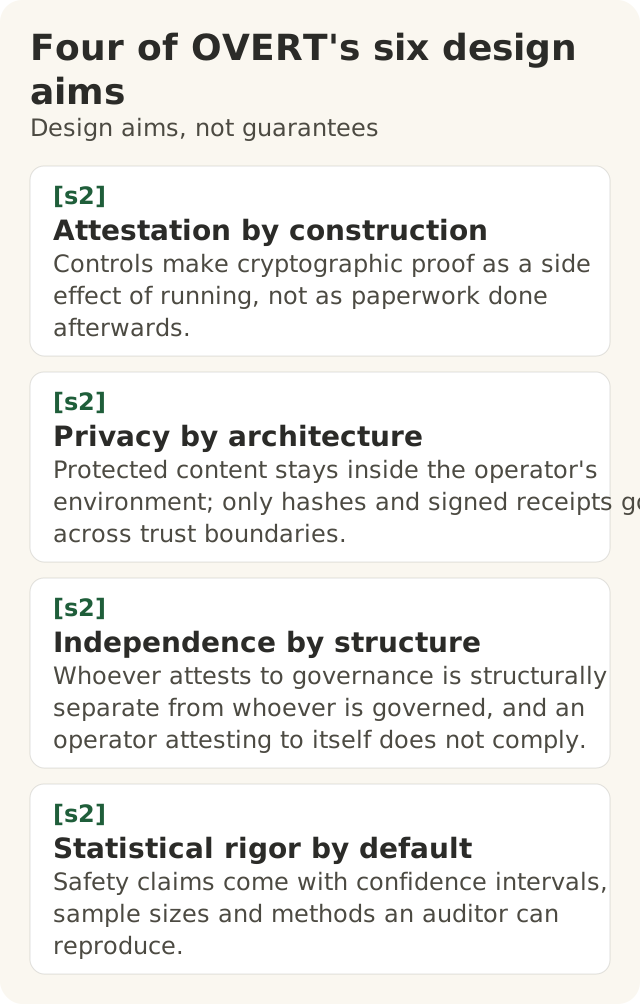
Figure data as text
Four of OVERT's six design aims
Design aims, not guarantees
| Part | Course wording | Sources |
|---|---|---|
| Attestation by construction | Controls make cryptographic proof as a side effect of running, not as paperwork done afterwards. | [s2] |
| Privacy by architecture | Protected content stays inside the operator's environment; only hashes and signed receipts go across trust boundaries. | [s2] |
| Independence by structure | Whoever attests to governance is structurally separate from whoever is governed, and an operator attesting to itself does not comply. | [s2] |
| Statistical rigor by default | Safety claims come with confidence intervals, sample sizes and methods an auditor can reproduce. | [s2] |
The four design principles highlighted by the lesson are design aims, not guarantees; the course paraphrases the home-page summaries, not a conformance or effectiveness finding (s2).
Imagine a letter in a sealed envelope. The wax seal is unbroken. The stamp in the wax is your bank's.
What do you know? You know nobody opened the letter after it was sealed. If you trust that only the bank has that stamp, you know the bank sealed it.
What don't you know? Whether the letter is true. Whether the bank did what the letter says. Whether the bank's rules are any good.
That gap is the whole of this lesson. We look at two real frameworks and one kind of table that joins them:
- OVERT is a standard for records that show an AI system's rules and security controls ran.1
- SAIL is a list of AI security risks, each with a short id number.2
- A crosswalk is a table that says: for this risk, look for this evidence.
You will learn to:
- tell apart what a sealed record proves, what it only claims, and what needs separate testing (500.7-a);
- follow one risk id through a made-up control, and list what proof is still missing (500.7-b);
- tell a table's own citing rule apart from the publisher's licence (500.7-c).
Please note: the Foundation's OVERT page is written by Ken Johnston and Bob Rapp, who also lead this course.3 Their Foundation is part of OVERT's planned stewardship.1 So we check OVERT's own pages too. We name OVERT, SAIL, Pillar Security and OWASP only because they wrote or published the documents we are reading. Bob Rapp's rule (20 November 2026) is that a company may be named only as the author or publisher of a source we cite. Other companies and products are not named. Naming a document is not advice to use it, and not a promise that any product meets it.
Whose words these are. When we quote OVERT's standard, we are using short pieces of OVERT — Observable Verification Evidence for Runtime Trust, Version 1.1 (June 2026), by Glacis Technologies, Inc. OVERT's governance page says that text may be reused under the Creative Commons Attribution 4.0 licence (CC BY 4.0), if you give credit, name the title and version, link the licence and say what you changed.4 What we changed: we picked out short pieces and put them in our own order. We have not checked whether that licence covers OVERT's other web pages, so we tell you what those pages say in our own words. You can read them yourself at overt.is.
What OVERT is, and what it is not
OVERT stands for Observable Verification Evidence for Runtime Trust.1 Version 1.1 came out on 11 June 2026.1 Its records are meant to show that the rules, security checks and human checks a company says it has really ran.1 Anyone should be able to check those records.
OVERT lists six design ideas.1 Four matter here:
- Proof comes from doing. Controls make proof as they run, not as paperwork later.1
- Private things stay home. Private content stays with the company. Only hashes and signed receipts go outside.1 A hash is a short fingerprint of some data. But a fingerprint is not always private. We come back to this.
- Someone else signs. The one vouching for the rules should be separate from the one following them. The home page says a company vouching for itself does not count.1
- Show your numbers. Safety claims should come with how many tests were run and how sure you can be.1
Now the important part. OVERT's own text says a conformance claim "does not constitute a general representation that the system is secure, compliant, or safe."5 It also says OVERT does not vouch that what an AI says is true.5 And its governance page makes clear, in our words, that using the OVERT name is not a stamp of approval for any product.4
So "it meets OVERT" does not mean "it is safe". It is a claim about records.
There are levels, too. OVERT conformance is a level from 1 to 4 plus a scope.5 At Levels 1 and 2, the standard says, an independent notary is not required.5 The company may check its own conformance at those levels.5 Some of the evidence may come from the company itself, and must be labelled that way.5 OVERT grades evidence, too. Only its top grade means someone independent made the proof.5 So always ask four things. What level? What scope? Who checked it? Who signed each piece?
The Foundation's page links to a tool it calls "an OVERT-conformant runtime".3 The page does not say which level or scope.3 Now you know to ask.
Who runs OVERT? On 21 September 2026, OVERT's site said three groups had signed a shared stewardship agreement.1 The site also said it had not started yet.1 Its governance page says a separate certificate must be signed first, and that it has not been signed yet.4 The Foundation's page says "the agreement is signed."3 Both can be true: signed, but not started yet. We do not claim the handover has happened.
Big Widget's blocked order
Big Widget Company has an AI helper called parts-buyer. It orders parts from suppliers. Big Widget's plan says every time it wants to use a tool, it should go through a checkpoint called the gateway. Big Widget's own team runs the gateway. Nobody has yet shown that every route really goes through it.
A rule called TS-2 says parts-buyer may only use certain tools, and may only place small orders.
One day parts-buyer tries to place a big order. The gateway says no. It writes a record and seals it with its own digital key. We call this record Card R7. Card R7 says:
- what parts-buyer asked to do (place an order);
- which rule was used (TS-2, version 3);
- what the gateway decided (no, too big);
- the risk id it relates to (SAIL
3.13); - two pieces of outside evidence it points to: a test report called EV-17, and a list of the helper's permissions called EV-18;
- no supplier names or prices. The order is hidden behind a locked fingerprint (more below).
The course gives you four rule cards. They are modelled on OVERT's ideas, but they are the course's own rules, not OVERT's.
| Card | Question | Card R7 (author's run) |
|---|---|---|
| RC-1 Seal | Is the seal good, with a key we trust? | Yes |
| RC-2 Who signed | Did the company sign, or someone separate? | The company signed |
| RC-3 Private | Is the private part locked, and has a named person checked what is left showing? | Locked, yes. Checked by a person: not on file, so no |
| RC-4 Works | Is there a test, by someone else, that a stranger could repeat? | No |
You can run this yourself. The bundle/ folder has Card R7, the rule, the two evidence files and a small checking program. It needs Python and nothing else, not even the internet. VERIFY.md in that folder walks you through it. The checker only does the machine parts: the seal and the fingerprints. It does not decide RC-3 or RC-4. A person has to.
Open EV-17, the test report. It says Big Widget's own gateway team tried 100 big orders, and none got through. That sounds good. But the same team runs the gateway. They only tried big orders. They did not say beforehand how many slips they would accept. So RC-4 is still no.
Why a fingerprint is not always private. Suppose an order could only be one of a few hundred part numbers. Someone with the fingerprint could make a fingerprint of every guess until one matches. Then they know the order. A locked fingerprint mixes in a secret only Big Widget knows, so guessing does not work. The bundle shows this. Out of 6,000 possible orders, a plain fingerprint was matched after 1,653 guesses. The locked one was not matched at all. Even then, the record still shows the time, the tool and where the test report is kept. So the course adds its own rule: a named person at Big Widget, the privacy owner, has to check those too. The Foundation says its own receipts never carry "prompts, outputs, payloads, personal data".6 A fingerprint is not permission to share what it stands for.
So what does Card R7 prove?
- The seal proves the record is unchanged, and that the gateway's key sealed it, if you trust that key. That is the wax seal.
- The record claims that rule TS-2 ran and said no. That is Big Widget's own word.
- Nobody has shown that TS-2 stops bad orders in general. That needs a separate test.
- Nothing here shows that parts-buyer is "safe". OVERT says conformance is not that claim.5
Following one risk id
SAIL comes from a company called Pillar Security.2 It splits an AI system's life into seven phases, from planning to retiring it.2 Each risk gets an id like 1.1 or 5.4.2 The first number is the phase.
Risk 3.13 is in the third phase.2 That phase does not build AI helpers. It looks closely at how they are set up: who they act as, and which tools and connections they can reach.2 In our own words, 3.13 is about an AI helper having more tool access, and more connections to other systems, than its job needs. (We use ids and our own words. Read SAIL's own wording on its page.)
Big Widget keeps a made-up crosswalk. Its row for 3.13 says: the control is TS-2, and the evidence is the gateway's records plus EV-17 and EV-18. Big Widget's governance lead signs off the row. It is that team's judgment, not a fact about the world.
Follow the trail:
- Risk
3.13: too much tool access. - Control: TS-2 says what parts-buyer may do.
- Record: Card R7 says TS-2 blocked one order because it was too big.
- Evidence: EV-17 and EV-18.
One blocked big order shows one limit working once. It does not show that the other tools are limited, or that the connections to suppliers are no wider than they should be.
A crosswalk row is like a sign that says "the spare key is under the mat". It tells you where to look. It does not prove the key is there, or that it opens the door.
What is still missing? To know TS-2 really works, you would want:
- the test report itself: what was tried, across every tool and connection, how often, and how often it slipped through. Big Widget should also say, before the test, how many slips it would accept;
- a tester who is not Big Widget's own team;
- a separate check that the permission list matches what the supplier systems really allow;
- proof that every route to a supplier goes through the gateway.
What can the record never see? This part is our own reasoning. The gateway only writes records for orders that pass through it. Suppose parts-buyer has a second, secret way to reach a supplier. Orders that way make no record at all. A missing record does not mean nothing happened. OVERT itself says it does not promise to see everything.4 Also, a small order is allowed even if it is the wrong part. TS-2 checks size and tools, not whether the order is right.
The Foundation's rule is: "No direct model-to-tool path for consequential actions."7 The gateway is Big Widget's way to follow that rule. Whether it works for every route is still an open question.
When the test report is missing
Now Card E says: EV-17 cannot be found. An earlier check of Card R7 passed. Since then, nothing has changed: not the record, not the seal, not the list of trusted keys. What now? (This is case X in the bundle.)
- The seal still checks out, because everything the check uses is the same as before.
- That TS-2 ran is still only Big Widget's claim.
- Whether TS-2 works is still not shown. The one test that might show it is missing.
This is different from a broken seal. A seal check can fail for more than one reason. The record may have changed. The seal itself may be wrong. Or the list of trusted keys may have changed. So when it fails, say which of these the check found, not just "it changed". Case M in the bundle is the first kind: a single word in R7 was changed, and the seal fails. In case X the seal is fine. It is the evidence the record points to that is gone. Call it "missing proof", and name who will find it.
Now try the third kind. Run case X with the newer key list, card-T-refetched.json. That list no longer has the gateway's key. Now the seal check fails, though the sealed part of the record did not change. The cause is the key list, not the record. Yesterday's "yes" only holds while everything the check uses stays the same.
One more list. Another group, OWASP, has its own list of ten risks for AI agents, dated 9 December 2025.8 Two of them, ASI02 "Tool Misuse and Exploitation" and ASI03 "Identity and Privilege Abuse", are close to SAIL 3.13.8 Putting them side by side is our idea, not OWASP's or Pillar's. Every crosswalk is someone's judgment.
A house rule is not the licence
Big Widget's crosswalk has a house rule: "We cite SAIL risks by id only." That is a choice. It is careful and simple. But it does not tell you what the publisher allows.
For that, read the licence. Pillar's sail-skill code library has a licence file. It is a Creative Commons licence called "Attribution-NonCommercial-ShareAlike 4.0 International".9 It lets you copy and share the material it covers, with conditions:9
- Attribution: if you share the material, give credit.9
- NonCommercial: the sharing must not be mainly aimed at business gain or at getting paid.9
- ShareAlike: if you share a changed version you made, it must go out under the same kind of licence.9 In this licence, "share" means giving the material to the public.9 Changes you keep to yourself are not shared.
- Not included: "Patent and trademark rights are not licensed".9
- Some uses need no licence at all, where the law makes an exception, such as fair use.9
Some things nobody here has shown:
- The licence file does not say which files it covers.9 And SAIL's web page says "All rights reserved."2 So we do not know if the licence covers the web page or other SAIL files.
- We do not know if Pillar gave anyone extra permission.
- We do not know if any one use of Pillar's name or logo is allowed. The licence just does not cover it.
When you don't know, write "not checked", and name who will find out. At Big Widget that is the person who handles legal questions. Don't guess, and don't treat the house rule as the licence.
| Statement | What kind? |
|---|---|
| "Cite SAIL risks by id only." | House rule (made up for this course) |
| "Give credit when you share." | Licence condition9 |
| "This licence lets you use Pillar's logo." | No: this licence does not give trademark rights. Any other permission: not checked9 |
| "The licence covers the SAIL download." | Not checked |
The three yeses for parts-buyer
The Foundation names three steps: get to yes, stay at yes, recover to yes.7 For parts-buyer:
- Get to Yes, "before a single action runs".7 TS-2 is written down, with its tools and its limit. A gate can say "go ahead · only this far · wait for a person · no".7 For a big order, TS-2 says no. If Big Widget wanted a person to be able to approve big orders, TS-2 would name that person. The privacy owner checks what the records show. The governance lead signs off the crosswalk row.
- Stay at Yes, "while it runs, in real time".7 Every decision leaves a record. Someone outside the gateway team tests TS-2 on a schedule. Big Widget knows how much of parts-buyer's work goes through the gateway, or says plainly that it does not know. A hold that nobody answers is not a yes.
- Recover to Yes, "after — on demand, on incident".7 A missing report, a broken seal or an order on a route the gateway never saw starts a review. Parts-buyer's access is cut back while people look. A promised fix is not proof. Big Widget is back at yes when a new outside test passes and the named people agree.
The AI never decides any of this. People write the rules, release holds and say when things are fixed.
Remember
- A seal proves the record is unchanged and who sealed it. It does not prove the rules worked. "Meets OVERT" is not "safe".5
- Ask who checked and who signed. At OVERT's lower levels, the company may vouch for itself.5
- A crosswalk row is a pointer. Follow it to the evidence, and list what is missing.
- A fingerprint is not always private. Lock it, and have a person check what still shows.
- A house rule is not a licence. Read the licence itself, and write "not checked" when you don't know.9
- The author's run is not a check. Run the bundle yourself, with the internet off, and write down what you saw.
The Foundation says "I don't know yet" "is always an answer, and it always pairs you with someone."6 So when you don't know, say who will find out.
Words to know: seal (signature), fingerprint (hash), locked fingerprint (keyed commitment), claim, test, crosswalk, risk id, licence, house rule.