
OVERT and the SAIL crosswalk · Standard gear
Facts as of 18 November 2026. Reviewed and published, version 1.0.0. Big Widget Company, its people, its keys, its rules and every card below are made up. The cards are course-owned synthetic teaching examples in this module's bundle/ folder: they are not OVERT conformance tests, not One Receipt conformance tests and not real deployment evidence. Every check result below is the author's own run of that bundle, not a check. Every real document is cited. Where we do not know something, we say so. Nothing here is legal advice.
What this module does
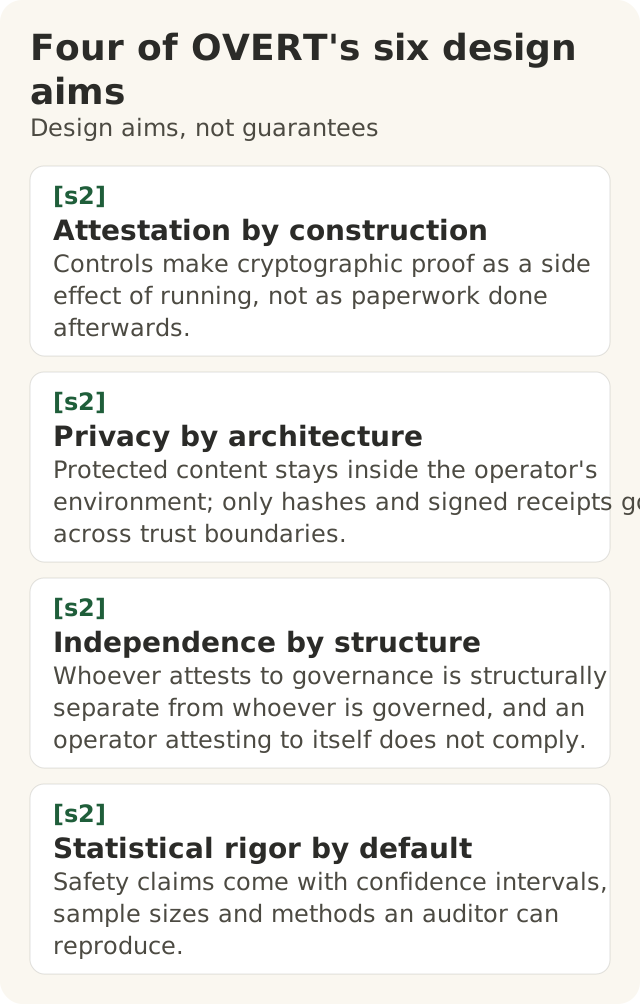
Figure data as text
Four of OVERT's six design aims
Design aims, not guarantees
| Part | Course wording | Sources |
|---|---|---|
| Attestation by construction | Controls make cryptographic proof as a side effect of running, not as paperwork done afterwards. | [s2] |
| Privacy by architecture | Protected content stays inside the operator's environment; only hashes and signed receipts go across trust boundaries. | [s2] |
| Independence by structure | Whoever attests to governance is structurally separate from whoever is governed, and an operator attesting to itself does not comply. | [s2] |
| Statistical rigor by default | Safety claims come with confidence intervals, sample sizes and methods an auditor can reproduce. | [s2] |
The four design principles highlighted by the lesson are design aims, not guarantees; the course paraphrases the home-page summaries, not a conformance or effectiveness finding (s2).
In 500.6 you learned to ask what a passing signature check actually establishes. This module puts that question to two public frameworks that people increasingly cite together:
- OVERT, a standard for runtime evidence that governance controls ran;1
- SAIL, a catalogue of AI security risks organised by lifecycle phase;2
and to the thing that joins them in practice: a crosswalk, a table that says "for this risk, look for this evidence".
Three mistakes are common, and each objective corrects one:
| Mistake | What is true instead | Objective |
|---|---|---|
| "It is OVERT-conformant, so it is safe." | OVERT's own text says conformance is not a general representation that a system is safe.3 | 500.7-a |
| "There is a crosswalk row for that risk, so the control works." | A row says where evidence should be. Whether the control works needs evidence the row does not contain. | 500.7-b |
| "The crosswalk only cites risks by id, so that is the licence." | An editorial rule is a choice. A licence is a separate legal text with its own conditions and its own scope.4 | 500.7-c |
By the end you will be able to:
- sort what a runtime record supports into signature integrity and origin, attested control claims and independently tested effectiveness, using OVERT 1.1's principles and the course's rule cards (500.7-a);
- trace one SAIL risk id through a synthetic control claim, and list the evidence still missing and a risk the record cannot cover by design (500.7-b);
- tell a crosswalk's editorial policy apart from the publisher's licence, and mark what neither establishes (500.7-c).
A disclosure. The AiGovOps Foundation's OVERT page is written by Ken Johnston and Bob Rapp,5 who also lead this course, and the Foundation is named as a party in OVERT's stewardship arrangement (below).1 Read the Foundation's statements as a party's account. Where the standard's own text and the Foundation's page differ, this module quotes both.
A note on names. Bob Rapp decides whether each vendor name is cleared for the course (Level 500 decision 12). His decision of 20 November 2026 lets a company be named only as the cited author or publisher of a source, never as a recommendation or a certification route. No wider clearance for this module is on record. So the text names only cited sources and their publishers that the lesson cannot do without: OVERT and SAIL, SAIL's publisher Pillar Security (whose licence we read), and OWASP. Other companies, products and parties are described by their role. The footnotes still name each source's publisher, because a citation needs one. Naming a source is not an endorsement, a claim that any product meets a framework, or the name of an exam.
Whose words these are. Quotations marked [^s8] are excerpts from OVERT — Observable Verification Evidence for Runtime Trust, Version 1.1 (June 2026), by Glacis Technologies, Inc. OVERT's governance page says the original text and prose examples of OVERT 1.1 are designated for licensing under the Creative Commons Attribution 4.0 International licence (CC BY 4.0), and asks reusers to credit Glacis Technologies, Inc., identify the title and version, link the licence and indicate changes.6 Our changes: we excerpted short passages, sometimes cut a sentence part-way, and regrouped them into the course's own tables and lists. The table layouts, headings and commentary are ours. That licence statement covers the standard's text; we have not confirmed that it covers the rest of OVERT's home page or governance page. So we describe those two pages in our own words and link to them: overt.is and overt.is/governance.
OVERT 1.1 in one page
What it is
OVERT stands for Observable Verification Evidence for Runtime Trust.1 Version 1.1 was published on 11 June 2026, and its home page gives the identifier overt.is/1.1.1 It is maintained by a company, named in the footnote.1 The Foundation describes it as "an open standard for producing independently verifiable runtime evidence".5 In our words, the standard's home page says OVERT produces records that anyone can check independently, showing that the governance policies, security controls and oversight actions an operator declared were actually carried out.1
Read that slowly. The records are about whether declared controls ran. They are not records that the controls were the right controls, that they worked, or that what the AI produced was true.
Six design principles
The home page lists six design principles.1 Four matter most here. The names are OVERT's; the summaries are ours.
| Principle (OVERT's name) | What the page says, in our words |
|---|---|
| Attestation by construction | Controls make cryptographic proof as a side effect of running, not as paperwork done afterwards.1 |
| Privacy by architecture | Protected content stays inside the operator's environment; only hashes and signed receipts go across trust boundaries.1 |
| Independence by structure | Whoever attests to governance is structurally separate from whoever is governed, and an operator attesting to itself does not comply.1 |
| Statistical rigor by default | Safety claims come with confidence intervals, sample sizes and methods an auditor can reproduce.1 |
The other two are Open by design (a royalty-free patent covenant, with multiple protocol profiles permitted) and Security-supporting evidence.1
A principle is a design aim, not a guarantee. "Only hashes" does not by itself make a record private: the full standard adds that "Raw content digests SHALL NOT egress."3 We come back to why below.
What OVERT says conformance is not
The standard is unusually direct about its own limits:
- A conformance claim "does not constitute a general representation that the system is secure, compliant, or safe."3
- OVERT "does not attest the truthfulness of model outputs, the absence of hallucination", among other things.3
- Its governance page, summarised in our words, rules out several readings of conformance. It does not show that the records are accurate or that nothing went unobserved. It does not show that a system is clinically adequate or lawful. It does not mean the evidence will be accepted in court, that insurance will pay out, or that any other body has certified the system.6
- The same page presents OVERT as an optional technical specification, and makes clear that using the OVERT name or marks is not a certification of any product.6
So when the Foundation's page invites you to try a runtime it calls "an OVERT-conformant runtime",5 the right response is not "so that runtime is safe". It is: conformant at what level, for what scope, attested by whom? The page we opened does not say.5
Levels, and three separate questions about who vouches
OVERT expresses conformance as "a composite claim combining a maturity level (1–4) and a scope designator".3 Three questions about independence are easy to run together. Keep them apart.
| Question | What the standard's text says |
|---|---|
| Who produced this evidence? (its grade) | Two of the assurance table's rows below AAL-4 bear on runtime records. AAL-2 reads "Self-attested; auditor must trust operator"; AAL-3 reads "Machine-generated but operator-controlled". Only AAL-4 is "Independent third party produces tamper-evident proof of control execution".3 The standard's example: "AAL-2 operator-generated evidence for a Level 2 deployment with no independent attestation infrastructure, or AAL-3 where an operator-controlled notary is deployed."3 |
| Who judged conformance? (assessment) | "Level 1 and Level 2 conformance MAY be self-assessed by the operator".3 |
| Is an independent notary required? (architecture) | Levels 1–2 are levels "whose required architecture does not include an independent notary", where "binary identity MAY instead be derived through an operator-attested measurement pipeline". "Temporal binding so derived is operator-attested evidence" and "SHALL be disclosed as such".3 |
So at Levels 1–2, an independent notary is not required, and some evidence may come from the operator. "Not required" is not the same as "there is none": what matters is what this claimant actually used, and how each piece of evidence is disclosed. And self-assessment is allowed for conformance at those levels, even though the home page's independence principle says that an operator attesting to itself does not comply.1 We do not know how OVERT's authors reconcile the two for a given claim. Ask the claimant, and record the answer.
Two definitions show why the signer matters. An attestation is "A cryptographically signed statement by an independent notary that a specific governance action occurred".3 A receipt is "A cryptographic artifact proving that a specific enforcement decision was made, at a specific time", and the definition ends "and attested by an independent party."3 A record signed only by the operator's own key is something less than either definition describes. It is not AAL-4 evidence. Whether it would count as AAL-2 or AAL-3 depends on facts about the set-up that a single record does not show, so we do not give R7 below a grade.
The practical lesson: a bare "OVERT-conformant" tells you little. Ask for the level and scope, ask who assessed it, and check who signed each piece of evidence.
Who stewards it, as of 18 November 2026
OVERT's home page announced on 21 September 2026 that three parties, among them the maintainer and the AiGovOps Foundation, had signed an agreement setting up shared stewardship of OVERT.1 The home page also says the arrangement is not yet in effect: it starts at a time stated in a separate certificate that all three parties sign.1 The governance page says the same, and adds that the certificate has not yet been signed.6 The Foundation's page, updated 9 October 2026, calls the Foundation a co-steward and says "the agreement is signed."5
Both can be true at once: an agreement can be signed and not yet in effect. On the date we looked, shared stewardship was agreed but not in effect. This module claims no completed transfer of stewardship. If you cite OVERT's governance, date what you saw.
The synthetic bundle: one blocked tool call
The bundle you can run
Big Widget Company runs an AI agent called parts-buyer that orders parts from approved suppliers. Big Widget's design says every tool call the agent asks for should go through a tool gateway run by Big Widget's own platform team. That is the design, not a checked fact: nothing in the bundle shows that every route does go through the gateway. A course rule, TS-2 ("tool scope"), says parts-buyer may call only the tools on its scope list, and may create a supplier order only below a set value. Each gateway decision produces a signed record.
This module's bundle/ folder holds a runnable synthetic bundle. Everything in it is course-owned, with no private crosswalks or test vectors (Level 500 decision 10):
VERIFY.md: the steps a stranger runs offline, with the author's results to compare against;verify.py: the checker, in plain Python with nothing to install;trust/card-T.json: Card T, the key you choose to trust and why;cases/V: Card R7, the rule fileTS-2-v3.txt, and the evidence files EV-17 and EV-18;cases/M: R7 with one value changed after signing;cases/X: R7 unchanged, with EV-17 removed (Card E);auditor-only/andprivacy-demo/: for the privacy steps below.
The keys are practice keys made from public labels, so anyone can rebuild them. That keeps the bundle reproducible, and it also means a valid signature here proves nothing about who made the files. The key to trust is bw-gateway-2026-11, Ed25519 public key AK-WHcpCWQIz37nToDym9RXURa3kwhbDvaRn2rC0GjI. It is printed here so that it reaches you by a second route, not only inside the bundle.
The results below are the author's run of the bundle on 19 November 2026. That is not a check. Rerun the bundle yourself, offline, and record what each step showed.
Card R7 (synthetic signed record, course-owned)
| Field | Value |
|---|---|
| Issuer | Big Widget Company tool gateway |
| Signer | the gateway's own key bw-gateway-2026-11 (operator-signed; no independent notary) |
| Event | parts-buyer asked to call supplier.order.create |
| Rule applied | TS-2 version 3, with the hash of the rule file |
| Decision | deny: order value above parts-buyer's limit |
| Risk reference | SAIL 3.13 (id only) |
| Control claim | "TS-2 keeps parts-buyer within its scope list and order limit" |
| Evidence references | EV-17: quarterly scope-test report, by hash and storage location. EV-18: export of the agent's connector permissions, by hash |
| Order content | a keyed commitment only (see RC-3): no supplier names, prices or order text |
| Signature | Ed25519 over the record's canonical JSON; verifies with the key in Card T (case V, author's run) |
The fields are not all the same kind of data. The rule-file hash points to a rule Big Widget may be happy to show anyone. The evidence hashes identify documents. The storage location and the tool name are plain metadata that a stranger can read. Only the order commitment stands in for protected content.
Card T (trust assumptions, course-owned)
- The verifier accepts that
bw-gateway-2026-11belongs to Big Widget's tool gateway, because it is in the company's published key list, and records the date it fetched that list. - The verifier assumes the private key was not stolen or misused before R7 was signed.
Card E (evidence status on the day of the check, course-owned; case X)
- An earlier check of R7 (case V) passed under Card T. Since then, R7's bytes, its signature, the fetched key list and Card T have not changed.
EV-18is present, and its hash matches the one in R7.EV-17is unavailable: its location returns "not found". R7's signed bytes, including both evidence references, are unchanged.
The course's four rule cards
These rule cards are course-authored. Each one is modelled on an OVERT 1.1 principle, but they are not OVERT's requirements and passing them is not OVERT conformance.
| Card | Modelled on | The course's rule |
|---|---|---|
| RC-1 Integrity | Attestation by construction1 | Pass if the signature verifies over the canonical bytes of the signed payload with a key listed in Card T. The checker rebuilds those canonical bytes from the record's payload field, so changing only the spacing or field order of the JSON file does not change them; changing any signed value does. Supports integrity and origin, under Card T only. |
| RC-2 Who attests | Independence by structure1 | Label the record by its signer. A record signed by the operator's own key is operator-attested. Only a structurally independent signer earns independently attested. |
| RC-3 Privacy | Privacy by architecture1 | Pass only if all four hold: (1) no protected content in the record; (2) any stand-in for protected content is a keyed commitment, not a plain hash of guessable data; (3) Big Widget's privacy owner has reviewed every metadata field and evidence location as safe to show a stranger; (4) the documents the references point to stay behind access controls. |
| RC-4 Effectiveness | Statistical rigor by default1 | A claim that a control works needs an available test report, run by someone other than the operator, stating what it tested, its method, sample size and uncertainty, and the pass mark set before the test, that a stranger could rerun. Otherwise: effectiveness not established. |
Why RC-3 asks for more than "only hashes". A hash of a public rule file leaks nothing, because the rule is public anyway. A plain hash of something easy to guess is different. If an order could only be one of a few hundred part numbers and prices, anyone holding the hash can hash each guess until one matches. A keyed commitment mixes in a secret only Big Widget holds, so guessing does not work.
You can watch this happen. python3 verify.py --guess privacy-demo tries every one of 6,000 possible orders built from public catalogue values. In the author's run, a plain hash of the order was matched after 1,653 guesses. R7's keyed commitment was not matched by any of the 6,000.
OVERT's own rule points the same way: commitments that cross the operator's boundary must use "a keyed cryptographic function", and "Raw content digests SHALL NOT egress."3 Even with a keyed commitment, R7 still shows when the call happened, which tool was asked for and where the evidence is kept. Having a named privacy owner review those fields is the course's rule (RC-3, part 3), not something OVERT requires. The Foundation's own Practice site makes the same promise for its receipts: they carry "hashes, decision, tier, policy hash, key id" and never carry "prompts, outputs, payloads, personal data".7 A hash is not a licence to share the thing it points to.
Run the cards against R7 (case V, author's run)
Run python3 verify.py --all in the bundle/ folder. The checker decides RC-1 and the hash matches, and labels RC-2. It does not decide RC-3 or RC-4: those need a person, and it says so.
| Card | Result for R7 | What it supports |
|---|---|---|
| RC-1 | Pass | The canonical bytes of R7's signed payload are unchanged since signing, and, if you accept Card T, the gateway's key signed them. |
| RC-2 | Operator-attested | The claims in R7 (rule TS-2 ran, decision was deny) are Big Widget's own word, bound to Big Widget's key. |
| RC-3 | Not passed: the privacy owner's review is not in the bundle | The commitment hides the order content. The tool name, time and EV-17 location are still visible. |
| RC-4 | Not established | EV-17 is present, but read it (below): it does not show TS-2 stops out-of-scope calls in general. |
Read EV-17 yourself. Open cases/V/evidence/EV-17.txt. It says the platform team, the same team that runs the gateway, tried 100 over-limit orders and none got through. It did not try the other tools, the scope list, the connector grants or routes around the gateway. No pass mark was set before the test. So the tester is not independent, the test covers one limit on one tool, and there was no threshold to pass. Even a clean 0 out of 100 leaves room for a bypass rate of about 3%, at 95% confidence, on the one thing it tested (the technical gear shows the sum). RC-4 stays not established. That is the author's reading; write down your own.
Now sort these statements. The layer each belongs to is the answer:
| Statement about R7 | Layer |
|---|---|
| "The signed payload has not changed since it was signed." | Integrity (RC-1) |
| "The gateway's key signed this record." | Origin, under Card T's assumptions |
| "TS-2 version 3 was applied and the decision was deny." | Attested control claim: the operator says so |
| "TS-2 blocks out-of-scope tool calls." | Effectiveness: needs independent testing, not in this bundle |
| "Parts-buyer is safe to run." | None of these. OVERT itself says conformance is not that claim.3 |
Notice the last line. Even if Big Widget held OVERT conformance at some level, the standard's text says the claim is not a general representation that the system is safe.3 A runtime record can support the first three lines. It cannot support the last one by itself.
Tracing one SAIL risk id
What SAIL is
SAIL is Pillar Security's "SAIL (Secure AI Lifecycle) Framework V2".2 Its page describes it as "a practical, lifecycle-oriented strategy to manage AI-specific risks".2 It is organised into seven phases that run from planning an AI system to retiring it; read the phase list on the SAIL page.2 Each risk has an id of the form phase.number, such as 1.1 or 5.4, and the page refers to "90+ SAIL risks".2 The page shows "Last updated: 08.07.2026"; it does not say whether that is 8 July or 7 August.2
This module follows an id-first practice: it names risks by id and describes them in its own words. Read each risk's own wording on the SAIL page.
Risk 3.13 sits in the third phase. That phase is not the act of building agents: it is a build-stage review of how agents are set up, including their identities and their tool and connector scopes.2 In our words, 3.13 is the case where an agent's tool permissions and connectors are broader than its job needs. Note both halves. A risk about connectors is wider than one order limit.
The crosswalk row
Big Widget's governance team keeps a course-authored, synthetic crosswalk. Its row for 3.13 reads:
| SAIL id | Control | Evidence the record should carry | Evidence held elsewhere | Whose judgment |
|---|---|---|---|---|
3.13 | TS-2 tool scope at the gateway | Tool-call event, rule version and hash, decision | EV-17 scope-test report; EV-18 connector permission export | Big Widget's governance lead, who signs off the row |
The trace
- Risk:
3.13, agent permissions and connectors wider than needed.2 - Control claim: TS-2 keeps parts-buyer within its scope list and order limit.
- Record: R7 says one call to
supplier.order.createwas denied under TS-2 version 3, because the order was above the value limit. - Evidence references: EV-17 (unavailable) and EV-18 (present, hash matches).
What has the trace shown? That Big Widget claims a control exists for 3.13, and that one signed, operator-attested record says the control denied one call for one reason: the value limit. That is real evidence, and it is narrow. It says nothing about whether the scope list is right, whether the other tools are limited, or whether the connectors themselves hold wider grants. The order limit is one partial control for 3.13, not the whole of it.
The evidence still missing
To test whether TS-2 actually works, a reviewer would need, at least:
- The test itself, with its frame stated. EV-17's content: which population of out-of-scope calls it sampled from (every tool and connector parts-buyer can reach, not just order values), how the attempts were chosen, how many, by whom, how many got through, with an uncertainty statement, and the largest bypass rate Big Widget decided before testing that it would accept. OVERT's own principle asks, in our words, that safety claims come with confidence intervals, sample sizes and methods an auditor can reproduce.1
- Independence. A tester other than Big Widget's platform team. R7 is operator-attested (RC-2).
- The real permissions. EV-18 is Big Widget's own export of what the connectors allow. A reviewer still needs to compare it, independently, with the permissions the supplier systems actually grant the agent's credentials.
- Coverage. Independent evidence that every route parts-buyer has to a tool passes through the gateway. Today that is Big Widget's design, not a tested fact.
A risk the record cannot cover by design
This section is the course's reasoning, not a statement in OVERT's text.
The gateway signs records only for calls that pass through the gateway. If parts-buyer has a second route to a supplier, such as a credential that reaches the supplier system directly, calls on that route produce no record at all. No signature check can notice a record that was never made. The absence of a record for a call is not evidence that the call did not happen. This fits the limit OVERT states for itself: conformance does not establish that observation was complete.6
A second limit is also by design: an order inside the limit is allowed and recorded as allowed, even if it is the wrong part or a fraudulent order. TS-2 is about scope, not about whether an in-scope order is right. OVERT's governance page says conformance does not establish that the recorded facts are accurate.6
The Foundation's manifesto puts the design rule plainly: "No direct model-to-tool path for consequential actions."8 The gateway is how Big Widget means to meet that rule. Whether it does is the coverage question above, and it stays open until someone independent checks.
The case with unavailable evidence
Card E describes the case to practise; it is case X in the bundle. An earlier check of R7 passed. R7's signed bytes, its references to EV-17 and EV-18, the fetched key list and Card T are all unchanged. Only the external EV-17 is unavailable. What follows?
- Signature verification can still pass. The check takes the same inputs as before (the same bytes, signature, key and trust assumptions), so RC-1 still passes, under Card T. In the author's run, case X gives RC-1 pass and EV-17 "unavailable". If any of those inputs changed, you would have to check again. Try it: run case X with
trust/card-T-refetched.json, a newer key list that no longer lists the key. RC-1 fails, though R7's signed payload has not changed. - Control execution stays an attested claim. R7 still says TS-2 ran and denied the call. That is the operator's statement, bound to its key, not an independent observation.
- Effectiveness stays unestablished. The one report that might have tested TS-2 cannot be read.
Keep this separate from a modified record. Case M is R7 with its decision changed after signing: RC-1 fails there, and nothing in the record can be relied on. Here nothing in R7 changed: the problem is evidence the record points to, not the record. Report it as "missing proof", not "integrity failure", and name who must find or replace the report.
A second catalogue nearby
SAIL is not the only risk catalogue. The OWASP GenAI Security Project's "OWASP Top 10 for Agentic Applications for 2026", dated 9 December 2025, lists ten agentic risks with ids ASI01 to ASI10.9 Two of them, ASI02 "Tool Misuse and Exploitation" and ASI03 "Identity and Privilege Abuse", cover ground near SAIL 3.13.9 Placing those ids next to 3.13 is our judgment, not a mapping published by OWASP or Pillar. A crosswalk between two catalogues is someone's judgment too. Label whose judgment each row is, and do not treat any row as proof that a control works.
Editorial policy is not the licence
Big Widget's editorial policy
Big Widget's crosswalk carries a note, written for this course:
BW-ED-1 (synthetic editorial policy). This crosswalk cites SAIL risks by id only. It reproduces no SAIL risk names, descriptions or controls.
That is a choice the crosswalk's authors made. It is conservative, and it is easy to follow. It is not the publisher's licence, and it does not tell you what the licence allows or forbids.
The publisher's licence, as one versioned file
Pillar Security's sail-skill repository, at commit 67e1691, contains a LICENSE file titled "Attribution-NonCommercial-ShareAlike 4.0 International".4 That file is the standard Creative Commons legal code. Each condition applies to a particular use of the Licensed Material, not to everything you might do:
- What is granted: the right to "reproduce and Share the Licensed Material, in whole or in part, for NonCommercial purposes only".4
- NonCommercial, as the licence defines it: "not primarily intended for or directed towards commercial advantage or monetary compensation."4 Note both "or" and "primarily". Either aim can make a use commercial, but only if the use is primarily intended for or directed towards it. Money changing hands somewhere does not settle the question by itself.
- Share is a defined word too: "Share means to provide material to the public by any means or process that requires permission under the Licensed Rights".4 Handing a copy privately to one partner is not automatically "Share" in this sense. Publishing it is.
- Attribution: applies when you share. "If You Share the Licensed Material (including in modified form), You must:" give the credit and notices the section lists.4
- ShareAlike: applies when you share an adaptation you made. "if You Share Adapted Material You produce, the following conditions also apply."4 It does not reach changes you keep to yourself, because those are not shared with the public.
- No added restrictions downstream: "You may not offer or impose any additional or different terms or conditions on" the Licensed Material.4
- Not everything is licensed: "Patent and trademark rights are not licensed under this Public License."4
- Exceptions still apply: "where Exceptions and Limitations apply to Your use, this Public License does not apply".4
What neither text establishes
The licence covers "Licensed Material", which it defines as the material "to which the Licensor applied this Public License."4 The file itself does not say which files or assets that is, names no copyright holder, and contains no separate permission or internal-use exception.4 Meanwhile the SAIL web page carries "© 2026 Pillar. All rights reserved."2 Neither text, alone, tells you what other permissions exist.
So these are not checked by anything this module opened:
- whether the
sail-skilllicence covers the SAIL web page, the downloadable framework or any other SAIL asset; - whether Pillar has granted any separate permission, for internal use or anything else;
- whether any particular reuse is NonCommercial in the licence's sense;
- whether any particular use of Pillar's name or logo is allowed. The licence does not grant trademark rights; that is all it tells you about them.
Mark them "not checked", and name who will find out. At Big Widget that is the person who owns legal questions, not the crosswalk's authors and not an AI assistant. Do not fill the gap with the editorial policy, and do not fill it with a guess.
Sort the statements
| Statement | Which kind |
|---|---|
| "Cite SAIL risks by id only." | Editorial policy (BW-ED-1, synthetic) |
| "If you publish an adapted version of the Licensed Material, the ShareAlike conditions apply." | Licence condition4 |
| "The licence grants sharing only for purposes not primarily aimed at commercial advantage or monetary compensation." | Licence condition4 |
| "Pillar's trademarks are licensed under CC BY-NC-SA." | False under the licence: patent and trademark rights are not licensed4 |
| "The CC licence covers the SAIL framework download." | Not checked |
| "Pillar allows free internal use of SAIL." | Not checked |
You do not need the private crosswalk that inspired this exercise. The point is general: whenever a document tells you how it will cite a source, check the source's own licence separately, and record its version.
The three yeses for parts-buyer
The Foundation's manifesto ties three movements, Get to Yes, Stay at Yes and Recover to Yes, to moments in a system's life.8 Here is what each could look like for parts-buyer. The people named are Big Widget roles, made up for this course.
- Get to Yes, "before a rule or a system ships" and "before a single action runs".8 TS-2 is written, versioned and hashed. Its scope list and order limit are set. A gate's answers are "go ahead · only this far · wait for a person · no";8 TS-2 gives "no" to an above-limit order. If Big Widget wanted bigger orders to be possible with approval, the answer would be "wait for a person", and TS-2 would name that person, say the
procurement-lead. The privacy owner approves R7's field list. The governance lead signs off the3.13crosswalk row as their judgment. A yes here is conditional: it covers these tools, this limit and this route, nothing more. - Stay at Yes, "while it runs, in real time".8 Every gateway decision leaves a record. An independent tester runs the scope test on a schedule, across every tool and connector, and compares EV-18 with what the supplier systems actually grant. Big Widget states how much of parts-buyer's traffic the gateway sees. The manifesto's checklist line fits: "I know my system's coverage number, or I know that I do not."8 A hold nobody answers is not a yes.
- Recover to Yes, "after — on demand, on incident".8 Triggers include a signature that fails, a report like EV-17 that goes missing, a connector grant wider than EV-18 shows, or an order found on a route the gateway never saw. The platform lead restricts parts-buyer's credentials while the governance lead looks at what happened. A restored file or a promised fix is not proof of recovery. Big Widget is back at yes only when a fresh independent test passes and the named people record that they agree.
At no step does the AI decide. The gateway applies a rule people wrote; people release holds, sign off rows and decide when recovery is real.
Check yourself
- Three layers (500.7-a). A verified signature supports integrity and, under stated trust assumptions, origin. A record's statements about which control ran are attested claims, and the signer matters: operator-attested is not independently attested.3 Keep the evidence grade, the assessment and the required architecture apart. Effectiveness needs independent testing. OVERT conformance is not a representation that a system is safe.3
- A crosswalk row is a pointer (500.7-b). Trace the SAIL id to the control claim to the record to the evidence. Name what is missing, and name what the record cannot see by design, such as calls that never pass the gateway.
- Privacy is a review, not a hash. A plain hash of guessable data can leak it; the bundle's guess step shows how. OVERT requires keyed commitments across the operator's boundary.3 The course adds its own rule: a named person reviews the metadata before a record is shared.
- The author's run is not a check. Rerun
bundle/VERIFY.mdoffline yourself, or have someone other than the author do it, and record what each step showed. - Editorial policy is not the licence (500.7-c). Read the licence as its own versioned text, say which use each condition applies to, and mark scope and separate permissions "not checked".4
The Foundation's Practice site says that "I don't know yet" "is always an answer, and it always pairs you with someone."7 Here, that means every "not checked" comes with an owner and a next check.
Words to know: runtime evidence, attestation, operator-attested, independent notary, evidence grade, self-assessment, conformance level, scope designator, keyed commitment, crosswalk, risk id, editorial policy, Licensed Material, NonCommercial, ShareAlike.
Further learning (not cited, not copied). UC Berkeley's CS294/194-280 Advanced Large Language Model Agents (Spring 2025) and MIT OpenCourseWare's 6.858 Computer Systems Security (Fall 2014) go deeper on agents and on threat models. Stanford's CS 181 Computers, Ethics, and Public Policy (Spring 2024) is background for 500.7-c. See levels/500/universities.md.