
OVERT and the SAIL crosswalk · Technical gear
Facts as of 18 November 2026. Reviewed and published, version 1.0.0. Big Widget Company, its keys, rules, records and evidence are course-owned synthetic fixtures in this module's bundle/ folder. They are not OVERT conformance tests, not One Receipt conformance tests and not deployment evidence. Every verification result below is the author's own run of that bundle on 19 November 2026, not a check. Quotations from OVERT's standard, the CC licence, SAIL and OWASP are from the versions opened on 18 to 20 November 2026. Not legal advice.
Scope
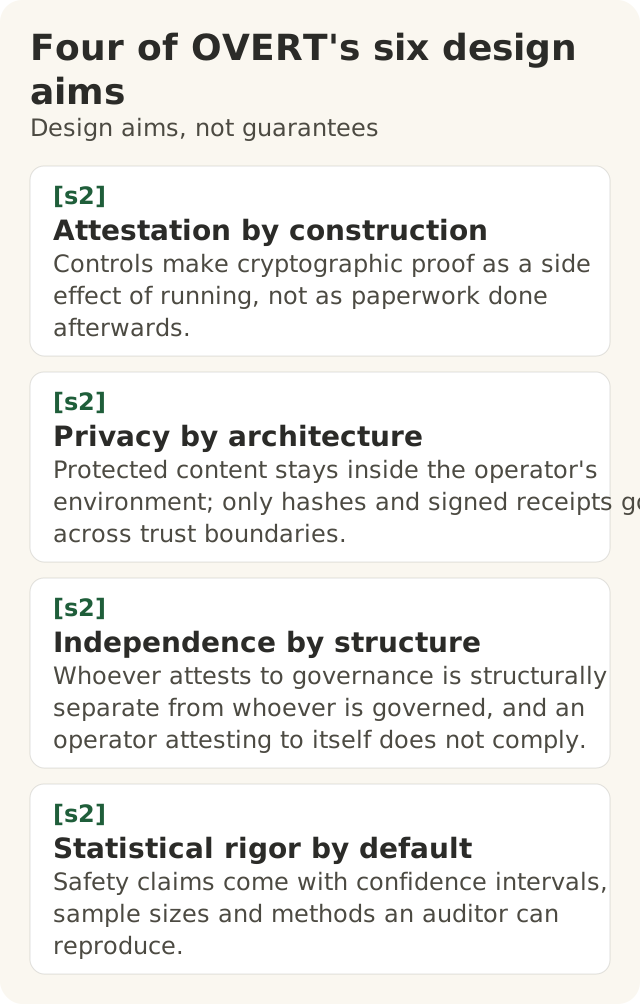
Figure data as text
Four of OVERT's six design aims
Design aims, not guarantees
| Part | Course wording | Sources |
|---|---|---|
| Attestation by construction | Controls make cryptographic proof as a side effect of running, not as paperwork done afterwards. | [s2] |
| Privacy by architecture | Protected content stays inside the operator's environment; only hashes and signed receipts go across trust boundaries. | [s2] |
| Independence by structure | Whoever attests to governance is structurally separate from whoever is governed, and an operator attesting to itself does not comply. | [s2] |
| Statistical rigor by default | Safety claims come with confidence intervals, sample sizes and methods an auditor can reproduce. | [s2] |
The four design principles highlighted by the lesson are design aims, not guarantees; the course paraphrases the home-page summaries, not a conformance or effectiveness finding (s2).
This gear formalises three separations that practitioners routinely collapse:
- Verification ≠ attestation ≠ effectiveness for a runtime record (500.7-a).
- A crosswalk row ≠ evidence that a control works (500.7-b).
- An editorial citation policy ≠ the publisher's licence (500.7-c).
The public artefacts are OVERT 1.1,12 the SAIL V2 landing page,3 the sail-skill LICENSE at a pinned commit,4 and the OWASP Top 10 for Agentic Applications for 2026.5 The private One Receipt crosswalk that motivated the exercise is not needed and is not excerpted (Level 500 decision 10).
Conflict-of-interest note. The Foundation's OVERT page is by Ken Johnston and Bob Rapp,6 who lead this course; the Foundation is a named party to OVERT's stewardship agreement.1 Statements from that page are treated as a party's account, and the standard's own text is preferred where they differ.
Naming note. Level 500 decision 12 keeps vendor and exam names out until Bob Rapp clears each one; Bob's decision of 20 November 2026 allows a company to be named only as the cited author or publisher of a source, never as a recommendation or certification rail. No wider clearance for this module is on record. So the body text names only cited sources and publishers the analysis cannot do without: the two frameworks (OVERT, SAIL), SAIL's publisher and licensor (Pillar), and OWASP. Other companies, products and parties are described by role. Publishers stay in the footnotes, because a citation needs its author. Naming a source is not an endorsement, a conformance or alignment claim, or the name of an exam.
Attribution and reuse. Quotations marked [^s8] are excerpts from OVERT — Observable Verification Evidence for Runtime Trust, Version 1.1 (June 2026), by Glacis Technologies, Inc. OVERT's governance page (§8) says the original text and prose examples of OVERT 1.1 are designated for licensing under CC BY 4.0, and asks reusers to credit Glacis Technologies, Inc., identify the title and version, link the licence and indicate changes.7 Changes made here: short passages excerpted, some sentences cut part-way, and the excerpts regrouped into the course's own tables and lists; layouts, headings and commentary are the course's. Coverage of the rest of OVERT's home page and governance page by that statement is not confirmed, so this gear paraphrases them and links to them; OVERT's principle names are kept as names.
OVERT 1.1: claims, scope and stated non-claims
Identity and version. OVERT (Observable Verification Evidence for Runtime Trust), version 1.1, published 11 June 2026, identifier overt.is/1.1, maintained by the company the home page names as maintainer (see the footnote).1
Object of evidence. Paraphrasing the home page: OVERT produces independently checkable records that an operator's declared governance policies, security controls and oversight actions were carried out.1 The predicate is execution of declared controls, not adequacy of the controls, their effectiveness, or the truth of model output.
Definitions (standard text).
- Attestation: "A cryptographically signed statement by an independent notary that a specific governance action occurred".2
- Receipt: "A cryptographic artifact proving that a specific enforcement decision was made, at a specific time", a definition that ends "and attested by an independent party."2
Both definitions build independence in. An operator-signed record therefore satisfies neither as written; call it an operator-signed record, not a receipt in OVERT's sense.
Design principles (home page; names kept, glosses paraphrased).1 Attestation by construction; Privacy by architecture; Independence by structure (the attester is structurally separate from the governed party, and self-attestation does not comply); Statistical rigor by default (a safety claim should state how uncertain it is, how many cases it rests on, and a method an auditor can rerun); Open by design; Security-supporting evidence.
Privacy (standard text). "The attestation protocol SHALL NOT require transmission of protected content outside the operator environment."2 "Raw content digests SHALL NOT egress."2
Conformance structure. "OVERT conformance is expressed as a composite claim combining a maturity level (1–4) and a scope designator".2 Three independent axes need separate answers:
| Axis | Standard text |
|---|---|
| Evidence grade (who produced it) | §4.1 grades evidence by row. AAL-2 ("Process Records"): "Self-attested; auditor must trust operator". AAL-3 ("Automated Monitoring"): "Machine-generated but operator-controlled". AAL-4: "Independent third party produces tamper-evident proof of control execution".2 §22.1's example: "AAL-2 operator-generated evidence for a Level 2 deployment with no independent attestation infrastructure, or AAL-3 where an operator-controlled notary is deployed."2 |
| Assessment (who judged conformance) | §22.8.6(a): "Level 1 and Level 2 conformance MAY be self-assessed by the operator".2 |
| Required architecture | §18.2: Levels 1–2 are levels "whose required architecture does not include an independent notary", where "binary identity MAY instead be derived through an operator-attested measurement pipeline"; "Temporal binding so derived is operator-attested evidence" and "SHALL be disclosed as such".2 |
So at Levels 1–2 an independent notary is not required and some evidence may be operator-attested; it does not follow that every Level 1–2 artefact is self-attested. The home page's principle that self-attestation does not comply1 sits beside §22.8.6(a)'s permitted self-assessment; this module does not resolve how OVERT's authors reconcile them for a given claim. The evaluator's job is to obtain the level, scope, assessor and per-artefact evidence grade, not to infer them. This module does not name the levels; their names were not read verbatim.
Stated non-claims.
- Conformance "does not constitute a general representation that the system is secure, compliant, or safe."2
- OVERT "does not attest the truthfulness of model outputs, the absence of hallucination".2
- Governance page §7, summarised in the course's words: conformance is silent on whether the records are accurate or observation was complete; on whether the system is clinically adequate or lawful; and on whether the evidence would be admitted in court, an insurer would cover a loss, or any other body has certified the system.7
- The same page presents OVERT as an optional technical specification and makes clear that use of the OVERT name or marks is not a product certification.7
Self-descriptions. The Foundation's page links to a runtime it calls "an OVERT-conformant runtime".6 The page opened does not state a maturity level or scope designator.6 Under §22.1's composite form,2 an unqualified "conformant" is underspecified.
Stewardship (dated). The 21 September 2026 announcement, paraphrased: three parties, among them the maintainer and the AiGovOps Foundation, signed an agreement setting up shared stewardship of OVERT.1 Home page status, in the course's words: the arrangement is not in force yet, and its start time will be set by a further certificate that all three parties must sign.1 Governance page, §1, in the course's words: the same start condition, and that certificate is still unsigned.7 The Foundation's page (updated 9 October 2026) calls the Foundation a co-steward and says "the agreement is signed."6 Executed and effective are distinct states: on 18 November 2026 shared stewardship was agreed, not effective. No effective transfer is asserted here.
A model of what a verifier learns
Fixture: the bundle
Card R7 is a synthetic record emitted by Big Widget's tool gateway for agent parts-buyer. It ships in bundle/cases/V/record/R7.json as {payload, signature}; in outline:
R7 = {
  record_id:   "R7",  issuer: "bw-tool-gateway",  agent: "parts-buyer",
  time:        "2026-11-12T14:03:27Z",             # fictional
  event:       tool.call("supplier.order.create"),
  rule:        { id: "TS-2", version: 3, h_rule: SHA-256(TS-2-v3.txt) },   # hash of a shareable rule
  decision:    "deny",  reason: "order value above limit",
  risk_ref:    "SAIL:3.13",                        # id only
  claim:       "TS-2 keeps parts-buyer within its scope list and order limit",
  evidence:    [ { id: "EV-17", h: h17, loc: L17 },   # scope-test report; L17 is visible metadata
                 { id: "EV-18", h: h18 } ],            # connector-permission export
  order_commitment: HMAC-SHA256(k_bw, C(order))     # keyed commitment; k_bw stays with Big Widget
}
sigma = Ed25519.Sign(sk_gw, C(R7.payload))    # C = canonical JSON (a JCS subset); kid "bw-gateway-2026-11"
The bundle (bundle/VERIFY.md, verify.py, trust/, cases/, auditor-only/, privacy-demo/, MANIFEST.sha256) ships three cases: V, valid; M, one payload value changed after signing with sigma kept; X, R7 byte-identical to V with EV-17 removed. verify.py is standard-library Python (RFC 8032 §5.1.7 verification); it needs no network. The keys are practice keys derived from public labels in author/build_bundle.py, so the bundle rebuilds byte for byte, and for the same reason a valid signature here says nothing about who made the files. Trusted key, given here as a second route: bw-gateway-2026-11, Ed25519 public key AK-WHcpCWQIz37nToDym9RXURa3kwhbDvaRn2rC0GjI.
Card T (trust/card-T.json): T1 kid binds to the gateway, via Big Widget's published key list fetched on a recorded (fictional) date; T2 sk_gw was not compromised or misused before signing. trust/card-T-refetched.json is the same list fetched later, without kid.
Card E (case X, at check time t1): a check at an earlier time t0 (case V) returned Ver(pk, C(R7), sigma) = 1 under T. Between t0 and t1, C(R7), sigma, the fetched key list and T are unchanged. EV-18 present with H(EV-18) = h18; EV-17 unavailable at L17.
Author's run, 19 November 2026 (not a check). Case V: RC-1 pass; rule file and both evidence files match their hashes; RC-2 operator-attested. Case M: RC-1 fail. Case X: RC-1 pass; EV-17 unavailable; RC-4 not established. Case X under the re-fetched Card T: RC-1 fail. VERIFY.md says how to rerun them, and where to record the result.
Architecture claim, not a fact. Big Widget's design routes every parts-buyer tool call through the gateway. The bundle contains no evidence that it does; see path coverage below.
Four propositions
Let Ver(pk, m, sigma) ∈ {0,1} be signature verification.
- I (integrity):
C(R7)is the byte string that was signed.Ver(pk, C(R7), sigma) = 1supports I, assuming an unforgeable scheme. - O (origin): the holder of
sk_gwsigned it, and that holder is the gateway.I ∧ T1 ∧ T2 ⊢ O. - A (attested execution): the signer asserts that TS-2 v3 was evaluated and returned
denyfor this event.O ⊢ "the gateway asserts A". It does not yield A as an independently observed fact. Its evidential weight depends on who produced it. Two of the rows below AAL-4 in OVERT's §4.1 table bear on runtime records: AAL-2, "Self-attested; auditor must trust operator", and AAL-3, "Machine-generated but operator-controlled". Only AAL-4 is "Independent third party produces tamper-evident proof of control execution".2 R7 is operator-signed, so it is not AAL-4 evidence. Whether it would grade as AAL-2 or AAL-3 depends on architectural and evidential facts the bundle does not give, so this module assigns it no grade. - E (effectiveness): over a stated population
Πof out-of-scope tool calls parts-buyer can make,Pr[bypass] ≤ εat confidence1 − α, shown by a reproducible test not run by the operator.
The verifier's entailment is Ver = 1 ∧ T1 ∧ T2 ⊢ I ∧ O ∧ "operator asserts A". Nothing in R7 entails E, and "safe" is outside even E: OVERT disclaims it at the level of conformance.2
Note also what deny tests. R7 instantiates one predicate of TS-2, value(order) > limit, on one event. It says nothing about the scope-list predicate on other tools, nor about connector grants. It is one partial control for 3.13.
Course rule cards (course-authored, modelled on OVERT principles, not OVERT requirements)
| Card | Predicate | R7, case V (author's run) |
|---|---|---|
| RC-1 Integrity | Ver(pk_kid, C(R7), sigma) = 1 with kid ∈ T | pass |
| RC-2 Who attests | signer ⟂ operator (structurally independent)? Else label operator-attested | operator-attested |
| RC-3 Privacy | (i) no protected plaintext; (ii) every field derived from protected, low-entropy data is a keyed commitment, not H(x); (iii) every metadata field and locator approved by a named privacy owner for disclosure; (iv) referenced documents access-controlled | (i), (ii) hold; (iii) is not in the bundle, so not passed |
| RC-4 Effectiveness | an available, independent, reproducible test reports Π, sampling method, n, failures, an upper bound on bypass rate, and an acceptance threshold ε* fixed before testing | not established (EV-17 read below) |
verify.py decides only RC-1 and the hash matches, and labels RC-2 from Card T's role. RC-3 (iii) and RC-4 are human judgments; the checker prints what the person needs and does not guess.
Principles they are modelled on: attestation by construction, independence by structure, privacy by architecture and statistical rigor by default.1
Why RC-3 is not "hashes only"
This is the course's reasoning. If x is drawn from a small, guessable set X (part numbers × price bands, say |X| in the hundreds), then given H(x) an adversary computes H(x') for all x' ∈ X and recovers x in at most |X| hash evaluations. A plain digest is a commitment only when the input has enough entropy; low-entropy protected data needs a keyed or salted commitment, HMAC(k, x) with k secret to the operator. §17.2 sets the matching rules for OVERT: "Request commitments crossing the operator's trust boundary SHALL be computed using a keyed cryptographic function", and "Raw content digests SHALL NOT egress."2
The bundle makes this concrete. privacy-demo/guess-space.json lists public catalogue values giving |X| = 6000 possible orders; privacy-demo/naive-record.json holds a plain SHA-256 of the order. In the author's run, verify.py --guess privacy-demo recovered the order from the plain digest after 1,653 guesses, and did not recover it from R7's HMAC commitment in all 6,000, because without k_bw a guess cannot be tested.
Even with keyed commitments, the record still exposes timing, tool identity, decision, rule version and the locator L17. Requiring a named privacy owner to review those fields is the course's RC-3 rule, not an OVERT requirement. Contrast h_rule: a hash of a rule the operator is willing to publish leaks nothing new. The Foundation's Practice site lists what its own receipts carry ("hashes, decision, tier, policy hash, key id") and never carry ("prompts, outputs, payloads, personal data").8
What RC-4 would need, quantitatively
OVERT's home page asks, in our paraphrase, that safety claims carry confidence intervals, sample sizes and methods an auditor can reproduce.1 Suppose an independent tester ran n out-of-scope call attempts and observed zero bypasses. Treat each attempt as an independent Bernoulli trial with common bypass probability p. Then
Pr[0 bypasses | p] = (1 − p)^nThe one-sided 1 − α upper bound p_u solves (1 − p_u)^n = α:
p_u = 1 − α^(1/n) ≈ −ln(α) / n (for small p_u)With α = 0.05, −ln(0.05) ≈ 3.00, so p_u ≈ 3/n. For n = 100, p_u = 1 − 0.05^(0.01) ≈ 0.0295: zero failures in 100 attempts still allows a bypass rate near 3% at 95% confidence.
The bound is only as good as its frame. A usable RC-4 report states:
- Sampling frame
Π: every tool and connector parts-buyer's credentials can reach (from an independently verified grant list, not EV-18 alone), crossed with the predicates TS-2 claims to enforce (scope list and value limit), not just over-limit orders. - Sampling method: how attempts were drawn from
Π; a curated suite is not a random sample, and an adaptive adversary does not draw attempts independently, so the Bernoulli bound is optimistic. - Acceptance threshold
ε*: fixed by a named owner before testing. Pass iffp_u ≤ ε*. Forε* = 0.01atα = 0.05with zero failures,n ≥ ln(0.05)/ln(0.99) ≈ 298.1, son ≥ 299. - Threat model and period: who the adversary is, and over what window TS-2 v3 was the active rule.
EV-17 against RC-4 (case V; the author's reading, which a rerunner should redo). The synthetic report says the platform team that runs the gateway tried 100 over-limit supplier.order.create calls and saw 0 get through; it did not try other tools, the scope list, connector grants or unmediated routes; and it records no acceptance threshold set beforehand. So n = 100, failures = 0, and p_u ≈ 0.0295 at α = 0.05, but over a frame of one tool and one predicate, from a curated suite, by a non-independent tester, with no ε*. RC-4: not established, even though EV-17 is present and is the file R7 names.
Unavailable external evidence (not a modified record)
Given Card E (case X):
Veris a deterministic function of(pk, C(R7), sigma), and the decision to acceptpkdepends on T and the fetched key list. All four are unchanged betweent0andt1, soVer = 1still holds and RC-1 passes under T1, T2. If any input changed, the conclusion must be re-derived, not carried forward. The bundle shows this: case X undertrust/card-T-refetched.json, a key list that no longer listskid, gives RC-1 fail withC(R7)unchanged (author's run).evidence[EV-17].h = h17is still inside the signed bytes, so if a document is later produced, a verifier can checkH(doc) = h17. Matching shows it is the referenced document; it says nothing about whether its content is accurate.- With EV-17 unavailable, A remains operator-asserted and E is unestablished.
Contrast with a modified record (case M): any change to C(R7) after signing gives Ver = 0 and RC-1 fails. Changing only whitespace or field order in the JSON file does not change C(R7), so RC-1 still passes; VERIFY.md step 6 lets you try both. Unavailable evidence is a missing-proof condition, not an integrity failure, and the two must be reported differently, each with a named owner for the next step.
Tracing SAIL 3.13
The catalogue
SAIL is Pillar Security's "SAIL (Secure AI Lifecycle) Framework V2", described as "a practical, lifecycle-oriented strategy to manage AI-specific risks".3 It has seven phases spanning an AI system's life from planning to retirement; the phase list is on the SAIL page and is not reproduced here.3 Risk ids take the form phase.n (for example 1.1, 5.4), and the page refers to "90+ SAIL risks".3 The page's "Last updated: 08.07.2026" does not fix day/month order.3 Risk 3.13 is in the third phase, a build-stage posture review of how agents are configured (identity, tool and connector scopes), not the act of building them;3 in our words, agent tool permissions and connectors broader than the task requires. This gear cites by id and paraphrases; read the risk's own text at the source.
The synthetic crosswalk row
SAIL:3.13  →  control TS-2 (gateway tool scope)
           →  per-event evidence: tool.call, rule id/version/hash, decision
           →  out-of-record evidence: EV-17 (scope-test report), EV-18 (connector-permission export)
           provenance: Big Widget governance lead (named owner of the row's judgment)
A row is a typed pointer: risk → control → evidence locations. Its truth conditions are about the mapping (is TS-2 a plausible mitigation for 3.13? are these the right evidence types?), not about whether TS-2 performs. Whose judgment the row encodes must be recorded.
Gap analysis for E
| Needed for E | Status in the bundle |
|---|---|
Test content: Π, sampling method, threat model, n, failures, bound, pre-set ε* | EV-17 unavailable |
| Tester independence | not shown; R7 is operator-attested |
| Ground-truth permissions: compare EV-18 with grants actually held by the agent's credentials at the supplier systems, checked independently | EV-18 is the operator's export only |
| Path coverage: every tool route for parts-buyer is mediated by the gateway | no evidence; architecture claim only |
| Predicate coverage: scope-list enforcement on every tool, not only the value limit | one deny on the value limit only |
| Temporal coverage: TS-2 v3 was the active rule over the claimed period | one record only |
By-design limit: unmediated paths (course reasoning)
The gateway emits a record only for events it mediates. Let P be the set of tool paths available to parts-buyer and G ⊆ P the mediated ones. Records exist only for events on G; for P \ G the record set is empty, and an empty set is indistinguishable from "no event". The standard's text does call for a transparency log "conformant with RFC 6962",2 which can make omission of a logged record detectable; it cannot log an event the gateway never saw. This argument is the module's, not OVERT's; it is consistent with OVERT's non-claim about completeness of observation.7 The Foundation's manifesto states the design rule that P \ G should be empty for consequential actions: "No direct model-to-tool path for consequential actions."9 Whether it is empty is an empirical question the bundle does not answer.
A second by-design limit: an in-scope order is allow, whatever its correctness; TS-2 constrains scope, not semantic validity, and conformance does not establish that recorded facts are accurate.7
Adjacent catalogue
The OWASP GenAI Security Project's "OWASP Top 10 for Agentic Applications for 2026" (dated 9 December 2025) uses ids ASI01–ASI10.5 ASI02 "Tool Misuse and Exploitation" and ASI03 "Identity and Privilege Abuse" are topically near SAIL 3.13.5 Any 3.13 ↔ ASI02/ASI03 edge is this module's judgment, not a published mapping, and is labelled as such. Crosswalk composition (A→B, B→C ⇒ A→C) compounds judgment error; keep provenance on every edge.
Editorial policy versus licence
The synthetic policy
BW-ED-1 (course-authored, synthetic). This crosswalk cites SAIL risks by id only. It reproduces no SAIL risk names, descriptions or controls.
BW-ED-1 is a self-imposed restriction. It neither grants nor reveals rights.
The versioned licence text
pillar-labs/sail-skill, LICENSE at 67e1691ac64586b0abea96c74f511ea5628f62ed, titled "Attribution-NonCommercial-ShareAlike 4.0 International".4 Relevant sections, with the act each condition attaches to:
| Section | Text | Attaches to |
|---|---|---|
| 1(h) | "Licensed Material means the artistic or literary work, database, or other material to which the Licensor applied this Public License." | Scope is set by the licensor's application, not by the file's location alone4 |
| 1(k) | "NonCommercial means not primarily intended for or directed towards commercial advantage or monetary compensation." | Definition. Two tests joined by "or", both governed by "primarily": payment alone does not decide it; the primary purpose does4 |
| 1(l) | "Share means to provide material to the public by any means or process that requires permission under the Licensed Rights" | Defined term: sharing is providing to the public, so a private hand-over is not automatically "Share"4 |
| 2(a)(1) | "reproduce and Share the Licensed Material, in whole or in part, for NonCommercial purposes only" | The grant: reproducing and Sharing Licensed Material4 |
| 2(a)(2) | "where Exceptions and Limitations apply to Your use, this Public License does not apply" | Uses already covered by an exception such as fair use4 |
| 2(a)(5)(c) | "You may not offer or impose any additional or different terms or conditions on" the Licensed Material | Downstream recipients4 |
| 2(b)(2) | "Patent and trademark rights are not licensed under this Public License." | Out of scope; says nothing about other permissions4 |
| 3(a) | "If You Share the Licensed Material (including in modified form), You must:" | Sharing, modified or not4 |
| 3(b) | "if You Share Adapted Material You produce, the following conditions also apply." | Sharing Adapted Material you produced; not private modification4 |
Not established
The file names no copyright holder, does not enumerate covered assets, and contains no separate or internal-use permission.4 The SAIL landing page carries "© 2026 Pillar. All rights reserved."3 Neither text alone determines what other permissions exist. Therefore, from the opened sources: coverage of the SAIL page, the framework download or other SAIL assets is not checked; any separate permission is not checked; whether a given use is NonCommercial under 1(k) is a fact-specific question this module does not decide; and any particular use of Pillar's marks is outside the licence and not checked. Route each to a named legal owner; neither the crosswalk's authors nor an AI assistant decides it.
Classification task: each statement is (E) BW-ED-1 editorial policy, (L) a condition in the pinned licence, (X) contradicted by the licence text, or (N) not established.
| Statement | Class |
|---|---|
| Cite SAIL risks by id only | E |
| Sharing (in 1(l)'s sense: to the public) adapted material you produced triggers ShareAlike conditions | L (3(b), 1(l))4 |
| The grant to reproduce and Share is for NonCommercial purposes only | L (2(a)(1), 1(k))4 |
| Pillar's trademarks are licensed | X (2(b)(2))4 |
| The licence covers the SAIL framework PDF | N |
| Pillar permits internal commercial use | N |
Lifecycle: the three yeses for parts-buyer
The Foundation's manifesto ties Get to Yes, Stay at Yes and Recover to Yes to gate timings.9 As applied to this fixture (roles are synthetic):
| Movement and timing9 | Gate content for parts-buyer | Named human |
|---|---|---|
| Get to Yes: "before a rule or a system ships"; "before a single action runs" | TS-2 v3 written, hashed, published to verifiers; scope list and limit fixed; gate outcome set from "go ahead · only this far · wait for a person · no";9 RC-3 field list approved; ε* fixed; 3.13 row signed off as judgment | governance lead; privacy owner; procurement-lead if TS-2 ever uses "wait for a person" |
| Stay at Yes: "while it runs, in real time" | records for every mediated call; scheduled independent RC-4 tests over Π; periodic EV-18 vs live-grant comparison; a stated coverage figure for G/P, or "I know that I do not"9 | independent tester; platform lead |
| Recover to Yes: "after — on demand, on incident" | triggers: Ver = 0, missing EV-17, grant drift beyond EV-18, an event found on P \ G; contain by restricting credentials; re-test; recovery claimed only on a fresh independent pass recorded by the named owners | platform lead; governance lead |
A restored link or announced fix is not by itself a return to yes. A hold nobody answers is not a yes. The model never releases a hold or declares recovery; the named people do, and they leave a record of it.
Summary
Ver = 1 ∧ T ⊢ I ∧ O ∧ "signer asserts A"; never E; never "safe".2 Separate evidence grade, assessment and required architecture before weighing a conformance claim.2 An operator-signed record is not AAL-4 evidence; do not assign it AAL-2 or AAL-3 without the facts that decide it.2- OVERT §17.2 requires keyed commitments across the operator's trust boundary and forbids raw content digests leaving it.2 The course's RC-3 adds a second condition of its own: a named privacy owner reviews the metadata and locators that remain visible. "Only hashes" is not sufficient for either.
- The bundle's results in this gear are the author's run, not a check; rerun
bundle/VERIFY.mdoffline yourself and record what you saw. - A crosswalk row is a typed pointer with provenance; E requires the gap table closed by independent, reproducible evidence with a stated frame and pre-set threshold. Unmediated paths are outside any gateway record by design (course reasoning), consistent with OVERT not establishing completeness of observation.7
- Editorial policy and licence are distinct texts; pin the licence version, quote its sections, state which act each condition attaches to, and mark scope and separate permissions as not checked.4
Further learning (not cited, not copied). UC Berkeley CS294/194-280 Advanced Large Language Model Agents (Spring 2025); MIT OCW 6.858 Computer Systems Security (Fall 2014) for threat models and capabilities; Stanford CS 181 (Spring 2024) for policy background. See levels/500/universities.md.